 Add to Chrome
 Add to Firefox
 Add to Edge
TRADE: Transducer-Augmented Decoder for Speech LLM
Jun 07, 2026
Speech Large Language Models (Speech LLMs) lack a principled mechanism for streaming inference: their label-synchronous generation has no acoustic-frame alignment, making real-time decoding and end-of-utterance detection difficult. We propose TRADE TRansducer-Augmented DEcoder, which augments a multimodal LLM with a transducer branch that shares the audio encoder and uses the LLM's hidden states directly as the prediction network -- coupling frame-synchronous acoustic alignment with the LLM's linguistic reasoning. Three design choices make the system accurate, streamable, and long-form capable: (1)Tightly coupled dual vocabularies -- a compact transducer vocabulary derived from the LLM vocabulary, enabling zero-cost score fusion; (2)Chunk-synchronized streaming training with gradient stopping, eliminating the train-inference mismatch at offline-equivalent memory cost; and (3)Localized Decoder Audio Attention (LDAA), a causal sliding window that caps KV-cache memory independently of utterance length. A single TRADE checkpoint supports offline and streaming decoding across a continuous range of latency operating points. TRADE achieves 6.71% average WER on the Open ASR Leaderboard, while the streaming recognition with 960ms chunk size reaches 8.40% from the same checkpoint. On long-form speech, it obtains 3.64% WER on TED-LIUM and 10.88% on Earnings-22 without external segmentation. TRADE provides sentence-end punctuation timestamps that, when combined with acoustic voice activity detection (VAD), improve end-of-utterance detection by +0.03 F_1 over acoustic VAD alone.

Dynamic Speech Endpoint Detection with Regression Targets
Oct 25, 2022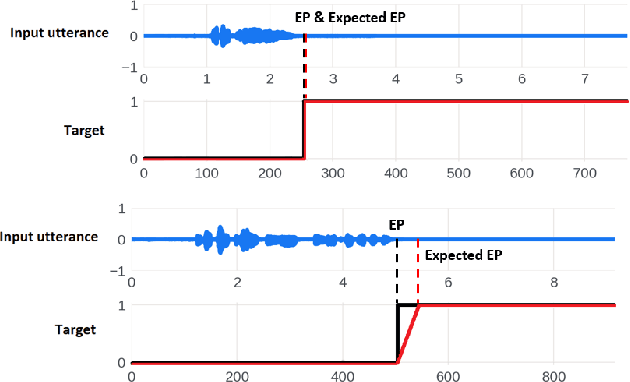
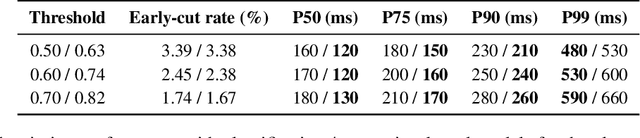
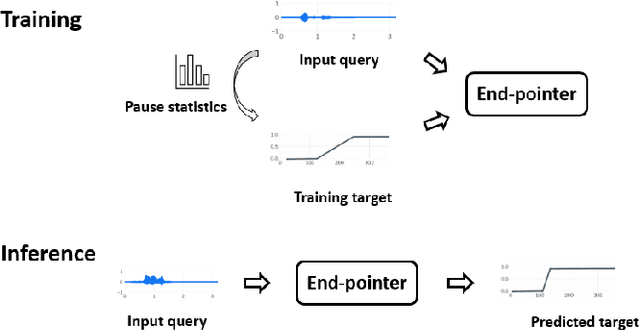

Interactive voice assistants have been widely used as input interfaces in various scenarios, e.g. on smart homes devices, wearables and on AR devices. Detecting the end of a speech query, i.e. speech end-pointing, is an important task for voice assistants to interact with users. Traditionally, speech end-pointing is based on pure classification methods along with arbitrary binary targets. In this paper, we propose a novel regression-based speech end-pointing model, which enables an end-pointer to adjust its detection behavior based on context of user queries. Specifically, we present a pause modeling method and show its effectiveness for dynamic end-pointing. Based on our experiments with vendor-collected smartphone and wearables speech queries, our strategy shows a better trade-off between endpointing latency and accuracy, compared to the traditional classification-based method. We further discuss the benefits of this model and generalization of the framework in the paper.