 Add to Chrome
 Add to Firefox
 Add to Edge
M3D-Net: Multi-Modal 3D Facial Feature Reconstruction Network for Deepfake Detection
Apr 16, 2026
With the rapid advancement of deep learning in image generation, facial forgery techniques have achieved unprecedented realism, posing serious threats to cybersecurity and information authenticity. Most existing deepfake detection approaches rely on the reconstruction of isolated facial attributes without fully exploiting the complementary nature of multi-modal feature representations. To address these challenges, this paper proposes a novel Multi-Modal 3D Facial Feature Reconstruction Network (M3D-Net) for deepfake detection. Our method leverages an end-to-end dual-stream architecture that reconstructs fine-grained facial geometry and reflectance properties from single-view RGB images via a self-supervised 3D facial reconstruction module. The network further enhances detection performance through a 3D Feature Pre-fusion Module (PFM), which adaptively adjusts multi-scale features, and a Multi-modal Fusion Module (MFM) that effectively integrates RGB and 3D-reconstructed features using attention mechanisms. Extensive experiments on multiple public datasets demonstrate that our approach achieves state-of-the-art performance in terms of detection accuracy and robustness, significantly outperforming existing methods while exhibiting strong generalization across diverse scenarios.

Ensemble-driven support vector clustering: From ensemble learning to automatic parameter estimation
Aug 09, 2016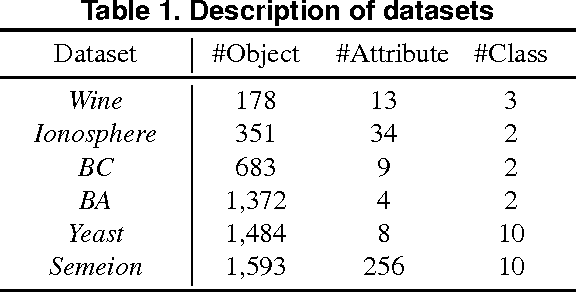
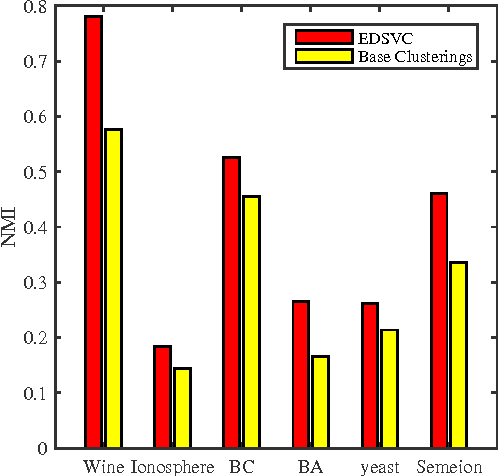
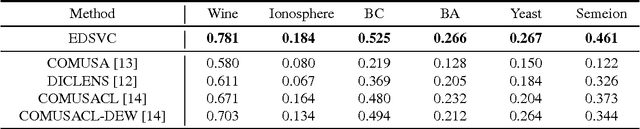
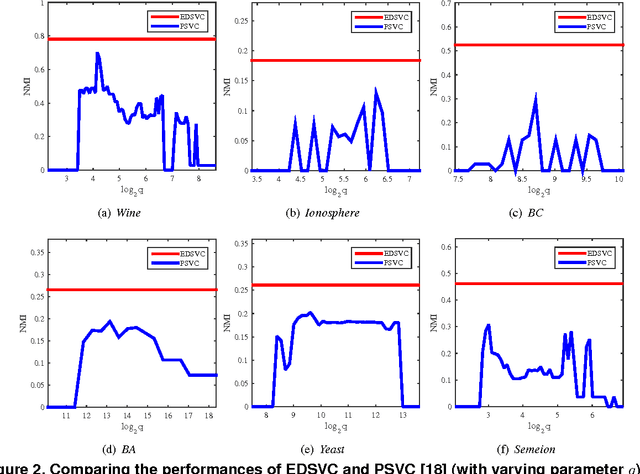
Support vector clustering (SVC) is a versatile clustering technique that is able to identify clusters of arbitrary shapes by exploiting the kernel trick. However, one hurdle that restricts the application of SVC lies in its sensitivity to the kernel parameter and the trade-off parameter. Although many extensions of SVC have been developed, to the best of our knowledge, there is still no algorithm that is able to effectively estimate the two crucial parameters in SVC without supervision. In this paper, we propose a novel support vector clustering approach termed ensemble-driven support vector clustering (EDSVC), which for the first time tackles the automatic parameter estimation problem for SVC based on ensemble learning, and is capable of producing robust clustering results in a purely unsupervised manner. Experimental results on multiple real-world datasets demonstrate the effectiveness of our approach.