 Add to Chrome
 Add to Firefox
 Add to Edge
Monocular Vision Based Control Framework for Grasping
Jul 08, 2026
Grasping in unstructured environments requires handling objects with widely different mechanical properties, from soft and deformable items to rigid everyday objects. Most existing approaches address these categories separately and often rely on tactile sensing, object-specific models, or specialized grippers. In this paper, we present a unified monocular vision-based grasping framework that targets both soft and rigid objects within a single control pipeline, using only RGB input and a position-controlled gripper. The proposed system combines open-vocabulary object detection, image segmentation, boundary-aware point assignment, real-time point tracking, and monocular depth estimation to recover object motion and geometry from visual observations. A key component of the framework is a language-based stiffness estimation model that infers an object's expected compliance from its semantic description and provides an object-level prior for selecting the grasping strategy before contact. For deformable objects, grasp adaptation is governed by a Procrustes-based dissimilarity measure computed from tracked keypoints, which acts as a visual proxy for deformation. For rigid objects, the gripper width is regulated through the scaling of tracked point distances. We validate the proposed method in real-world pick-and-place experiments on a Franka Emika Research 3 arm using objects with substantially different mechanical properties, including lettuce, fresh mozzarella cheese, croissants, paper towels, and hard plastic bottles. Results demonstrate that the framework achieves stable grasping across both soft and rigid objects using visual feedback alone, highlighting a practical, sensor-efficient, and generalizable approach for food handling and household manipulation.

LOPAL: Local Performance-Aware Active Learning from Imperfect Demonstrations
Jun 15, 2026Learning from Demonstration (LfD) enables intuitive robot skill acquisition by allowing robots to learn directly from human task demonstrations. However, current methods often fail to address the fact that due to suboptimal and inconsistent human behavior, the quality of the demonstration can vary within each demonstration. Therefore, we introduce LOPAL (LOcal Performance-aware Active Learning), an active learning approach that leverages this local demonstration quality information. Our approach consists of two synergistic components. First, a local performance-driven LfD method uses a Gaussian Mixture Model (GMM) to encode both the demonstrated trajectories and their associated local quality assessments. This enables the generation of trajectories that outperform the imperfect demonstrations by utilizing complementary local data of high performance. Second, active data acquisition allows to improve beyond the imperfect demonstrations by collecting additional informative samples. In areas missing good data, the user is actively requested to provide corrections through a shared autonomy (SA) mechanism, while the robot autonomously executes the learned behavior. The efficacy of LOPAL was validated in both a simulation and a real-world experiment. The results from a real-world pipe inspection task showed that the proposed approach can achieve up to 27.31 % improvement in task performance while also reducing the effort required to collect the demonstrations.
REASSEMBLE: A Multimodal Dataset for Contact-rich Robotic Assembly and Disassembly
Feb 07, 2025
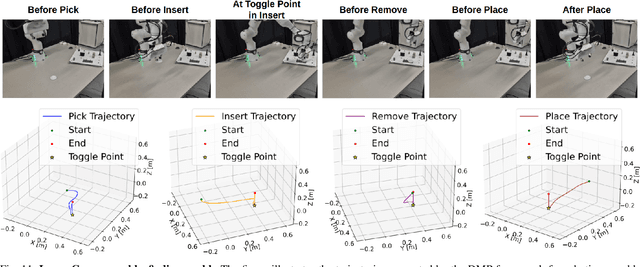

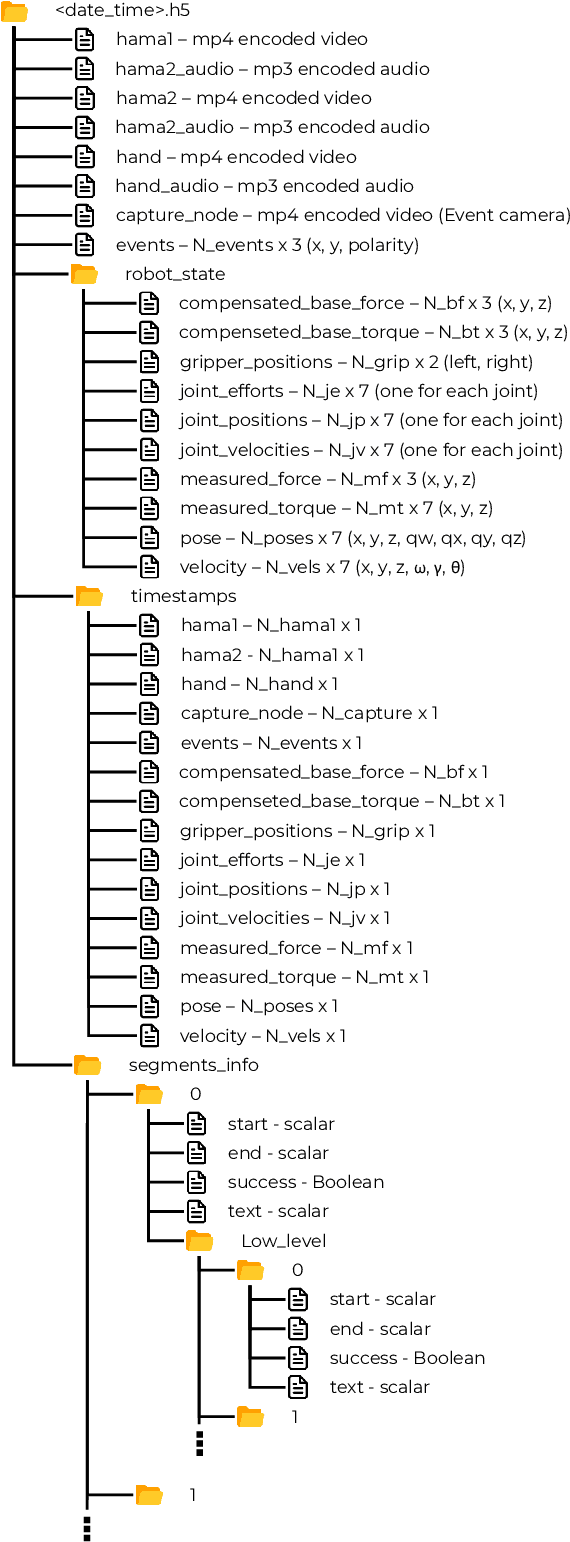
Robotic manipulation remains a core challenge in robotics, particularly for contact-rich tasks such as industrial assembly and disassembly. Existing datasets have significantly advanced learning in manipulation but are primarily focused on simpler tasks like object rearrangement, falling short of capturing the complexity and physical dynamics involved in assembly and disassembly. To bridge this gap, we present REASSEMBLE (Robotic assEmbly disASSEMBLy datasEt), a new dataset designed specifically for contact-rich manipulation tasks. Built around the NIST Assembly Task Board 1 benchmark, REASSEMBLE includes four actions (pick, insert, remove, and place) involving 17 objects. The dataset contains 4,551 demonstrations, of which 4,035 were successful, spanning a total of 781 minutes. Our dataset features multi-modal sensor data including event cameras, force-torque sensors, microphones, and multi-view RGB cameras. This diverse dataset supports research in areas such as learning contact-rich manipulation, task condition identification, action segmentation, and more. We believe REASSEMBLE will be a valuable resource for advancing robotic manipulation in complex, real-world scenarios. The dataset is publicly available on our project website: https://dsliwowski1.github.io/REASSEMBLE_page.
Shared Autonomy via Variable Impedance Control and Virtual Potential Fields for Encoding Human Demonstration
Mar 19, 2024This article introduces a framework for complex human-robot collaboration tasks, such as the co-manufacturing of furniture. For these tasks, it is essential to encode tasks from human demonstration and reproduce these skills in a compliant and safe manner. Therefore, two key components are addressed in this work: motion generation and shared autonomy. We propose a motion generator based on a time-invariant potential field, capable of encoding wrench profiles, complex and closed-loop trajectories, and additionally incorporates obstacle avoidance. Additionally, the paper addresses shared autonomy (SA) which enables synergetic collaboration between human operators and robots by dynamically allocating authority. Variable impedance control (VIC) and force control are employed, where impedance and wrench are adapted based on the human-robot autonomy factor derived from interaction forces. System passivity is ensured by an energy-tank based task passivation strategy. The framework's efficacy is validated through simulations and an experimental study employing a Franka Emika Research 3 robot.