 Add to Chrome
 Add to Firefox
 Add to Edge
An Ensemble Learning Approach towards Waste Segmentation in Cluttered Environment
Feb 14, 2026
Environmental pollution is a critical global issue, with recycling emerging as one of the most viable solutions. This study focuses on waste segregation, a crucial step in recycling processes to obtain raw material. Recent advancements in computer vision have significantly contributed to waste classification and recognition. In waste segregation, segmentation masks are essential for robots to accurately localize and pick objects from conveyor belts. The complexity of real-world waste environments, characterized by deformed items without specific patterns and overlapping objects, further complicates waste segmentation tasks. This paper proposes an Ensemble Learning approach to improve segmentation accuracy by combining high performing segmentation models, U-Net and FPN, using a weighted average method. U-Net excels in capturing fine details and boundaries in segmentation tasks, while FPN effectively handles scale variation and context in complex environments, and their combined masks result in more precise predictions. The dataset used closely mimics real-life waste scenarios, and preprocessing techniques were applied to enhance feature learning for deep learning segmentation models. The ensemble model, referred to as EL-4, achieved an IoU value of 0.8306, an improvement over U-Net's 0.8065, and reduced Dice loss to 0.09019 from FPN's 0.1183. This study could contribute to the efficiency of waste sorting at Material Recovery Facility, facilitating better raw material acquisition for recycling with minimal human intervention and enhancing the overall throughput.

BERT-Embedding and Citation Network Analysis based Query Expansion Technique for Scholarly Search
Jan 26, 2023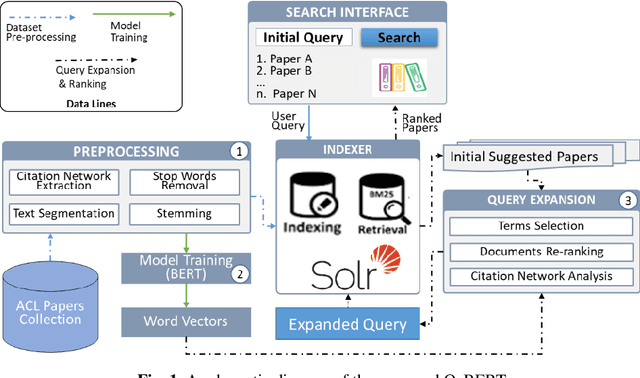

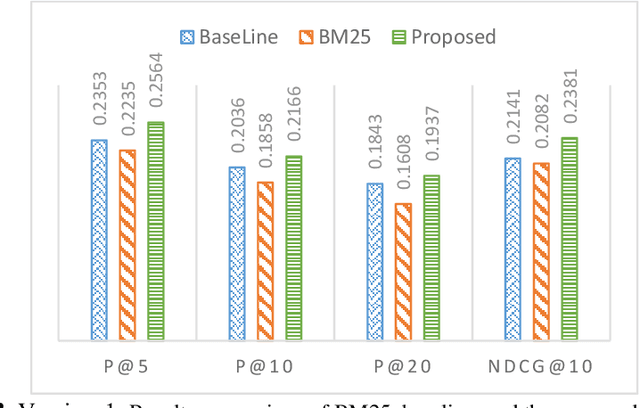
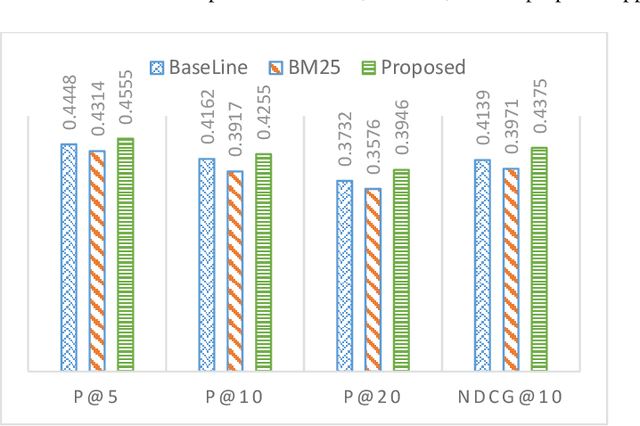
The enormous growth of research publications has made it challenging for academic search engines to bring the most relevant papers against the given search query. Numerous solutions have been proposed over the years to improve the effectiveness of academic search, including exploiting query expansion and citation analysis. Query expansion techniques mitigate the mismatch between the language used in a query and indexed documents. However, these techniques can suffer from introducing non-relevant information while expanding the original query. Recently, contextualized model BERT to document retrieval has been quite successful in query expansion. Motivated by such issues and inspired by the success of BERT, this paper proposes a novel approach called QeBERT. QeBERT exploits BERT-based embedding and Citation Network Analysis (CNA) in query expansion for improving scholarly search. Specifically, we use the context-aware BERT-embedding and CNA for query expansion in Pseudo-Relevance Feedback (PRF) fash-ion. Initial experimental results on the ACL dataset show that BERT-embedding can provide a valuable augmentation to query expansion and improve search relevance when combined with CNA.