 Add to Chrome
 Add to Firefox
 Add to Edge
CURaTE: Continual Unlearning in Real Time with Ensured Preservation of LLM Knowledge
Apr 16, 2026
The inability to filter out in advance all potentially problematic data from the pre-training of large language models has given rise to the need for methods for unlearning specific pieces of knowledge after training. Existing techniques overlook the need for continuous and immediate action, causing them to suffer from degraded utility as updates accumulate and protracted exposure of sensitive information. To address these issues, we propose Continual Unlearning in Real Time with Ensured Preservation of LLM Knowledge (CURaTE). Our method begins by training a sentence embedding model on a dataset designed to enable the formation of sharp decision boundaries for determining whether a given input prompt corresponds to any stored forget requests. The similarity of a given input to the forget requests is then used to determine whether to answer or return a refusal response. We show that even with such a simple approach, not only does CURaTE achieve more effective forgetting than existing methods, but by avoiding modification of the language model parameters, it also maintains near perfect knowledge preservation over any number of updates and is the only method capable of continual unlearning in real-time.

Graph Perceiver IO: A General Architecture for Graph Structured Data
Sep 14, 2022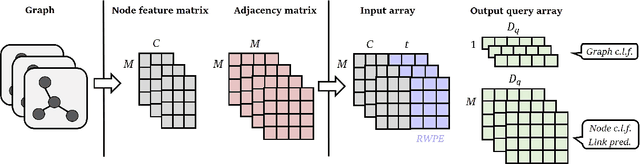

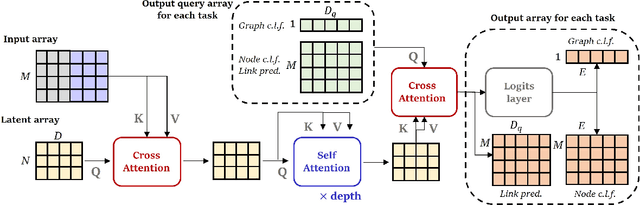
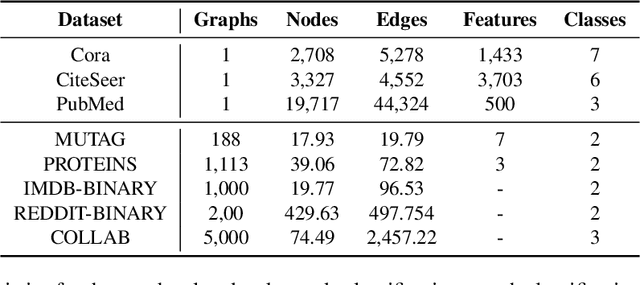
Multimodal machine learning has been widely studied for the development of general intelligence. Recently, the remarkable multimodal algorithms, the Perceiver and Perceiver IO, show competitive results for diverse dataset domains and tasks. However, recent works, Perceiver and Perceiver IO, have focused on heterogeneous modalities, including image, text, and speech, and there are few research works for graph structured datasets. A graph is one of the most generalized dataset structures, and we can represent the other dataset, including images, text, and speech, as graph structured data. A graph has an adjacency matrix different from other dataset domains such as text and image, and it is not trivial to handle the topological information, relational information, and canonical positional information. In this study, we provide a Graph Perceiver IO, the Perceiver IO for the graph structured dataset. We keep the main structure of the Graph Perceiver IO as the Perceiver IO because the Perceiver IO already handles the diverse dataset well, except for the graph structured dataset. The Graph Perceiver IO is a general method, and it can handle diverse datasets such as graph structured data as well as text and images. Comparing the graph neural networks, the Graph Perceiver IO requires a lower complexity, and it can incorporate the local and global information efficiently. We show that Graph Perceiver IO shows competitive results for diverse graph-related tasks, including node classification, graph classification, and link prediction.