 Add to Chrome
 Add to Firefox
 Add to Edge
When the Knowledge Base Becomes the Gold Standard: Measuring Resource-Shared Evaluation Loops in Entity-Level Machine Translation
Aug 12, 2026
The Seungjeongwon Ilgi, a UNESCO Memory of the World record, is only 37.4% translated, and the most conspicuous failure mode in automatic translation is the person name -- a misread name corrupts the historical fact rather than merely the surface. Low-resource historical domains have no expert gold standard for entity translation, so practitioners substitute a knowledge base (KB) for the gold. That KB is the same resource injected into the system: scoring becomes self-referential and the metric measures instruction compliance rather than translation quality. We measure this loop. Using expert person-name annotations from the National Institute of Korean History as a gold independent of the injection pipeline, we hold the entity set fixed and vary only the provenance of the correct reading. Of 527 expert-annotated mentions, only 31.1% lie outside the injection pipeline, and the residual loop is not uniform -- in the overlapping segment the injected reading agrees with the human translation 97.8% of the time against 70.1% in the independent one, so the segment that looks healthiest is the one the loop is holding up. Across four models, a difference-in-differences analysis shows the gain from KB injection is confined to the segment whose gold shares the injected resource; in the independent segment it is at or below zero. Post-injection preservation clusters in a narrow 0.910-0.996 band even though baseline capability differs fivefold, so the reported gain is the complement of prior performance and weaker models appear to improve more dramatically. On an independent sample built by removing the construction filter, the measure replicates within model (overlapping intervals) while discriminating between models (non-overlapping intervals) -- it reflects a property of the model, not of the sample.

Automated Terminal-to-Housing Assembly System for Flat Ribbon Cable Harness
Aug 07, 2026This paper presents a sensor-minimal automated assembly system for bidirectional single-row flat ribbon cable harnesses (FRCHs). Unlike conventional peg-in-hole or single-terminal insertion tasks, FRCH assembly involves mechanically coupled multi-terminal insertion under flexible and dense geometric constraints. To address this problem, the proposed system performs the assembly through a purely mechanical sequence consisting of Cable Alignment, Lean & Slide, Weaving, and Clamping, without relying on active sensing or vision. Each mechanism is designed to progressively reduce correlated terminal misalignment, insertion interference, and instability before final locking. Experiments on bidirectional single-row FRCHs achieved an 83.75% end-to-end process success rate over 80 trials, with success rates of 85.0% and 82.5% in the first and second halves, respectively. The cycle time was 33 s under half-speed operation. To the best of our knowledge, this work presents the first automated prototype for FRCH terminal-to-housing assembly for multi-pin housings.
Let Triggers Control: Frequency-Aware Dropout for Effective Token Control
Mar 28, 2026Text-to-image models such as Stable Diffusion have achieved unprecedented levels of high-fidelity visual synthesis. As these models advance, personalization of generative models -- commonly facilitated through Low-Rank Adaptation (LoRA) with a dedicated trigger token -- has become a significant area of research. Previous works have naively assumed that fine-tuning with a single trigger token to represent new concepts. However, this often results in poor controllability, where the trigger token alone fails to reliably evoke the intended concept. We attribute this issue to the frequent co-occurrence of the trigger token with the surrounding context during fine-tuning, which entangles their representations and compromises the token's semantic distinctiveness. To disentangle this, we propose Frequency-Aware Dropout (FAD) -- a novel regularization technique that improves prompt controllability without adding new parameters. FAD consists of two key components: co-occurrence analysis and curriculum-inspired scheduling. Qualitative and quantitative analyses across token-based diffusion models (SD~1.5 and SDXL) and natural language--driven backbones (FLUX and Qwen-Image) demonstrate consistent gains in prompt fidelity, stylistic precision, and user-perceived quality. Our method provides a simple yet effective dropout strategy that enhances controllability and personalization in text-to-image generation. Notably, it achieves these improvements without introducing additional parameters or architectural modifications, making it readily applicable to existing models with minimal computational overhead.
Automatic Inter-document Multi-hop Scientific QA Generation
Mar 15, 2026Existing automatic scientific question generation studies mainly focus on single-document factoid QA, overlooking the inter-document reasoning crucial for scientific understanding. We present AIM-SciQA, an automated framework for generating multi-document, multi-hop scientific QA datasets. AIM-SciQA extracts single-hop QAs using large language models (LLMs) with machine reading comprehension and constructs cross-document relations based on embedding-based semantic alignment while selectively leveraging citation information. Applied to 8,211 PubMed Central papers, it produced 411,409 single-hop and 13,672 multi-hop QAs, forming the IM-SciQA dataset. Human and automatic validation confirmed high factual consistency, and experimental results demonstrate that IM-SciQA effectively differentiates reasoning capabilities across retrieval and QA stages, providing a realistic and interpretable benchmark for retrieval-augmented scientific reasoning. We further extend this framework to construct CIM-SciQA, a citation-guided variant achieving comparable performance to the Oracle setting, reinforcing the dataset's validity and generality.
Performance Analysis of IEEE 802.11bn with Coordinated TDMA on Real-Time Applications
Aug 28, 2025Wi-Fi plays a crucial role in connecting electronic devices and providing communication services in everyday life. Recently, there has been a growing demand for services that require low-latency communication, such as real-time applications. The latest amendments to Wi-Fi, IEEE 802.11bn, are being developed to address these demands with technologies such as the multiple access point coordination (MAPC). In this paper, we demonstrate that coordinated TDMA (Co-TDMA), one of the MAPC techniques, effectively reduces the latency of transmitting time-sensitive traffic. In particular, we focus on worst-case latency and jitter, which are key metrics for evaluating the performance of real-time applications. We first introduce a Co-TDMA scheduling strategy. We then investigate how this scheduling strategy impacts latency under varying levels of network congestion and traffic volume characteristics. Finally, we validate our findings through system-level simulations. Our simulation results demonstrate that Co-TDMA effectively mitigates jitter and worst-case latency for low-latency traffic, with the latter exhibiting an improvement of approximately 24%.
Def-DTS: Deductive Reasoning for Open-domain Dialogue Topic Segmentation
May 27, 2025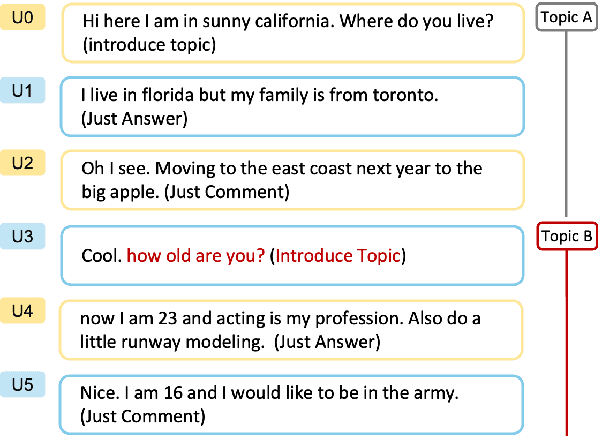
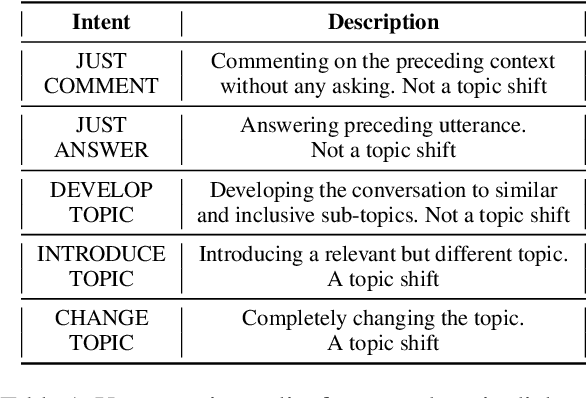
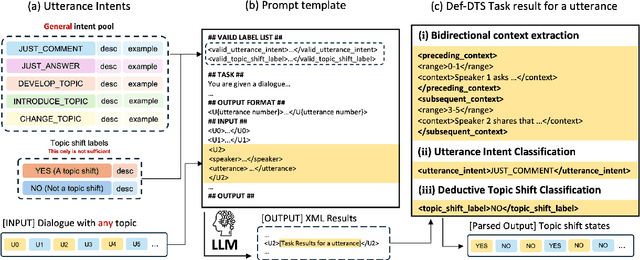
Dialogue Topic Segmentation (DTS) aims to divide dialogues into coherent segments. DTS plays a crucial role in various NLP downstream tasks, but suffers from chronic problems: data shortage, labeling ambiguity, and incremental complexity of recently proposed solutions. On the other hand, Despite advances in Large Language Models (LLMs) and reasoning strategies, these have rarely been applied to DTS. This paper introduces Def-DTS: Deductive Reasoning for Open-domain Dialogue Topic Segmentation, which utilizes LLM-based multi-step deductive reasoning to enhance DTS performance and enable case study using intermediate result. Our method employs a structured prompting approach for bidirectional context summarization, utterance intent classification, and deductive topic shift detection. In the intent classification process, we propose the generalizable intent list for domain-agnostic dialogue intent classification. Experiments in various dialogue settings demonstrate that Def-DTS consistently outperforms traditional and state-of-the-art approaches, with each subtask contributing to improved performance, particularly in reducing type 2 error. We also explore the potential for autolabeling, emphasizing the importance of LLM reasoning techniques in DTS.
Context-Aware LLM Translation System Using Conversation Summarization and Dialogue History
Oct 22, 2024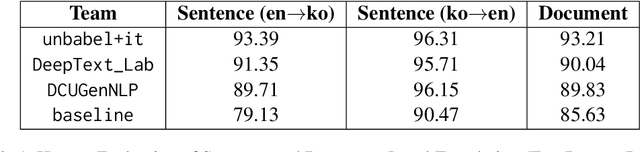
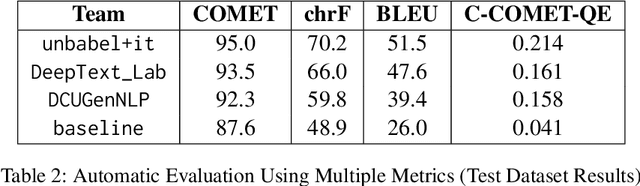

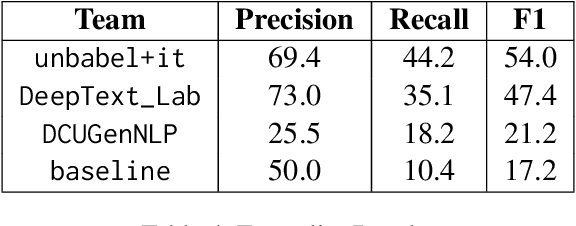
Translating conversational text, particularly in customer support contexts, presents unique challenges due to its informal and unstructured nature. We propose a context-aware LLM translation system that leverages conversation summarization and dialogue history to enhance translation quality for the English-Korean language pair. Our approach incorporates the two most recent dialogues as raw data and a summary of earlier conversations to manage context length effectively. We demonstrate that this method significantly improves translation accuracy, maintaining coherence and consistency across conversations. This system offers a practical solution for customer support translation tasks, addressing the complexities of conversational text.
Drop to Adapt: Learning Discriminative Features for Unsupervised Domain Adaptation
Oct 12, 2019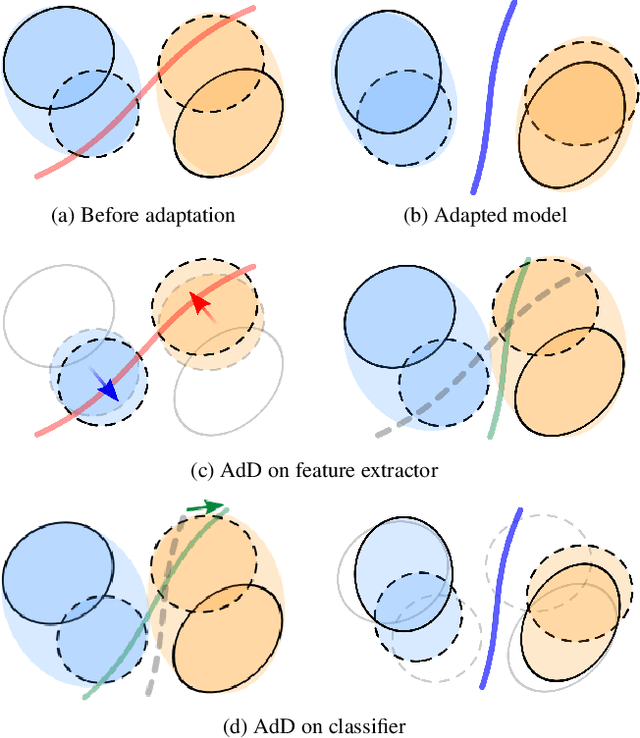
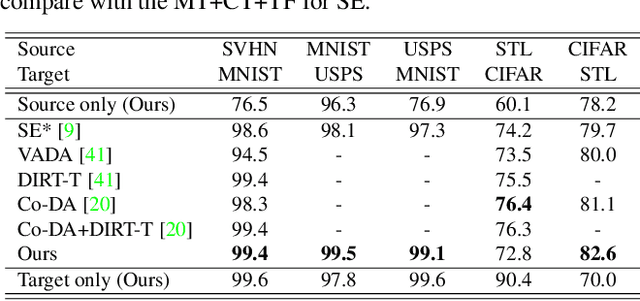
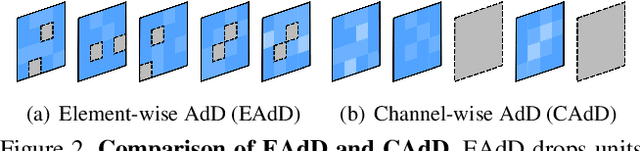
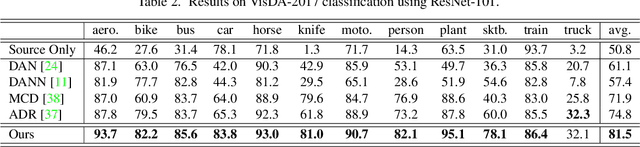
Recent works on domain adaptation exploit adversarial training to obtain domain-invariant feature representations from the joint learning of feature extractor and domain discriminator networks. However, domain adversarial methods render suboptimal performances since they attempt to match the distributions among the domains without considering the task at hand. We propose Drop to Adapt (DTA), which leverages adversarial dropout to learn strongly discriminative features by enforcing the cluster assumption. Accordingly, we design objective functions to support robust domain adaptation. We demonstrate efficacy of the proposed method on various experiments and achieve consistent improvements in both image classification and semantic segmentation tasks. Our source code is available at https://github.com/postBG/DTA.pytorch.