 Add to Chrome
 Add to Firefox
 Add to Edge
Auditable Graph-Guided Root Cause Analysis for Kubernetes Incidents
Jun 07, 2026
Kubernetes incidents are diagnosed reliably only when a root-cause system's reported gains come from incident evidence rather than scenario-specific shortcuts. We present Graph Traversal Agent, a graph-guided RCA agent that combines LLM reasoning with specialized tools. The model reasons over a typed evidence graph, while deterministic graph and tool operations collect evidence, bound the search, and check proposed verdicts. We map operational constraints, including read-only evidence collection, propagation-aware diagnosis, bounded execution, and independently validated verdicts, to a typed incident graph, a LangGraph traversal state machine, and a separate validation stage. On ITBench snapshots scored by one fixed qwen-plus judge, the audited system raises root-cause-entity F1 over an earlier iteration of the same system from 0.6087 to 0.9130 on a 23-scenario common subset. A prompt-level ablation separates prompt-tuned gains from gains that survive once scenario-specific hints are removed: the stripped-prompt configuration retains 0.6958 F1 on a 19-scenario subset. The surviving gain concentrates on ChaosMesh scenarios whose ground-truth root cause is the injected fault object already present in the evidence graph, so we report it as benchmark-coupled rather than broad cross-cluster RCA evidence. Lightweight checks, including same-judge comparison, prompt-level ablation, cascade-source checking, and a telemetry no-leak test, mark claims as supported, pending, or out of scope. We scope the work to ITBench OpenTelemetry-demo snapshots. Live-cluster trials served as an engineering stress test, but alert state and trace availability did not stay stable enough for controlled scoring, so we make no production-readiness or mean-time-to-repair claim.

ContextRAG: Extraction-Free Hierarchical Graph Construction for Retrieval-Augmented Generation
May 19, 2026Graph-structured retrieval-augmented generation (RAG) systems can improve answer quality on multi-hop questions, but many current systems rely on large language models (LLMs) to extract entities, relations, and summaries during indexing. These calls add token and wall-clock costs that grow with corpus size. We present ContextRAG, a graph RAG system whose graph topology is constructed without LLM-based entity or relation extraction. ContextRAG derives a fuzzy concept graph over chunk embeddings using residual-quantization k-means and Formal Concept Analysis with Lukasiewicz residuated logic. Bridge-like and meet-derived context nodes are induced by soft fuzzy join and meet operations, rather than by LLM-written graph edges. On a 130-task UltraDomain subset, ContextRAG builds its index with 30 LLM calls and 22,073 tokens. In contrast, a local HiRAG reproduction stress test required 870 indexing calls and 3.54M tokens on a 20-task subset before failing during graph construction; linear extrapolation to 130 tasks implies over 23M indexing tokens. ContextRAG obtains 33.6% F1 overall and 36.8% F1 on multi-hop tasks. An activation analysis shows that queries retrieving at least one lattice-derived node in the top five achieve +3.9 percentage points F1 over queries that do not; this association is diagnostic rather than causal.
From Patterns to Predictions: A Shapelet-Based Framework for Directional Forecasting in Noisy Financial Markets
Sep 18, 2025Directional forecasting in financial markets requires both accuracy and interpretability. Before the advent of deep learning, interpretable approaches based on human-defined patterns were prevalent, but their structural vagueness and scale ambiguity hindered generalization. In contrast, deep learning models can effectively capture complex dynamics, yet often offer limited transparency. To bridge this gap, we propose a two-stage framework that integrates unsupervised pattern extracion with interpretable forecasting. (i) SIMPC segments and clusters multivariate time series, extracting recurrent patterns that are invariant to amplitude scaling and temporal distortion, even under varying window sizes. (ii) JISC-Net is a shapelet-based classifier that uses the initial part of extracted patterns as input and forecasts subsequent partial sequences for short-term directional movement. Experiments on Bitcoin and three S&P 500 equities demonstrate that our method ranks first or second in 11 out of 12 metric--dataset combinations, consistently outperforming baselines. Unlike conventional deep learning models that output buy-or-sell signals without interpretable justification, our approach enables transparent decision-making by revealing the underlying pattern structures that drive predictive outcomes.
A Visual Analytics System for Improving Attention-based Traffic Forecasting Models
Aug 11, 2022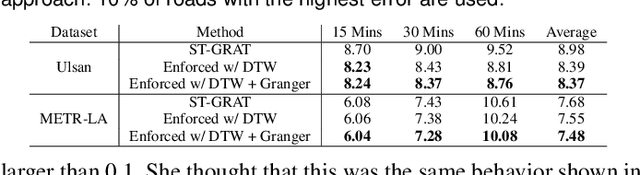
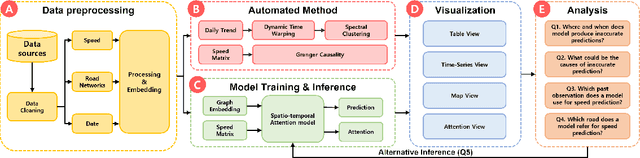
With deep learning (DL) outperforming conventional methods for different tasks, much effort has been devoted to utilizing DL in various domains. Researchers and developers in the traffic domain have also designed and improved DL models for forecasting tasks such as estimation of traffic speed and time of arrival. However, there exist many challenges in analyzing DL models due to the black-box property of DL models and complexity of traffic data (i.e., spatio-temporal dependencies). Collaborating with domain experts, we design a visual analytics system, AttnAnalyzer, that enables users to explore how DL models make predictions by allowing effective spatio-temporal dependency analysis. The system incorporates dynamic time warping (DTW) and Granger causality tests for computational spatio-temporal dependency analysis while providing map, table, line chart, and pixel views to assist user to perform dependency and model behavior analysis. For the evaluation, we present three case studies showing how AttnAnalyzer can effectively explore model behaviors and improve model performance in two different road networks. We also provide domain expert feedback.
Learning to Remember Patterns: Pattern Matching Memory Networks for Traffic Forecasting
Oct 20, 2021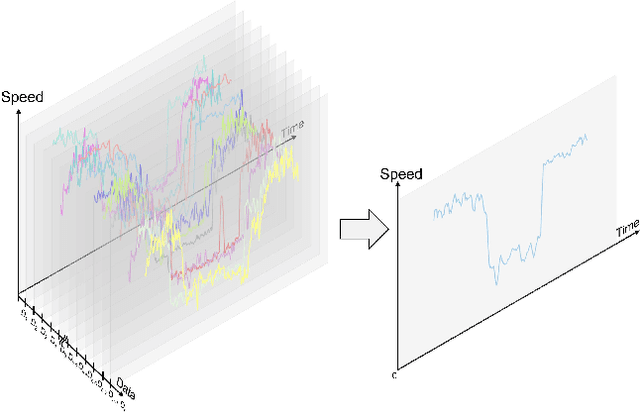
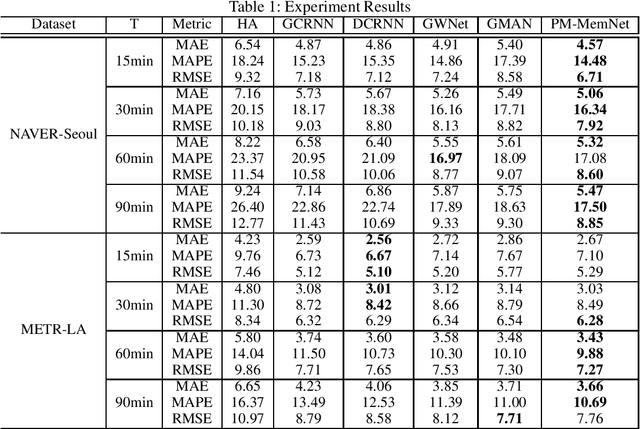
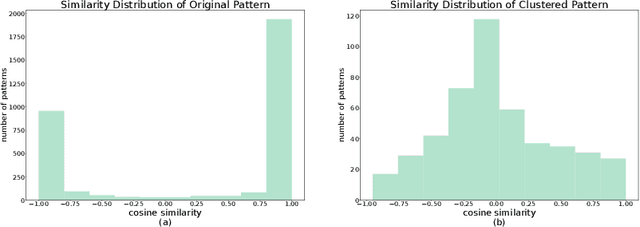
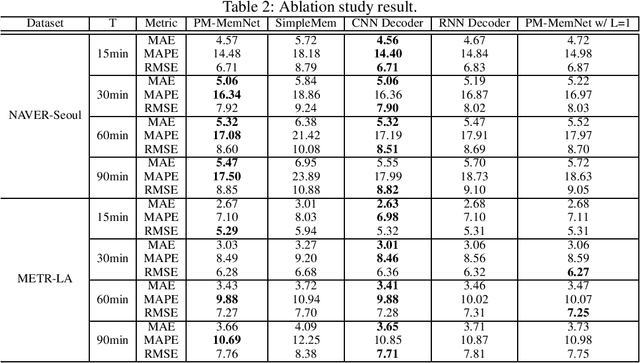
Traffic forecasting is a challenging problem due to complex road networks and sudden speed changes caused by various events on roads. A number of models have been proposed to solve this challenging problem with a focus on learning spatio-temporal dependencies of roads. In this work, we propose a new perspective of converting the forecasting problem into a pattern matching task, assuming that large data can be represented by a set of patterns. To evaluate the validness of the new perspective, we design a novel traffic forecasting model, called Pattern-Matching Memory Networks (PM-MemNet), which learns to match input data to the representative patterns with a key-value memory structure. We first extract and cluster representative traffic patterns, which serve as keys in the memory. Then via matching the extracted keys and inputs, PM-MemNet acquires necessary information of existing traffic patterns from the memory and uses it for forecasting. To model spatio-temporal correlation of traffic, we proposed novel memory architecture GCMem, which integrates attention and graph convolution for memory enhancement. The experiment results indicate that PM-MemNet is more accurate than state-of-the-art models, such as Graph WaveNet with higher responsiveness. We also present a qualitative analysis result, describing how PM-MemNet works and achieves its higher accuracy when road speed rapidly changes.
An Empirical Experiment on Deep Learning Models for Predicting Traffic Data
May 12, 2021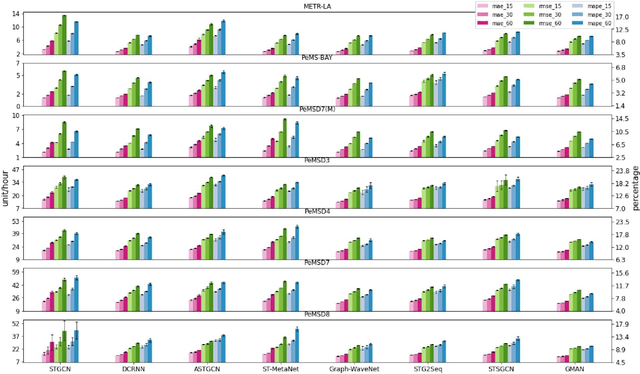

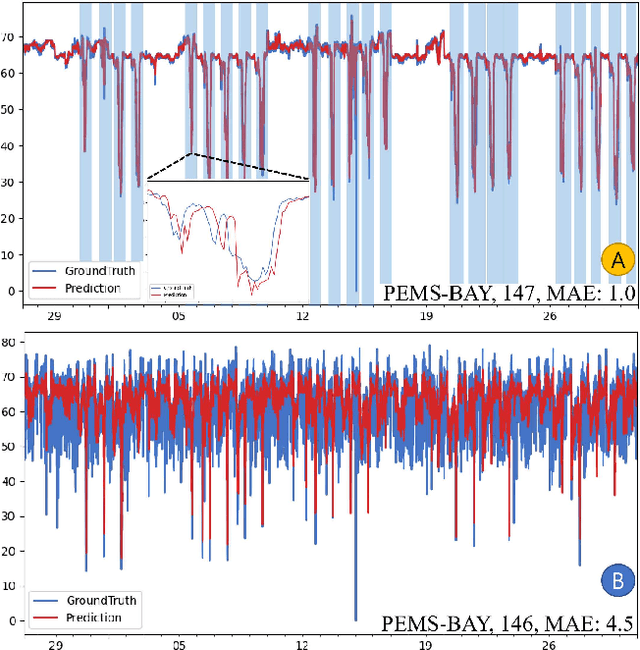
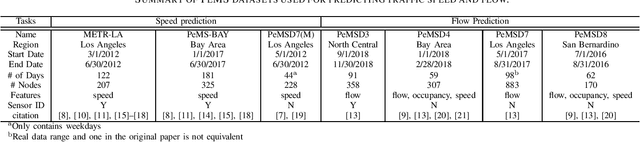
To tackle ever-increasing city traffic congestion problems, researchers have proposed deep learning models to aid decision-makers in the traffic control domain. Although the proposed models have been remarkably improved in recent years, there are still questions that need to be answered before deploying models. For example, it is difficult to figure out which models provide state-of-the-art performance, as recently proposed models have often been evaluated with different datasets and experiment environments. It is also difficult to determine which models would work when traffic conditions change abruptly (e.g., rush hour). In this work, we conduct two experiments to answer the two questions. In the first experiment, we conduct an experiment with the state-of-the-art models and the identical public datasets to compare model performance under a consistent experiment environment. We then extract a set of temporal regions in the datasets, whose speeds change abruptly and use these regions to explore model performance with difficult intervals. The experiment results indicate that Graph-WaveNet and GMAN show better performance in general. We also find that prediction models tend to have varying performances with data and intervals, which calls for in-depth analysis of models on difficult intervals for real-world deployment.
STGRAT: A Spatio-Temporal Graph Attention Network for Traffic Forecasting
Nov 29, 2019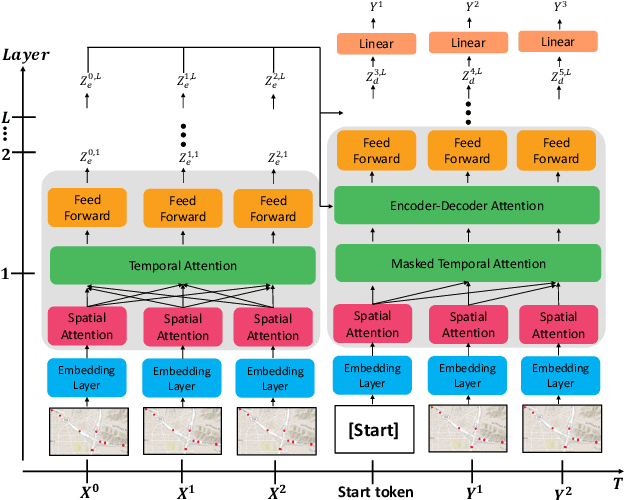
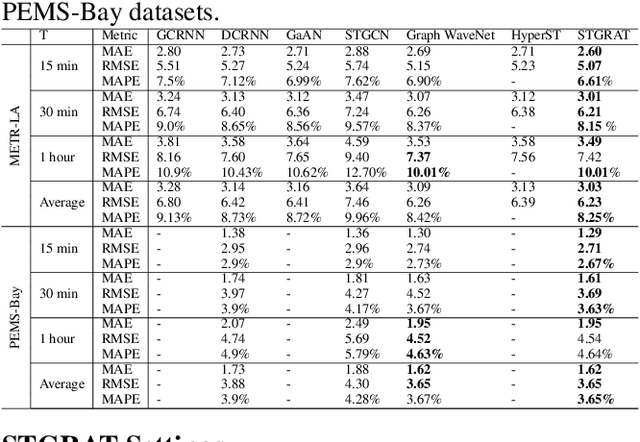
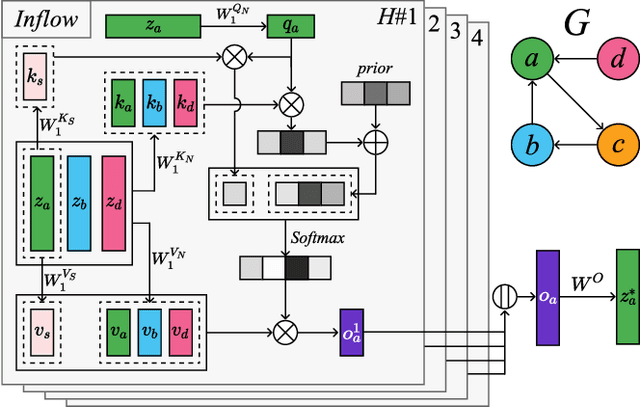
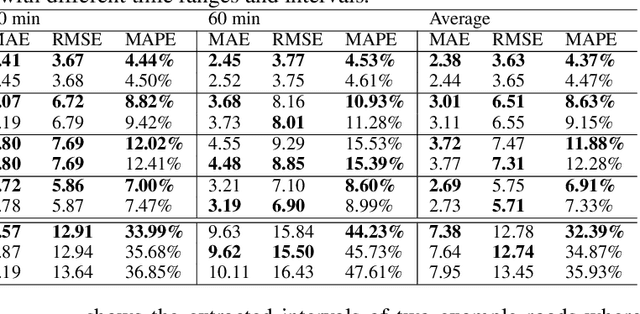
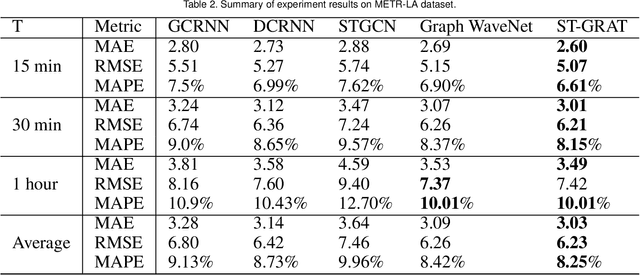
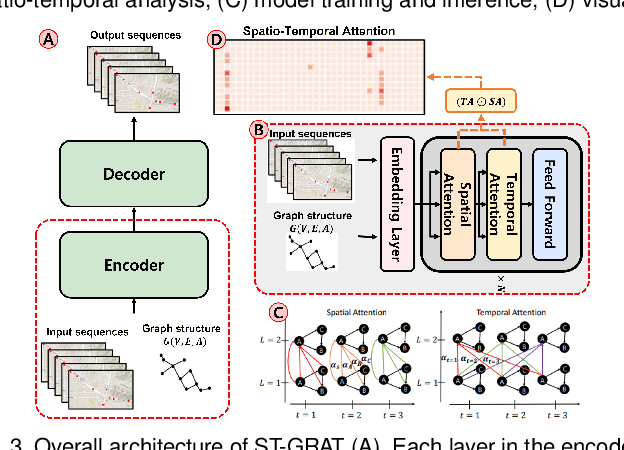
Predicting the road traffic speed is a challenging task due to different types of roads, abrupt speed changes, and spatial dependencies between roads, which requires the modeling of dynamically changing spatial dependencies among roads and temporal patterns over long input sequences. This paper proposes a novel Spatio-Temporal Graph Attention (STGRAT) that effectively captures the spatio-temporal dynamics in road networks. The features of our approach mainly include spatial attention, temporal attention, and spatial sentinel vectors. The spatial attention takes the graph structure information (e.g., distance between roads) and dynamically adjusts spatial correlation based on road states. The temporal attention is responsible for capturing traffic speed changes, while the sentinel vectors allow the model to retrieve new features from spatially correlated nodes or preserve existing features. The experimental results show that STGRAT outperforms existing models, especially in difficult conditions where traffic speeds rapidly change (e.g., rush hours). We additionally provide a qualitative study to analyze when and where STGRAT mainly attended to make accurate predictions during a rush-hour time.