 Add to Chrome
 Add to Firefox
 Add to Edge
KVoiceBench, KOpenAudioBench, and KMMAU: Agent-Driven Korean Speech Benchmarks for Evaluating SpeechLMs
May 27, 2026
Speech language models (SpeechLMs) have achieved substantial progress by extending large language models (LLMs) to the speech modality. However, SpeechLM evaluation remains heavily centered on English, limiting reliable assessment of multilingual speech capabilities. Straightforward benchmark transfer through ASR, translation, normalization, and TTS can corrupt language-specific instructions, answer constraints, and spoken forms; for audio understanding, transferring source-language audio also fails to preserve target-language speaker attributes, accents, and paralinguistic properties. To address these limitations, we propose two human-agent benchmark-construction frameworks: one transfers source-language SpokenQA benchmarks into target-language SpokenQA benchmarks, and the other converts target-language ASR corpora into audio understanding benchmarks using transcriptions and speaker metadata. Using these frameworks, we construct and publicly release three Korean speech benchmarks: KVoiceBench and KOpenAudioBench for Korean SpokenQA, and KMMAU for Korean audio understanding, comprising 12,345 samples in total. We evaluate eight recent SpeechLMs and find that English-Korean performance gaps vary substantially across models and task families, and that SpokenQA and audio understanding rankings diverge, revealing complementary weaknesses invisible to English-only evaluation.

Raon-OpenTTS: Open Models and Data for Robust Text-to-Speech
May 20, 2026Recent advances in text-to-speech (TTS) models show impressive speech naturalness and quality, yet the role of large-scale open data in driving this progress remains underexplored. In this work, we introduce Raon-OpenTTS, an open TTS model that performs competitively with state-of-the-art closed-data TTS models, and Raon-OpenTTS-Pool, a large-scale open dataset for reproducible TTS training. Raon-OpenTTS-Pool consists of 615K hours of 240M speech segments aggregated from publicly available English speech corpora and web-sourced recordings. With a model-based filtering pipeline applied to Raon-OpenTTS-Pool, we derive Raon-OpenTTS-Core, a curated, high-quality subset of 510K hours and 194M speech segments. Using Raon-OpenTTS-Core, we train Raon-OpenTTS, a series of diffusion transformer (DiT)-based TTS models from 0.3B to 1B parameters. On multiple benchmarks, Raon-OpenTTS-1B shows comparable performance to state-of-the-art models such as Qwen3-TTS and CosyVoice 3, which are trained on several million hours of proprietary speech data. Notably, on Seed-TTS-Eval, Raon-OpenTTS-1B achieves a word error rate (WER) of 1.78% and a speaker similarity (SIM) of 0.749, ranking second on WER and first on SIM among recent open-weight TTS baselines. On CV3-Hard-EN, Raon-OpenTTS-1B achieves a WER of 6.15% and a SIM of 0.775, ranking first on both metrics. Furthermore, to support robust evaluation, we introduce Raon-OpenTTS-Eval, a structured benchmark for assessing TTS robustness across diverse acoustic conditions including clean, noisy, in-the-wild, and expressive speech. On Raon-OpenTTS-Eval, Raon-OpenTTS-1B achieves the best average WER and SIM among all evaluated models, and the second-best human preference, as measured by comparative mean opinion score (CMOS). Our data pool, filtering pipeline, training code, and checkpoints are publicly available at https://github.com/krafton-ai/RAON-OpenTTS.
CLaM-TTS: Improving Neural Codec Language Model for Zero-Shot Text-to-Speech
Apr 03, 2024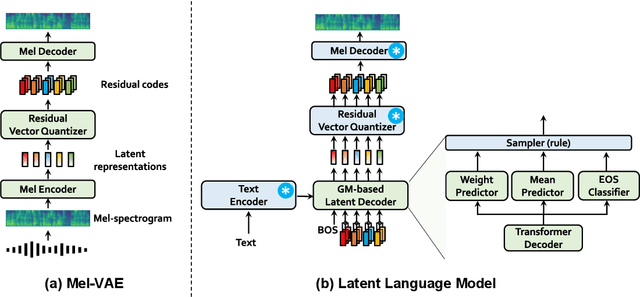
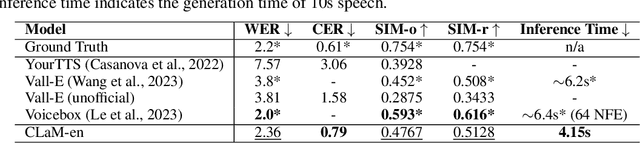
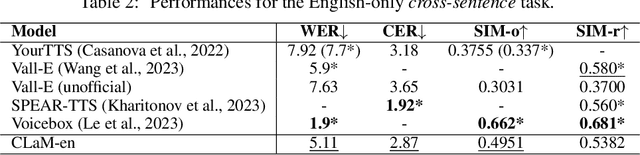
With the emergence of neural audio codecs, which encode multiple streams of discrete tokens from audio, large language models have recently gained attention as a promising approach for zero-shot Text-to-Speech (TTS) synthesis. Despite the ongoing rush towards scaling paradigms, audio tokenization ironically amplifies the scalability challenge, stemming from its long sequence length and the complexity of modelling the multiple sequences. To mitigate these issues, we present CLaM-TTS that employs a probabilistic residual vector quantization to (1) achieve superior compression in the token length, and (2) allow a language model to generate multiple tokens at once, thereby eliminating the need for cascaded modeling to handle the number of token streams. Our experimental results demonstrate that CLaM-TTS is better than or comparable to state-of-the-art neural codec-based TTS models regarding naturalness, intelligibility, speaker similarity, and inference speed. In addition, we examine the impact of the pretraining extent of the language models and their text tokenization strategies on performances.