 Add to Chrome
 Add to Firefox
 Add to Edge
Geometry-Correct Diffusion Posterior Sampling with Denoiser-Pullback Curvature Guidance and Manifold-Aligned Damping
May 27, 2026
Diffusion posterior sampling conditions diffusion priors on measurements, but data-consistency updates are typically scaled by hand-tuned guidance weights and can destabilize sampling under stiff, operator-dependent curvature. We replace scalar guidance with a per-noise-level damped Gauss--Newton correction computed in diffusion-state coordinates. The correction pulls likelihood gradients back through the denoiser, uses a one-sided curvature model that avoids forward denoiser Jacobians, and applies diffusion-calibrated rank-one damping aligned with the denoiser residual. Each correction is solved with matrix-free GMRES using automatic differentiation, and sampling proceeds with a variance-preserving Langevin transition with a closed-form drift/noise split. On FFHQ and ImageNet across inverse problems, it achieves competitive PSNR/SSIM/LPIPS while running markedly faster than most of the compared baselines; on accelerated MRI reconstruction, it achieves the best PSNR/SSIM among the compared baselines.
* Code: https://github.com/Seunghyeok0715/CLAMP

FAST-DIPS: Adjoint-Free Analytic Steps and Hard-Constrained Likelihood Correction for Diffusion-Prior Inverse Problems
Mar 02, 2026Training-free diffusion priors enable inverse-problem solvers without retraining, but for nonlinear forward operators data consistency often relies on repeated derivatives or inner optimization/MCMC loops with conservative step sizes, incurring many iterations and denoiser/score evaluations. We propose a training-free solver that replaces these inner loops with a hard measurement-space feasibility constraint (closed-form projection) and an analytic, model-optimal step size, enabling a small, fixed compute budget per noise level. Anchored at the denoiser prediction, the correction is approximated via an adjoint-free, ADMM-style splitting with projection and a few steepest-descent updates, using one VJP and either one JVP or a forward-difference probe, followed by backtracking and decoupled re-annealing. We prove local model optimality and descent under backtracking for the step-size rule, and derive an explicit KL bound for mode-substitution re-annealing under a local Gaussian conditional surrogate. We also develop a latent variant and a one-parameter pixel$\rightarrow$latent hybrid schedule. Experiments achieve competitive PSNR/SSIM/LPIPS with up to 19.5$\times$ speedup, without hand-coded adjoints or inner MCMC.
Adaptive 3D Reconstruction via Diffusion Priors and Forward Curvature-Matching Likelihood Updates
Nov 09, 2025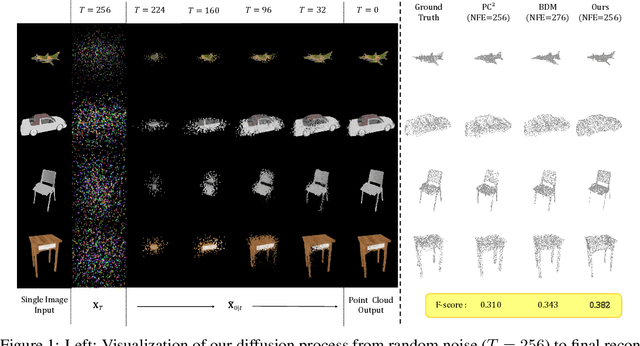
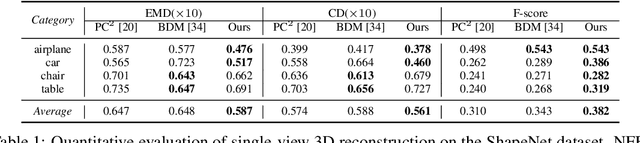
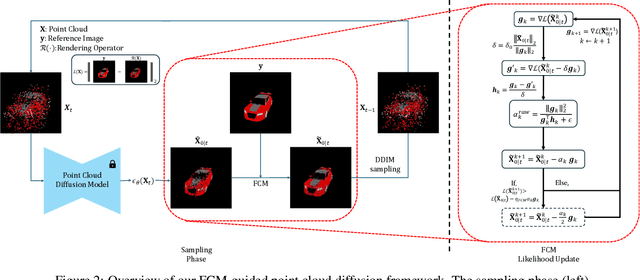
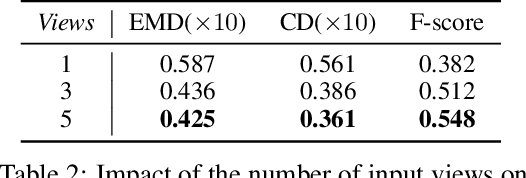
Reconstructing high-quality point clouds from images remains challenging in computer vision. Existing generative-model-based approaches, particularly diffusion-model approaches that directly learn the posterior, may suffer from inflexibility -- they require conditioning signals during training, support only a fixed number of input views, and need complete retraining for different measurements. Recent diffusion-based methods have attempted to address this by combining prior models with likelihood updates, but they rely on heuristic fixed step sizes for the likelihood update that lead to slow convergence and suboptimal reconstruction quality. We advance this line of approach by integrating our novel Forward Curvature-Matching (FCM) update method with diffusion sampling. Our method dynamically determines optimal step sizes using only forward automatic differentiation and finite-difference curvature estimates, enabling precise optimization of the likelihood update. This formulation enables high-fidelity reconstruction from both single-view and multi-view inputs, and supports various input modalities through simple operator substitution -- all without retraining. Experiments on ShapeNet and CO3D datasets demonstrate that our method achieves superior reconstruction quality at matched or lower NFEs, yielding higher F-score and lower CD and EMD, validating its efficiency and adaptability for practical applications. Code is available at https://github.com/Seunghyeok0715/FCM