 Add to Chrome
 Add to Firefox
 Add to Edge
ViewSplat: View-Adaptive Dynamic Gaussian Splatting for Feed-Forward Synthesis
Mar 26, 2026
We present ViewSplat, a view-adaptive 3D Gaussian splatting network for novel view synthesis from unposed images. While recent feed-forward 3D Gaussian splatting has significantly accelerated 3D scene reconstruction by bypassing per-scene optimization, a fundamental fidelity gap remains. We attribute this bottleneck to the limited capacity of single-step feed-forward networks to regress static Gaussian primitives that satisfy all viewpoints. To address this limitation, we shift the paradigm from static primitive regression to view-adaptive dynamic splatting. Instead of a rigid Gaussian representation, our pipeline learns a view-adaptable latent representation. Specifically, ViewSplat initially predicts base Gaussian primitives alongside the weights of dynamic MLPs. During rendering, these MLPs take target view coordinates as input and predict view-dependent residual updates for each Gaussian attribute (i.e., 3D position, scale, rotation, opacity, and color). This mechanism, which we term view-adaptive dynamic splatting, allows each primitive to rectify initial estimation errors, effectively capturing high-fidelity appearances. Extensive experiments demonstrate that ViewSplat achieves state-of-the-art fidelity while maintaining fast inference (17 FPS) and real-time rendering (154 FPS).

ATLANTIS: AI-driven Threat Localization, Analysis, and Triage Intelligence System
Sep 18, 2025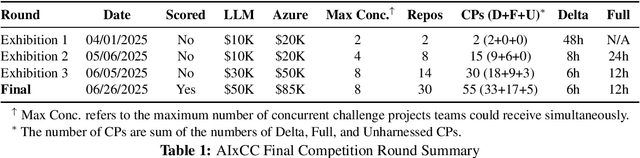
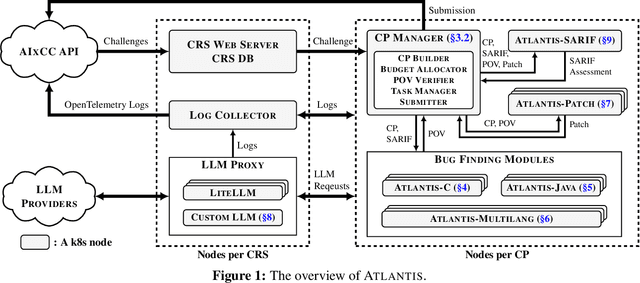
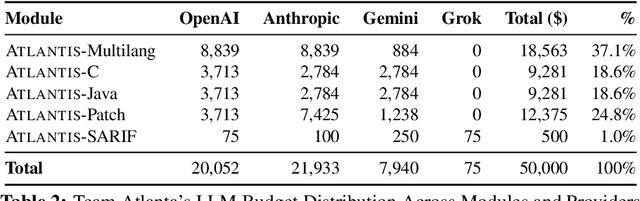
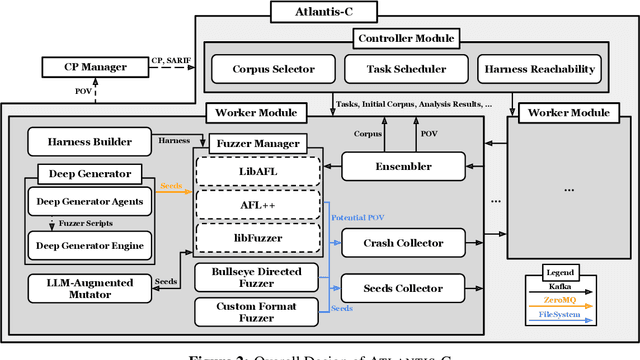
We present ATLANTIS, the cyber reasoning system developed by Team Atlanta that won 1st place in the Final Competition of DARPA's AI Cyber Challenge (AIxCC) at DEF CON 33 (August 2025). AIxCC (2023-2025) challenged teams to build autonomous cyber reasoning systems capable of discovering and patching vulnerabilities at the speed and scale of modern software. ATLANTIS integrates large language models (LLMs) with program analysis -- combining symbolic execution, directed fuzzing, and static analysis -- to address limitations in automated vulnerability discovery and program repair. Developed by researchers at Georgia Institute of Technology, Samsung Research, KAIST, and POSTECH, the system addresses core challenges: scaling across diverse codebases from C to Java, achieving high precision while maintaining broad coverage, and producing semantically correct patches that preserve intended behavior. We detail the design philosophy, architectural decisions, and implementation strategies behind ATLANTIS, share lessons learned from pushing the boundaries of automated security when program analysis meets modern AI, and release artifacts to support reproducibility and future research.