 Add to Chrome
 Add to Firefox
 Add to Edge
Membrane: A Self-Evolving Contrastive Safety Memory for LLM Agent Defense
Jun 04, 2026
Despite advances in safety alignment, large language models remain vulnerable to continuously evolving jailbreaks. Existing fine-tuned safety classifiers cannot adapt to these evolving attacks, while adaptive memory-based guardrails tend to over-refuse benign queries that resemble stored attacks. We propose Membrane, a self-evolving guardrail built on Contrastive Safety Memory (CSM): each cell pairs the conditions for blocking a harmful query with those for permitting a superficially similar benign request. Without retraining, Membrane evolves CSM by distilling each harmful interaction and its benign counterpart into a contrastive cell indexed by the underlying attack strategy, so that one cell generalizes across topical variants of the same mechanism. At inference, retrieved cells serve as grounding context for precise safety decisions. Across model-level safety on HarmBench and agent-level safety on AgentHarm, Membrane achieves the highest F1 on all six jailbreak attacks. Notably, benign refusal on AgentHarm stays at 7-14%, well below the 28-85% range of prior guards. Memory cells also retain 87-88% F1 under cross-attack transfer and remain stable under memory poisoning.

LiveWeb-IE: A Benchmark For Online Web Information Extraction
Mar 14, 2026Web information extraction (WIE) is the task of automatically extracting data from web pages, offering high utility for various applications. The evaluation of WIE systems has traditionally relied on benchmarks built from HTML snapshots captured at a single point in time. However, this offline evaluation paradigm fails to account for the temporally evolving nature of the web; consequently, performance on these static benchmarks often fails to generalize to dynamic real-world scenarios. To bridge this gap, we introduce \dataset, a new benchmark designed for evaluating WIE systems directly against live websites. Based on trusted and permission-granted websites, we curate natural language queries that require information extraction of various data categories, such as text, images, and hyperlinks. We further design these queries to represent four levels of complexity, based on the number and cardinality of attributes to be extracted, enabling a granular assessment of WIE systems. In addition, we propose Visual Grounding Scraper (VGS), a novel multi-stage agentic framework that mimics human cognitive processes by visually narrowing down web page content to extract desired information. Extensive experiments across diverse backbone models demonstrate the effectiveness and robustness of VGS. We believe that this study lays the foundation for developing practical and robust WIE systems.
ExpGuard: LLM Content Moderation in Specialized Domains
Mar 03, 2026With the growing deployment of large language models (LLMs) in real-world applications, establishing robust safety guardrails to moderate their inputs and outputs has become essential to ensure adherence to safety policies. Current guardrail models predominantly address general human-LLM interactions, rendering LLMs vulnerable to harmful and adversarial content within domain-specific contexts, particularly those rich in technical jargon and specialized concepts. To address this limitation, we introduce ExpGuard, a robust and specialized guardrail model designed to protect against harmful prompts and responses across financial, medical, and legal domains. In addition, we present ExpGuardMix, a meticulously curated dataset comprising 58,928 labeled prompts paired with corresponding refusal and compliant responses, from these specific sectors. This dataset is divided into two subsets: ExpGuardTrain, for model training, and ExpGuardTest, a high-quality test set annotated by domain experts to evaluate model robustness against technical and domain-specific content. Comprehensive evaluations conducted on ExpGuardTest and eight established public benchmarks reveal that ExpGuard delivers competitive performance across the board while demonstrating exceptional resilience to domain-specific adversarial attacks, surpassing state-of-the-art models such as WildGuard by up to 8.9% in prompt classification and 15.3% in response classification. To encourage further research and development, we open-source our code, data, and model, enabling adaptation to additional domains and supporting the creation of increasingly robust guardrail models.
Can Tool-augmented Large Language Models be Aware of Incomplete Conditions?
Jun 18, 2024
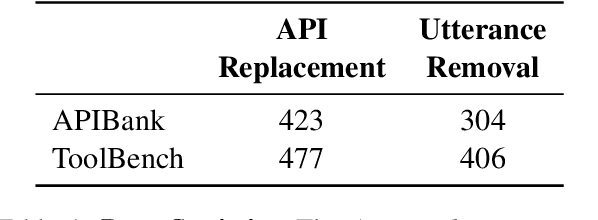
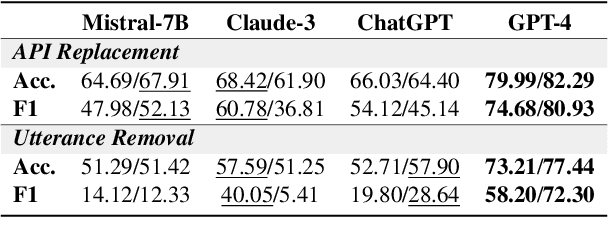

Recent advancements in integrating large language models (LLMs) with tools have allowed the models to interact with real-world environments. However, these tool-augmented LLMs often encounter incomplete scenarios when users provide partial information or the necessary tools are unavailable. Recognizing and managing such scenarios is crucial for LLMs to ensure their reliability, but this exploration remains understudied. This study examines whether LLMs can identify incomplete conditions and appropriately determine when to refrain from using tools. To this end, we address a dataset by manipulating instances from two datasets by removing necessary tools or essential information for tool invocation. We confirm that most LLMs are challenged to identify the additional information required to utilize specific tools and the absence of appropriate tools. Our research can contribute to advancing reliable LLMs by addressing scenarios that commonly arise during interactions between humans and LLMs.