 Add to Chrome
 Add to Firefox
 Add to Edge
Transductive Generalization via Optimal Transport and Its Application to Graph Node Classification
Mar 10, 2026
Many existing transductive bounds rely on classical complexity measures that are computationally intractable and often misaligned with empirical behavior. In this work, we establish new representation-based generalization bounds in a distribution-free transductive setting, where learned representations are dependent, and test features are accessible during training. We derive global and class-wise bounds via optimal transport, expressed in terms of Wasserstein distances between encoded feature distributions. We demonstrate that our bounds are efficiently computable and strongly correlate with empirical generalization in graph node classification, improving upon classical complexity measures. Additionally, our analysis reveals how the GNN aggregation process transforms the representation distributions, inducing a trade-off between intra-class concentration and inter-class separation. This yields depth-dependent characterizations that capture the non-monotonic relationship between depth and generalization error observed in practice. The code is available at https://github.com/ml-postech/Transductive-OT-Gen-Bound.

Training-free Composition of Pre-trained GFlowNets for Multi-Objective Generation
Feb 25, 2026Generative Flow Networks (GFlowNets) learn to sample diverse candidates in proportion to a reward function, making them well-suited for scientific discovery, where exploring multiple promising solutions is crucial. Further extending GFlowNets to multi-objective settings has attracted growing interest since real-world applications often involve multiple, conflicting objectives. However, existing approaches require additional training for each set of objectives, limiting their applicability and incurring substantial computational overhead. We propose a training-free mixing policy that composes pre-trained GFlowNets at inference time, enabling rapid adaptation without finetuning or retraining. Importantly, our framework is flexible, capable of handling diverse reward combinations ranging from linear scalarization to complex non-linear logical operators, which are often handled separately in previous literature. We prove that our method exactly recovers the target distribution for linear scalarization and quantify the approximation quality for nonlinear operators through a distortion factor. Experiments on a synthetic 2D grid and real-world molecule-generation tasks demonstrate that our approach achieves performance comparable to baselines that require additional training.
Plane Geometry Problem Solving with Multi-modal Reasoning: A Survey
May 20, 2025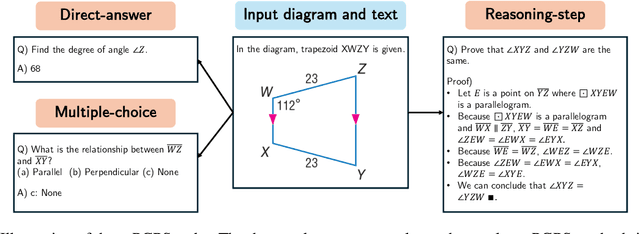
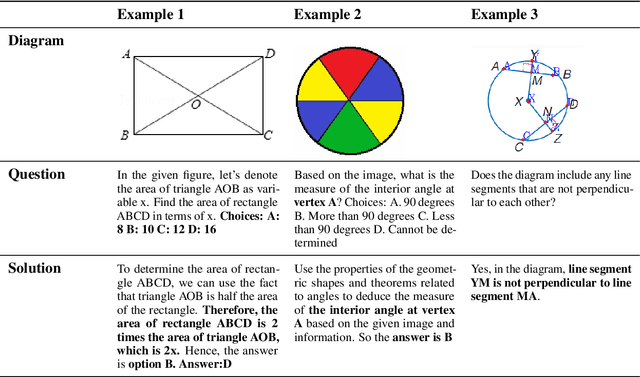
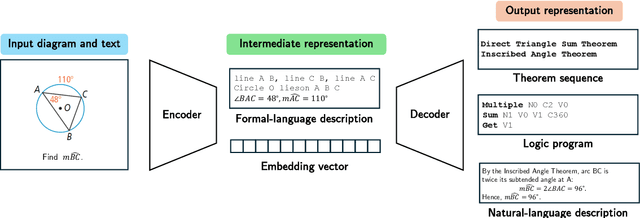
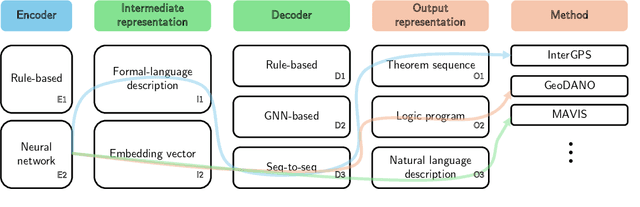
Plane geometry problem solving (PGPS) has recently gained significant attention as a benchmark to assess the multi-modal reasoning capabilities of large vision-language models. Despite the growing interest in PGPS, the research community still lacks a comprehensive overview that systematically synthesizes recent work in PGPS. To fill this gap, we present a survey of existing PGPS studies. We first categorize PGPS methods into an encoder-decoder framework and summarize the corresponding output formats used by their encoders and decoders. Subsequently, we classify and analyze these encoders and decoders according to their architectural designs. Finally, we outline major challenges and promising directions for future research. In particular, we discuss the hallucination issues arising during the encoding phase within encoder-decoder architectures, as well as the problem of data leakage in current PGPS benchmarks.
GeoDANO: Geometric VLM with Domain Agnostic Vision Encoder
Feb 17, 2025We introduce GeoDANO, a geometric vision-language model (VLM) with a domain-agnostic vision encoder, for solving plane geometry problems. Although VLMs have been employed for solving geometry problems, their ability to recognize geometric features remains insufficiently analyzed. To address this gap, we propose a benchmark that evaluates the recognition of visual geometric features, including primitives such as dots and lines, and relations such as orthogonality. Our preliminary study shows that vision encoders often used in general-purpose VLMs, e.g., OpenCLIP, fail to detect these features and struggle to generalize across domains. We develop GeoCLIP, a CLIP based model trained on synthetic geometric diagram-caption pairs to overcome the limitation. Benchmark results show that GeoCLIP outperforms existing vision encoders in recognizing geometric features. We then propose our VLM, GeoDANO, which augments GeoCLIP with a domain adaptation strategy for unseen diagram styles. GeoDANO outperforms specialized methods for plane geometry problems and GPT-4o on MathVerse.
EPIC: Graph Augmentation with Edit Path Interpolation via Learnable Cost
Jun 02, 2023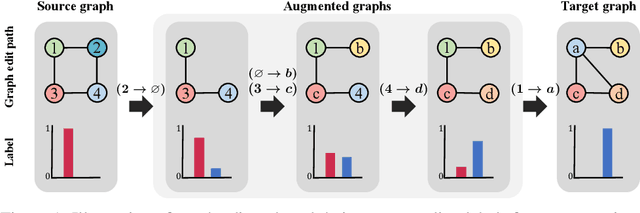
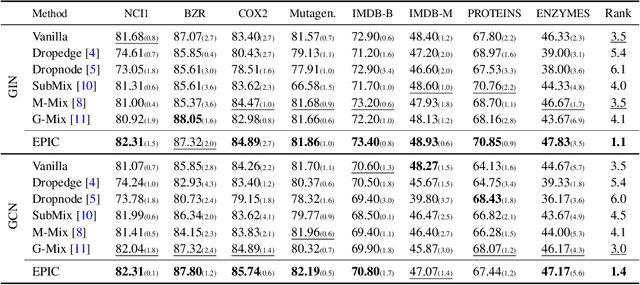
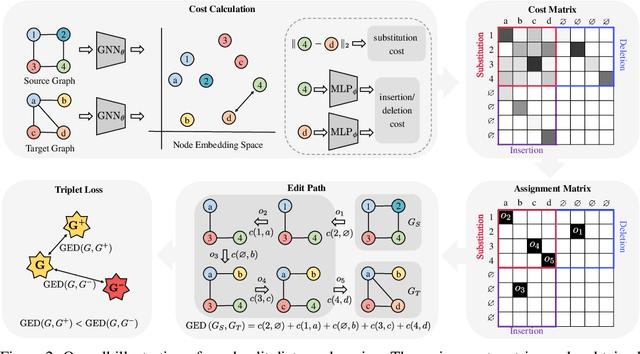

Graph-based models have become increasingly important in various domains, but the limited size and diversity of existing graph datasets often limit their performance. To address this issue, we propose EPIC (Edit Path Interpolation via learnable Cost), a novel interpolation-based method for augmenting graph datasets. Our approach leverages graph edit distance to generate new graphs that are similar to the original ones but exhibit some variation in their structures. To achieve this, we learn the graph edit distance through a comparison of labeled graphs and utilize this knowledge to create graph edit paths between pairs of original graphs. With randomly sampled graphs from a graph edit path, we enrich the training set to enhance the generalization capability of classification models. We demonstrate the effectiveness of our approach on several benchmark datasets and show that it outperforms existing augmentation methods in graph classification tasks.
Substructure-Atom Cross Attention for Molecular Representation Learning
Oct 15, 2022
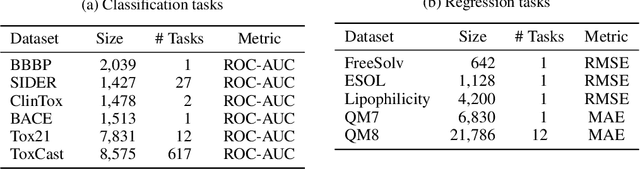
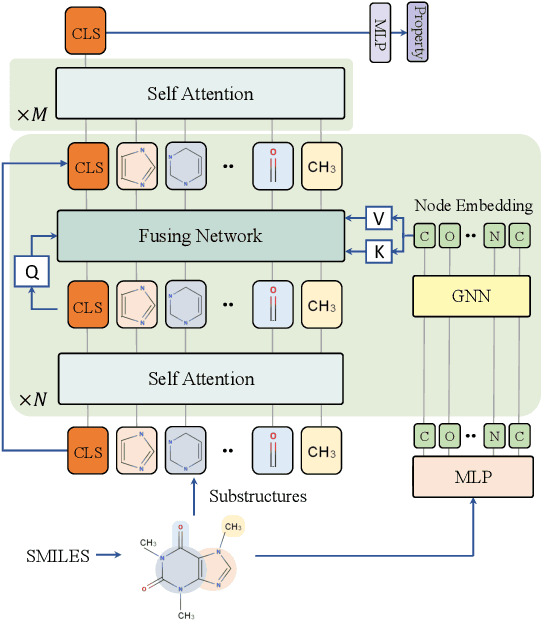
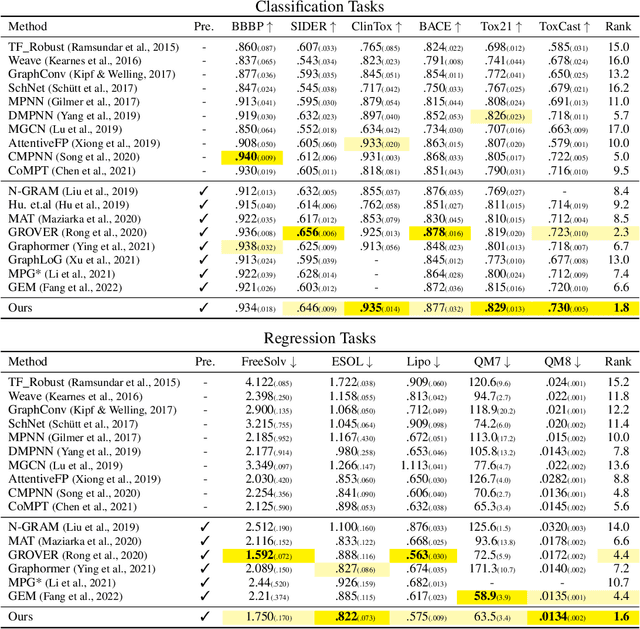
Designing a neural network architecture for molecular representation is crucial for AI-driven drug discovery and molecule design. In this work, we propose a new framework for molecular representation learning. Our contribution is threefold: (a) demonstrating the usefulness of incorporating substructures to node-wise features from molecules, (b) designing two branch networks consisting of a transformer and a graph neural network so that the networks fused with asymmetric attention, and (c) not requiring heuristic features and computationally-expensive information from molecules. Using 1.8 million molecules collected from ChEMBL and PubChem database, we pretrain our network to learn a general representation of molecules with minimal supervision. The experimental results show that our pretrained network achieves competitive performance on 11 downstream tasks for molecular property prediction.