 Add to Chrome
 Add to Firefox
 Add to Edge
RLHFless: Serverless Computing for Efficient RLHF
Feb 26, 2026
Reinforcement Learning from Human Feedback (RLHF) has been widely applied to Large Language Model (LLM) post-training to align model outputs with human preferences. Recent models, such as DeepSeek-R1, have also shown RLHF's potential to improve LLM reasoning on complex tasks. In RL, inference and training co-exist, creating dynamic resource demands throughout the workflow. Compared to traditional RL, RLHF further challenges training efficiency due to expanding model sizes and resource consumption. Several RLHF frameworks aim to balance flexible abstraction and efficient execution. However, they rely on serverful infrastructures, which struggle with fine-grained resource variability. As a result, during synchronous RLHF training, idle time between or within RL components often causes overhead and resource wastage. To address these issues, we present RLHFless, the first scalable training framework for synchronous RLHF, built on serverless computing environments. RLHFless adapts to dynamic resource demands throughout the RLHF pipeline, pre-computes shared prefixes to avoid repeated computation, and uses a cost-aware actor scaling strategy that accounts for response length variation to find sweet spots with lower cost and higher speed. In addition, RLHFless assigns workloads efficiently to reduce intra-function imbalance and idle time. Experiments on both physical testbeds and a large-scale simulated cluster show that RLHFless achieves up to 1.35x speedup and 44.8% cost reduction compared to the state-of-the-art baseline.

Harvesting Idle Resources in Serverless Computing via Reinforcement Learning
Aug 28, 2021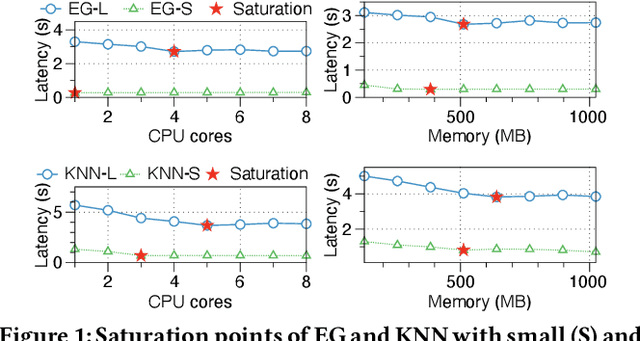
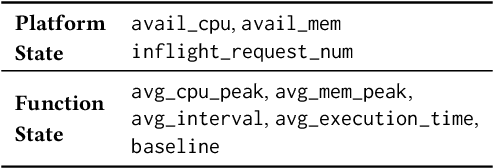
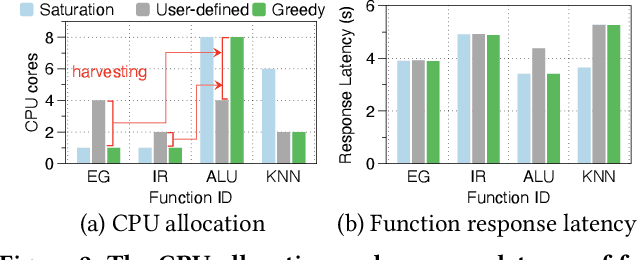
Serverless computing has become a new cloud computing paradigm that promises to deliver high cost-efficiency and simplified cloud deployment with automated resource scaling at a fine granularity. Users decouple a cloud application into chained functions and preset each serverless function's memory and CPU demands at megabyte-level and core-level, respectively. Serverless platforms then automatically scale the number of functions to accommodate the workloads. However, the complexities of chained functions make it non-trivial to accurately determine the resource demands of each function for users, leading to either resource over-provision or under-provision for individual functions. This paper presents FaaSRM, a new resource manager (RM) for serverless platforms that maximizes resource efficiency by dynamically harvesting idle resources from functions over-supplied to functions under-supplied. FaaSRM monitors each function's resource utilization in real-time, detects over-provisioning and under-provisioning, and applies deep reinforcement learning to harvest idle resources safely using a safeguard mechanism and accelerate functions efficiently. We have implemented and deployed a FaaSRM prototype in a 13-node Apache OpenWhisk cluster. Experimental results on the OpenWhisk cluster show that FaaSRM reduces the execution time of 98% of function invocations by 35.81% compared to the baseline RMs by harvesting idle resources from 38.8% of the invocations and accelerating 39.2% of the invocations.