 Add to Chrome
 Add to Firefox
 Add to Edge
Simulation-Based Multi-Fillet Evaluation of Woody Breast Poultry Fillets
Jun 15, 2026
Woody breast (WB) is a myopathy in modern broiler chickens that causes the breast muscle to become unusually stiff and fibrous, leading to decreased meat quality and significant economic losses. State-of-the-art automated WB detection relies on a side-view imaging system to analyze the bending behavior of a single fillet as it falls off a conveyor belt. While highly accurate, this approach is constrained by its single-fillet field of view, creating throughput bottlenecks on commercial processing lines. In this paper, we address this limitation via a novel multi-fillet detection architecture utilizing a top-down camera configuration. To validate our approach, we first develop a high-fidelity digital twin of an industrial conveyor system. Next, we synthesize a diverse dataset of 3D fillet meshes and model their viscoelastic bending dynamics using a physics-based simulation engine. Lastly, a continuous 2D shape deformation score is extracted from the top-down perspective as the simulated fillets traverse the roller precipice. Experimental results demonstrate that the top-down shape score effectively captures the contour changes of the fillets as it bends, providing a robust and scalable alternative to a side-view imaging system for simultaneous multi-fillet WB evaluation.

Peanut Maturity Classification using Hyperspectral Imagery
Oct 25, 2019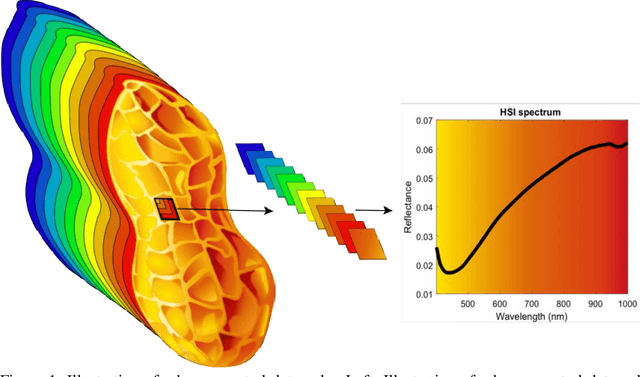
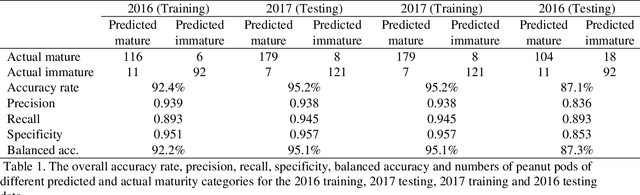
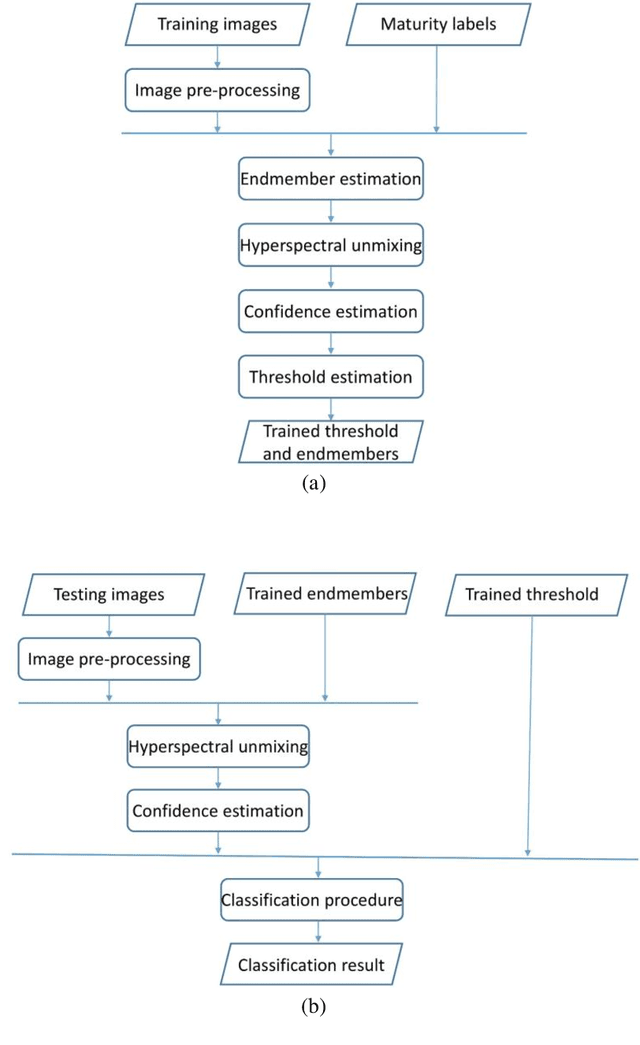
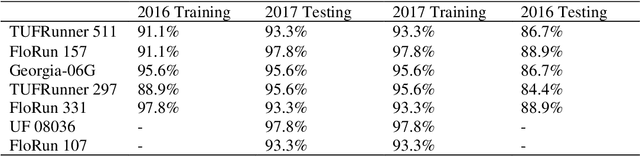
Seed maturity in peanut (Arachis hypogaea L.) determines economic return to a producer because of its impact on seed weight (yield), and critically influences seed vigor and other quality characteristics. During seed development, the inner mesocarp layer of the pericarp (hull) transitions in color from white to black as the seed matures. The maturity assessment process involves the removal of the exocarp of the hull and visually categorizing the mesocarp color into varying color classes from immature (white, yellow, orange) to mature (brown, and black). This visual color classification is time consuming because the exocarp must be manually removed. In addition, the visual classification process involves human assessment of colors, which leads to large variability of color classification from observer to observer. A more objective, digital imaging approach to peanut maturity is needed, optimally without the requirement of removal of the hull's exocarp. This study examined the use of a hyperspectral imaging (HSI) process to determine pod maturity with intact pericarps. The HSI method leveraged spectral differences between mature and immature pods within a classification algorithm to identify the mature and immature pods. The results showed a high classification accuracy with consistency using samples from different years and cultivars. In addition, the proposed method was capable of estimating a continuous-valued, pixel-level maturity value for individual peanut pods, allowing for a valuable tool that can be utilized in seed quality research. This new method solves issues of labor intensity and subjective error that all current methods of peanut maturity determination have.