 Add to Chrome
 Add to Firefox
 Add to Edge
HP2-SLAM: Adaptive Hybrid ICP for Robust and Efficient LiDAR SLAM
Aug 15, 2026
Achieving robustness, accuracy, and efficiency simultaneously remains a central challenge in light detection and ranging (LiDAR) simultaneous localization and mapping (SLAM). While learning-based approaches deliver strong benchmark performance, they often require extensive training, substantial computational resources, and struggle to generalize to unseen or degenerate environments. Geometry-based methods are efficient and interpretable, yet their performance degrades in planar or repetitive scenes due to limitations of standard iterative closest point (ICP) formulations. We present HP2-SLAM, a minimalist yet robust LiDAR SLAM framework built around a neighborhood-size adaptive hybrid ICP. Our key insight is a planarity-aware adaptive threshold that dynamically classifies correspondences based on local geometric structure and density, thereby enabling a principled balance between point-to-plane and point-to-point residuals. This formulation stabilizes alignment in both structured and degenerate environments without feature engineering, learning modules, or dataset-specific tuning. Integrated into a complete SLAM pipeline with submap management, loop closure detection, and pose graph optimization, HP2-SLAM consistently outperforms strong geometry-based baselines across publicly available datasets while maintaining real-time performance on commodity hardware. Our results demonstrate that carefully designed geometric adaptation can achieve strong generalization and robustness without sacrificing simplicity or efficiency.

Rectifying Mask via Entropy for Distractor-Free 3DGS in Ambiguous Scenarios
Jun 28, 2026We present RefineSplat, a systematic framework that effectively constructs transient masks to identify diverse ambiguous distractors. To do this, we qualitatively and quantitatively analyze issues and propose a novel entropy-aware adaptive masking method. Unlike existing approaches that struggle to distinguish transient elements from static scenes due to color or semantic ambiguity, RefineSplat captures ambiguous distractors leveraging entropy and instance masks. Furthermore, we propose a simple yet effective entropy-aware density control to align Gaussians in ambiguous scenarios considering Entropy-aware positional gradients. Additionally, to rigorously validate our method, we first create and release the Ambiguous wild dataset, including 18 scenes where distractors and static scenes are hard to distinguish due to color or semantic resemblances. Experimental results on various datasets demonstrate that RefineSplat shows state-of-the-art performance, showing distractor-free novel view synthesis.
Simulation-Based Multi-Fillet Evaluation of Woody Breast Poultry Fillets
Jun 15, 2026Woody breast (WB) is a myopathy in modern broiler chickens that causes the breast muscle to become unusually stiff and fibrous, leading to decreased meat quality and significant economic losses. State-of-the-art automated WB detection relies on a side-view imaging system to analyze the bending behavior of a single fillet as it falls off a conveyor belt. While highly accurate, this approach is constrained by its single-fillet field of view, creating throughput bottlenecks on commercial processing lines. In this paper, we address this limitation via a novel multi-fillet detection architecture utilizing a top-down camera configuration. To validate our approach, we first develop a high-fidelity digital twin of an industrial conveyor system. Next, we synthesize a diverse dataset of 3D fillet meshes and model their viscoelastic bending dynamics using a physics-based simulation engine. Lastly, a continuous 2D shape deformation score is extracted from the top-down perspective as the simulated fillets traverse the roller precipice. Experimental results demonstrate that the top-down shape score effectively captures the contour changes of the fillets as it bends, providing a robust and scalable alternative to a side-view imaging system for simultaneous multi-fillet WB evaluation.
Energy-Based Open-Set Active Learning for Object Classification
Apr 22, 2026Active learning (AL) has emerged as a crucial methodology for minimizing labeling costs in deep learning by selecting the most valuable samples from a pool of unlabeled data for annotation. Traditional AL operates under a closed-set assumption, where all classes in the dataset are known and consistent. However, real-world scenarios often present open-set conditions in which unlabeled data contains both known and unknown classes. In such environments, standard AL techniques struggle. They can mistakenly query samples from unknown categories, leading to inefficient use of annotation budgets. In this paper, we propose a novel dual-stage energy-based framework for open-set AL. Our method employs two specialized energy-based models (EBMs). The first, an energy-based known/unknown separator, filters out samples likely to belong to unknown classes. The second, an energy-based sample scorer, assesses the informativeness of the filtered known samples. Using the energy landscape, our models distinguish between data points from known and unknown classes in the unlabeled pool by assigning lower energy to known samples and higher energy to unknown samples, ensuring that only samples from classes of interest are selected for labeling. By integrating these components, our approach ensures efficient and targeted sample selection, maximizing learning impact in each iteration. Experiments on 2D (CIFAR-10, CIFAR-100, TinyImageNet) and 3D (ModelNet40) object classification benchmarks demonstrates that our framework outperforms existing approaches, achieving superior annotation efficiency and classification performance in open-set environments.
UEOF: A Benchmark Dataset for Underwater Event-Based Optical Flow
Jan 15, 2026Underwater imaging is fundamentally challenging due to wavelength-dependent light attenuation, strong scattering from suspended particles, turbidity-induced blur, and non-uniform illumination. These effects impair standard cameras and make ground-truth motion nearly impossible to obtain. On the other hand, event cameras offer microsecond resolution and high dynamic range. Nonetheless, progress on investigating event cameras for underwater environments has been limited due to the lack of datasets that pair realistic underwater optics with accurate optical flow. To address this problem, we introduce the first synthetic underwater benchmark dataset for event-based optical flow derived from physically-based ray-traced RGBD sequences. Using a modern video-to-event pipeline applied to rendered underwater videos, we produce realistic event data streams with dense ground-truth flow, depth, and camera motion. Moreover, we benchmark state-of-the-art learning-based and model-based optical flow prediction methods to understand how underwater light transport affects event formation and motion estimation accuracy. Our dataset establishes a new baseline for future development and evaluation of underwater event-based perception algorithms. The source code and dataset for this project are publicly available at https://robotic-vision-lab.github.io/ueof.
CropNeRF: A Neural Radiance Field-Based Framework for Crop Counting
Jan 01, 2026Rigorous crop counting is crucial for effective agricultural management and informed intervention strategies. However, in outdoor field environments, partial occlusions combined with inherent ambiguity in distinguishing clustered crops from individual viewpoints poses an immense challenge for image-based segmentation methods. To address these problems, we introduce a novel crop counting framework designed for exact enumeration via 3D instance segmentation. Our approach utilizes 2D images captured from multiple viewpoints and associates independent instance masks for neural radiance field (NeRF) view synthesis. We introduce crop visibility and mask consistency scores, which are incorporated alongside 3D information from a NeRF model. This results in an effective segmentation of crop instances in 3D and highly-accurate crop counts. Furthermore, our method eliminates the dependence on crop-specific parameter tuning. We validate our framework on three agricultural datasets consisting of cotton bolls, apples, and pears, and demonstrate consistent counting performance despite major variations in crop color, shape, and size. A comparative analysis against the state of the art highlights superior performance on crop counting tasks. Lastly, we contribute a cotton plant dataset to advance further research on this topic.
CropTrack: A Tracking with Re-Identification Framework for Precision Agriculture
Dec 31, 2025Multiple-object tracking (MOT) in agricultural environments presents major challenges due to repetitive patterns, similar object appearances, sudden illumination changes, and frequent occlusions. Contemporary trackers in this domain rely on the motion of objects rather than appearance for association. Nevertheless, they struggle to maintain object identities when targets undergo frequent and strong occlusions. The high similarity of object appearances makes integrating appearance-based association nontrivial for agricultural scenarios. To solve this problem we propose CropTrack, a novel MOT framework based on the combination of appearance and motion information. CropTrack integrates a reranking-enhanced appearance association, a one-to-many association with appearance-based conflict resolution strategy, and an exponential moving average prototype feature bank to improve appearance-based association. Evaluated on publicly available agricultural MOT datasets, CropTrack demonstrates consistent identity preservation, outperforming traditional motion-based tracking methods. Compared to the state of the art, CropTrack achieves significant gains in identification F1 and association accuracy scores with a lower number of identity switches.
Inertia-Informed Orientation Priors for Event-Based Optical Flow Estimation
Nov 17, 2025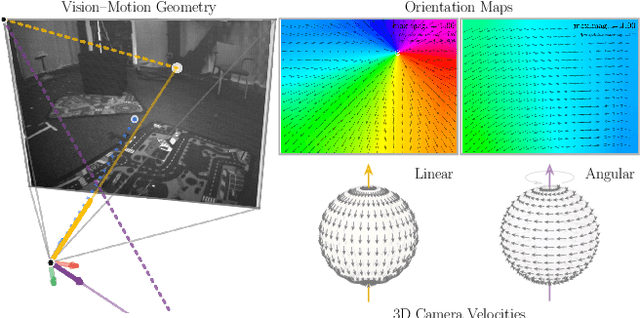
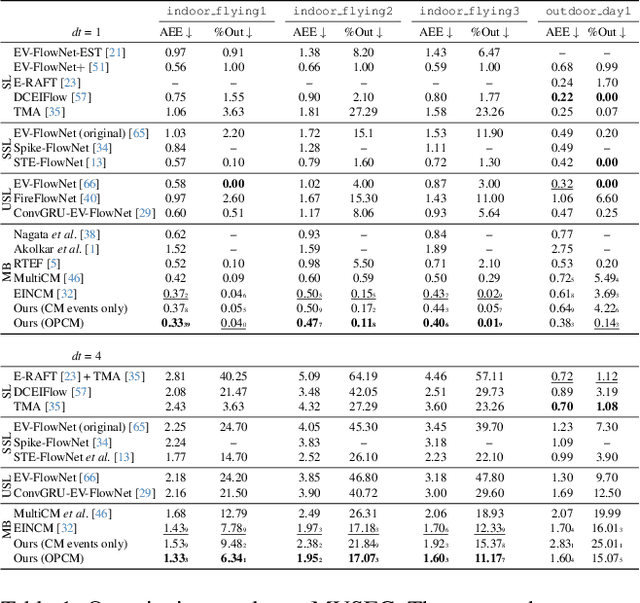
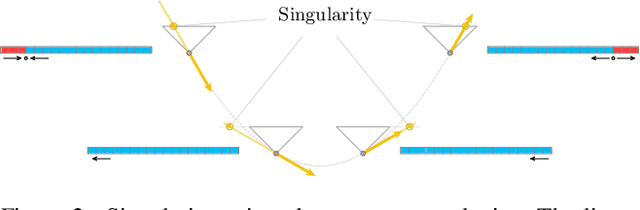
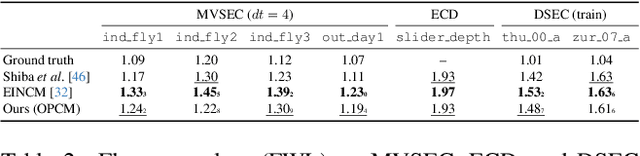
Event cameras, by virtue of their working principle, directly encode motion within a scene. Many learning-based and model-based methods exist that estimate event-based optical flow, however the temporally dense yet spatially sparse nature of events poses significant challenges. To address these issues, contrast maximization (CM) is a prominent model-based optimization methodology that estimates the motion trajectories of events within an event volume by optimally warping them. Since its introduction, the CM framework has undergone a series of refinements by the computer vision community. Nonetheless, it remains a highly non-convex optimization problem. In this paper, we introduce a novel biologically-inspired hybrid CM method for event-based optical flow estimation that couples visual and inertial motion cues. Concretely, we propose the use of orientation maps, derived from camera 3D velocities, as priors to guide the CM process. The orientation maps provide directional guidance and constrain the space of estimated motion trajectories. We show that this orientation-guided formulation leads to improved robustness and convergence in event-based optical flow estimation. The evaluation of our approach on the MVSEC, DSEC, and ECD datasets yields superior accuracy scores over the state of the art.
Secrets of Edge-Informed Contrast Maximization for Event-Based Vision
Sep 22, 2024Event cameras capture the motion of intensity gradients (edges) in the image plane in the form of rapid asynchronous events. When accumulated in 2D histograms, these events depict overlays of the edges in motion, consequently obscuring the spatial structure of the generating edges. Contrast maximization (CM) is an optimization framework that can reverse this effect and produce sharp spatial structures that resemble the moving intensity gradients by estimating the motion trajectories of the events. Nonetheless, CM is still an underexplored area of research with avenues for improvement. In this paper, we propose a novel hybrid approach that extends CM from uni-modal (events only) to bi-modal (events and edges). We leverage the underpinning concept that, given a reference time, optimally warped events produce sharp gradients consistent with the moving edge at that time. Specifically, we formalize a correlation-based objective to aid CM and provide key insights into the incorporation of multiscale and multireference techniques. Moreover, our edge-informed CM method yields superior sharpness scores and establishes new state-of-the-art event optical flow benchmarks on the MVSEC, DSEC, and ECD datasets.
Semi-Supervised Variational Adversarial Active Learning via Learning to Rank and Agreement-Based Pseudo Labeling
Aug 23, 2024


Active learning aims to alleviate the amount of labor involved in data labeling by automating the selection of unlabeled samples via an acquisition function. For example, variational adversarial active learning (VAAL) leverages an adversarial network to discriminate unlabeled samples from labeled ones using latent space information. However, VAAL has the following shortcomings: (i) it does not exploit target task information, and (ii) unlabeled data is only used for sample selection rather than model training. To address these limitations, we introduce novel techniques that significantly improve the use of abundant unlabeled data during training and take into account the task information. Concretely, we propose an improved pseudo-labeling algorithm that leverages information from all unlabeled data in a semi-supervised manner, thus allowing a model to explore a richer data space. In addition, we develop a ranking-based loss prediction module that converts predicted relative ranking information into a differentiable ranking loss. This loss can be embedded as a rank variable into the latent space of a variational autoencoder and then trained with a discriminator in an adversarial fashion for sample selection. We demonstrate the superior performance of our approach over the state of the art on various image classification and segmentation benchmark datasets.