 Add to Chrome
 Add to Firefox
 Add to Edge
System Identification under Constraints and Disturbance: A Bayesian Estimation Approach
Feb 18, 2026
We introduce a Bayesian system identification (SysID) framework for jointly estimating robot's state trajectories and physical parameters with high accuracy. It embeds physically consistent inverse dynamics, contact and loop-closure constraints, and fully featured joint friction models as hard, stage-wise equality constraints. It relies on energy-based regressors to enhance parameter observability, supports both equality and inequality priors on inertial and actuation parameters, enforces dynamically consistent disturbance projections, and augments proprioceptive measurements with energy observations to disambiguate nonlinear friction effects. To ensure scalability, we derive a parameterized equality-constrained Riccati recursion that preserves the banded structure of the problem, achieving linear complexity in the time horizon, and develop computationally efficient derivatives. Simulation studies on representative robotic systems, together with hardware experiments on a Unitree B1 equipped with a Z1 arm, demonstrate faster convergence, lower inertial and friction estimation errors, and improved contact consistency compared to forward-dynamics and decoupled identification baselines. When deployed within model predictive control frameworks, the resulting models yield measurable improvements in tracking performance during locomotion over challenging environments.

ODYN: An All-Shifted Non-Interior-Point Method for Quadratic Programming in Robotics and AI
Feb 17, 2026We introduce ODYN, a novel all-shifted primal-dual non-interior-point quadratic programming (QP) solver designed to efficiently handle challenging dense and sparse QPs. ODYN combines all-shifted nonlinear complementarity problem (NCP) functions with proximal method of multipliers to robustly address ill-conditioned and degenerate problems, without requiring linear independence of the constraints. It exhibits strong warm-start performance and is well suited to both general-purpose optimization, and robotics and AI applications, including model-based control, estimation, and kernel-based learning methods. We provide an open-source implementation and benchmark ODYN on the Maros-Mészáros test set, demonstrating state-of-the-art convergence performance in small-to-high-scale problems. The results highlight ODYN's superior warm-starting capabilities, which are critical in sequential and real-time settings common in robotics and AI. These advantages are further demonstrated by deploying ODYN as the backend of an SQP-based predictive control framework (OdynSQP), as the implicitly differentiable optimization layer for deep learning (ODYNLayer), and the optimizer of a contact-dynamics simulation (ODYNSim).
Endpoint-Explicit Differential Dynamic Programming via Exact Resolution
Mar 05, 2025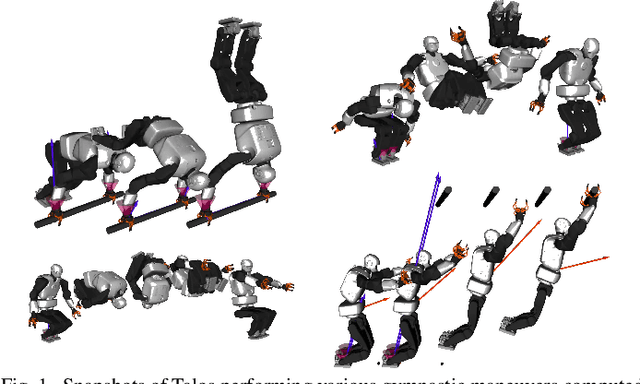
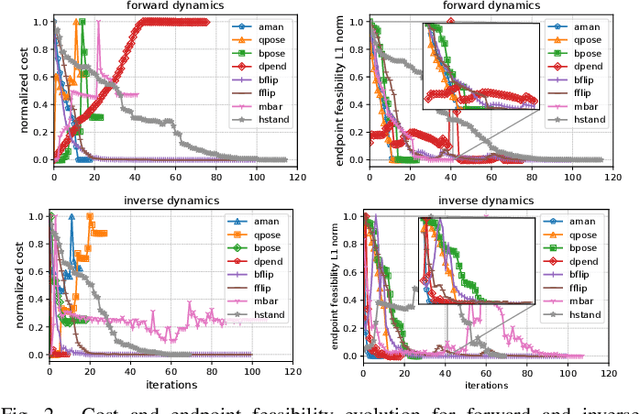
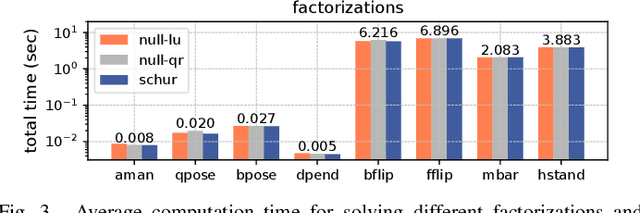
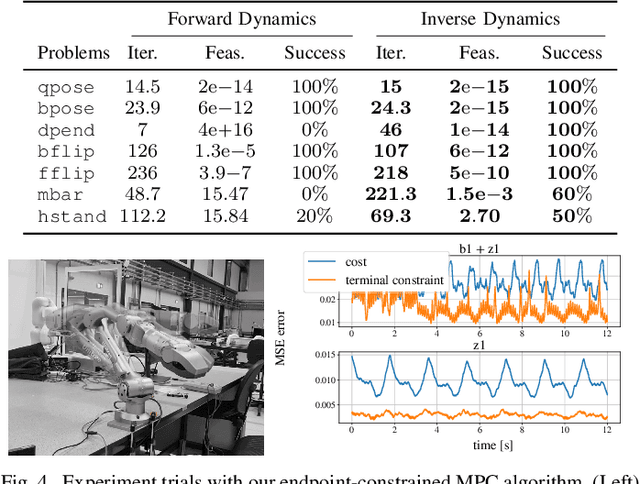
We introduce a novel method for handling endpoint constraints in constrained differential dynamic programming (DDP). Unlike existing approaches, our method guarantees quadratic convergence and is exact, effectively managing rank deficiencies in both endpoint and stagewise equality constraints. It is applicable to both forward and inverse dynamics formulations, making it particularly well-suited for model predictive control (MPC) applications and for accelerating optimal control (OC) solvers. We demonstrate the efficacy of our approach across a broad range of robotics problems and provide a user-friendly open-source implementation within CROCODDYL.
* 7 pages, IEEE ICRA paper
Multi-Contact Inertial Estimation and Localization in Legged Robots
Mar 25, 2024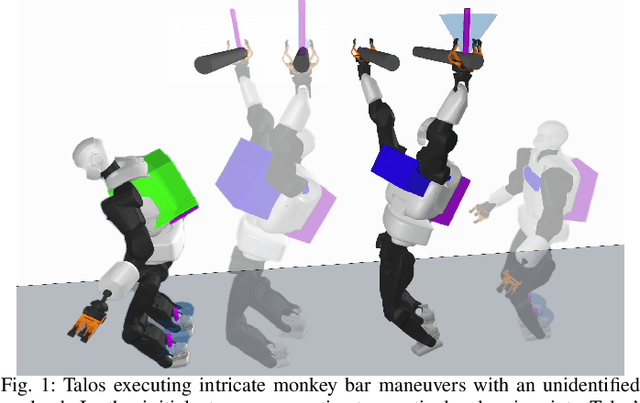
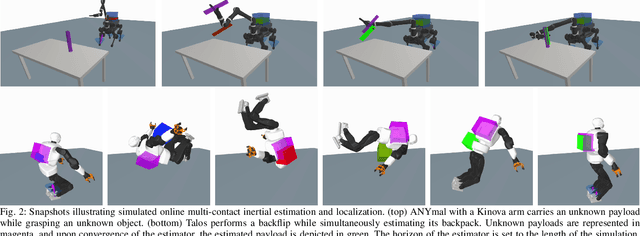
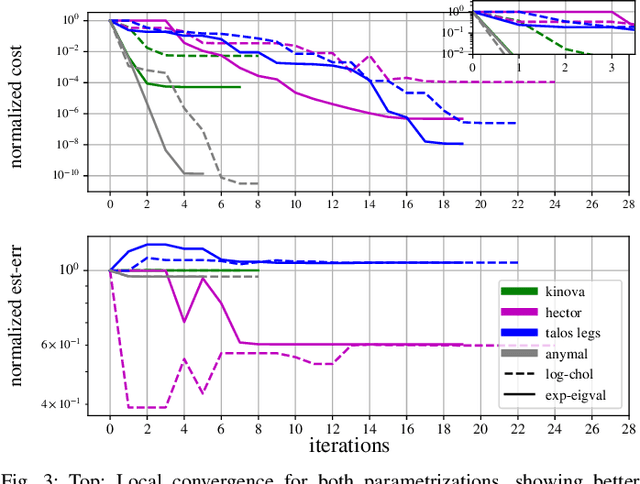
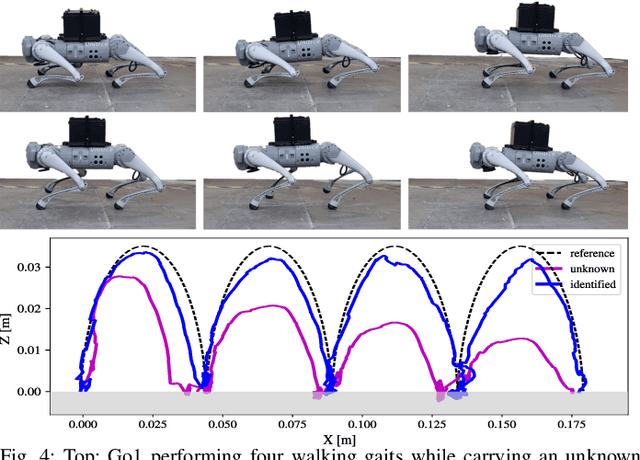
Optimal estimation is a promising tool for multi-contact inertial estimation and localization. To harness its advantages in robotics, it is crucial to solve these large and challenging optimization problems efficiently. To tackle this, we (i) develop a multiple-shooting solver that exploits both temporal and parametric structures through a parametrized Riccati recursion. Additionally, we (ii) propose an inertial local manifold that ensures its full physical consistency. It also enhances convergence compared to the singularity-free log-Cholesky approach. To handle its singularities, we (iii) introduce a nullspace approach in our optimal estimation solver. We (iv) finally develop the analytical derivatives of contact dynamics for both inertial parametrizations. Our framework can successfully solve estimation problems for complex maneuvers such as brachiation in humanoids. We demonstrate its numerical capabilities across various robotics tasks and its benefits in experimental trials with the Go1 robot.