 Add to Chrome
 Add to Firefox
 Add to Edge
Associative Emotional Learning in Convolutional Neural Networks
Jul 21, 2026
Associative emotional learning enables organisms to adaptively link pleasant or unpleasant outcomes to the presence of predictive stimuli. Whereas computational models such as the Rescorla-Wagner model have shed light on this important function, the limitations of these models are also known, especially when they are applied to neural data. The advent of deep neural networks has opened another avenue for modeling associative emotional learning. In this work we proposed a deep neural network model of visual valence processing, consisting of a visual module that encodes complex natural scenes and a module that recognizes their emotional significance in terms of valence, a key dimension of emotion, and tested a novel Pavlovian learning paradigm on the model. The results showed that with learning, the model reproduced several observations from human associative learning studies, including association formation and generalization, and that the neural representations of the conditioned and the unconditioned stimuli became increasingly aligned both at the single unit and at the neural population level. Comparison between the model and human experimental data provided further validation of our approach. This study thus suggests that deep neural network models, when combined with appropriate learning algorithms, can be used to model behavioral and neural signatures of associative emotion/valence learning.

REVEAL++: Differentiable Phenotypic Grouping for Vision-Language Retinal Modeling of Alzheimer's Disease Risk
Jun 17, 2026The retina offers a noninvasive window into neurodegenerative disease, capturing subtle structural patterns associated with a risk of future cognitive decline. Vision-language alignment frameworks such as REVEAL have shown that pairing retinal fundus images with structured clinical risk narratives improves early prediction of Alzheimer's disease (AD). A key design choice in these approaches is the use of phenotypic grouping, where individuals with similar risk profiles are treated as multi-positive pairs during contrastive learning. However, existing methods operationalize phenotypic similarity as a discrete construct, relying on hard group assignments that impose rigid supervision and decouple group formation from representation learning. We propose a continuous formulation of phenotypic structure within contrastive learning. Rather than assigning samples to fixed clusters, we model inter-subject similarity as a differentiable weighting function derived from intra-modality embedding similarities in both retinal images and risk profiles. These weights define soft multi-positive relationships through a continuous aggregation operator, enabling graded supervision that reflects the spectrum nature of disease risk. We further introduce a soft-target contrastive objective that jointly learns cross-modal alignment and phenotypic structure in an end-to-end manner. Evaluated on UK Biobank retinal imaging data for incident AD prediction, the proposed framework consistently outperforms discrete group-based contrastive learning and standard vision-language baselines. By treating phenotypic similarity as a learnable, continuous signal rather than a fixed grouping rule, our approach provides a principled and robust foundation for population-scale neurodegenerative risk modeling from multi-modal retinal and clinical data.
REVEAL: Multimodal Vision-Language Alignment of Retinal Morphometry and Clinical Risks for Incident AD and Dementia Prediction
Apr 20, 2026The retina provides a unique, noninvasive window into Alzheimer's disease (AD) and dementia, capturing early structural changes through morphometric features, while systemic and lifestyle risk factors reflect well-established contributors to disease susceptibility long before clinical symptom onset. However, current retinal analysis frameworks typically model imaging and risk factors separately, limiting their ability to capture joint multimodal patterns critical for early risk prediction. Moreover, existing methods rarely incorporate mechanisms to organize or align patients with similar retinal and clinical characteristics, constraining the learning of coherent cross-modal associations. To address these limitations, we introduce REVEAL (REtinal-risk Vision-Language Early Alzheimer's Learning), a framework that aligns color fundus photographs with individualized disease-specific risk profiles for predicting incident AD and dementia, on average 8 years before diagnosis (range: 1-11 years). Because real-world risk factors are structured questionnaire data, we translate them into clinically interpretable narratives compatible with pretrained vision-language models (VLMs). We further propose a group-aware contrastive learning (GACL) strategy that clusters patients with similar retinal morphometry and risk factors as positive pairs, strengthening multimodal alignment. This unified representation learning framework substantially outperforms state-of-the-art retinal imaging models paired with clinical text encoders, as well as general-purpose VLMs, demonstrating the value of jointly modeling retinal biomarkers and clinical risk factors. By providing a generalizable and noninvasive approach for early AD and dementia risk stratification, REVEAL has the potential to enable earlier intervention and improve preventive care at the population level.
From edges to meaning: Semantic line sketches as a cognitive scaffold for ancient pictograph invention
Apr 14, 2026Humans readily recognize objects from sparse line drawings, a capacity that appears early in development and persists across cultures, suggesting neural rather than purely learned origins. Yet the computational mechanism by which the brain transforms high-level semantic knowledge into low-level visual symbols remains poorly understood. Here we propose that ancient pictographic writing emerged from the brain's intrinsic tendency to compress visual input into stable, boundary-based abstractions. We construct a biologically inspired digital twin of the visual hierarchy that encodes an image into low-level features, generates a contour sketch, and iteratively refines it through top-down feedback guided by semantic representations, mirroring the feedforward and recurrent architecture of the human visual cortex. The resulting symbols bear striking structural resemblance to early pictographs across culturally distant writing systems, including Egyptian hieroglyphs, Chinese oracle bone characters, and proto-cuneiform, and offer candidate interpretations for undeciphered scripts. Our findings support a neuro-computational origin of pictographic writing and establish a framework in which AI can recapitulate the cognitive processes by which humans first externalized perception into symbols.
A Comprehensive Survey of Foundation Models in Medicine
Jun 15, 2024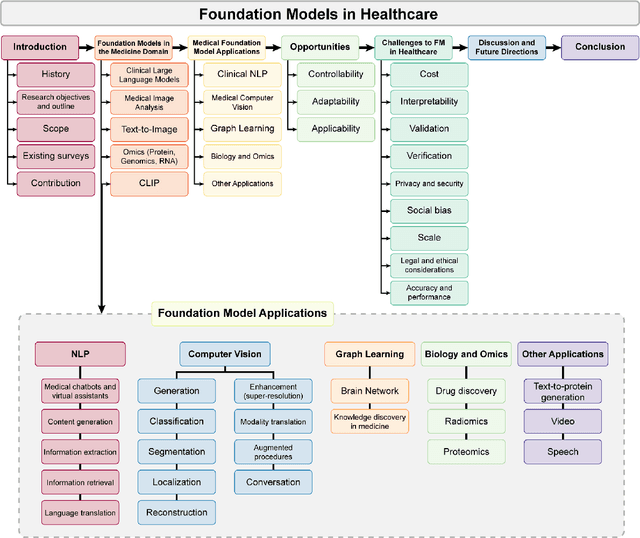
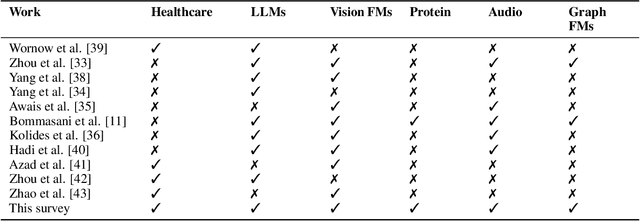
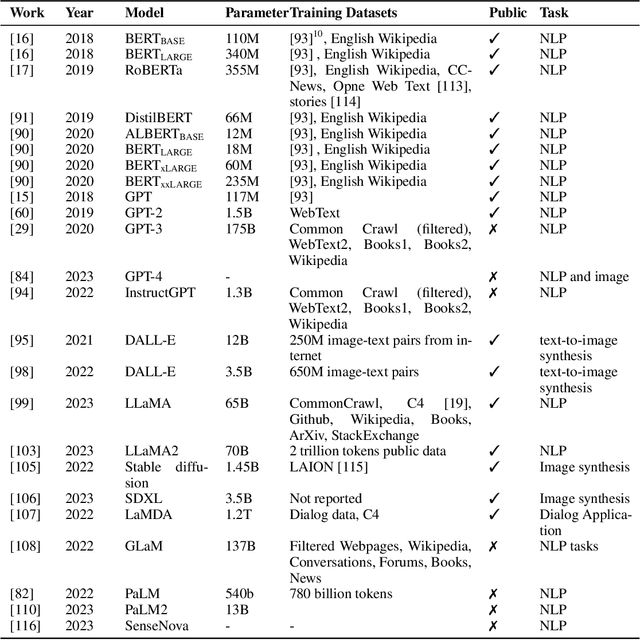
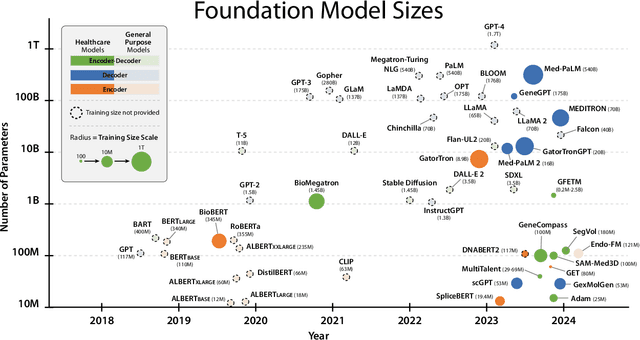
Foundation models (FMs) are large-scale deep-learning models trained on extensive datasets using self-supervised techniques. These models serve as a base for various downstream tasks, including healthcare. FMs have been adopted with great success across various domains within healthcare, including natural language processing (NLP), computer vision, graph learning, biology, and omics. Existing healthcare-based surveys have not yet included all of these domains. Therefore, this survey provides a comprehensive overview of FMs in healthcare. We focus on the history, learning strategies, flagship models, applications, and challenges of FMs. We explore how FMs such as the BERT and GPT families are reshaping various healthcare domains, including clinical large language models, medical image analysis, and omics data. Furthermore, we provide a detailed taxonomy of healthcare applications facilitated by FMs, such as clinical NLP, medical computer vision, graph learning, and other biology-related tasks. Despite the promising opportunities FMs provide, they also have several associated challenges, which are explained in detail. We also outline potential future directions to provide researchers and practitioners with insights into the potential and limitations of FMs in healthcare to advance their deployment and mitigate associated risks.