 Add to Chrome
 Add to Firefox
 Add to Edge
Memory-Bounded Continuation of Greedy Sampling for Continual Anomaly Detection
Aug 15, 2026
Greedy sampling produces a compact yet representative summary of normal data, which is essential for reliable anomaly detection that relies on measuring distance from normality. For continual anomaly detection where tasks arrive sequentially, extending greedy sampling is straightforward with unbounded memory through coreset accumulation. However, practical deployment requires fixed memory where the coreset size remains constant regardless of task count. We observe that continued greedy sampling, which iteratively applies greedy selection over previously greedy-sampled sets, effectively preserves representativeness under strict memory limits. Despite discarding data at each step to satisfy the memory constraint, coreset quality degrades gracefully rather than catastrophically, enabling reliable anomaly detection across the tasks. We provide theoretical justification by showing that resulting greedy-continued coreset approximates the oracle coreset within a bounded gap. We instantiate this principle in ContCore, which constructs a greedy-continued coreset through greedy expansion on new task features followed by greedy consolidation to enforce the memory budget. Unlike neural methods susceptible to catastrophic forgetting or naive coreset accumulation requiring unbounded memory, ContCore maintains fixed memory with theoretical guarantees. Empirically, ContCore achieves state-of-the-art performance across 11 task schedules on MVTecAD and VisA, and extends effectively to online continual AD settings where prior methods degrade significantly. Code: https://github.com/jungyg/ContCore

Memory-Distilled Selection for Noise-Robust Anomaly Detection
May 26, 2026Anomaly detection (AD) under data contamination is critical for deploying unsupervised defect detection in industrial environments, where curating perfectly clean training sets is impractical. However, existing methods are sensitive to contamination, suffering significant performance degradation as the noise ratio increases. In this paper, we propose Memory-Distilled Selection (MeDS), a training algorithm based on data selection. MeDS constructs an ensemble of partial memories via random subsampling, where the resulting sparsity acts as a low-pass filter that captures nominal patterns across a wide range of noise ratios, enabling coarse-level identification of contaminated samples. The aggregated distances to the bootstrapped memories are then distilled into a reconstruction score network, which is subsequently fine-tuned on clean data filtered using scores from the distilled model, enabling fine-grained localization of anomalies. MeDS is robust across a wide range of noise ratios without requiring noise-ratio-specific hyperparameter tuning, achieving 99.16\% image-level AUROC on MVTecAD at a 40\% noise ratio, and attaining state-of-the-art performance on both VisA and Real-IAD under noisy settings. We thoroughly verify the efficacy of MeDS on industrial AD benchmarks under noisy data scenarios, accompanied by in-depth empirical analyses.
Revisiting DDIM Inversion for Controlling Defect Generation by Disentangling the Background
Nov 25, 2024In anomaly detection, the scarcity of anomalous data compared to normal data poses a challenge in effectively utilizing deep neural network representations to identify anomalous features. From a data-centric perspective, generative models can solve this data imbalance issue by synthesizing anomaly datasets. Although previous research tried to enhance the controllability and quality of generating defects, they do not consider the relation between background and defect. Since the defect depends on the object's background (i.e., the normal part of an object), training only the defect area cannot utilize the background information, and even generation can be biased depending on the mask information. In addition, controlling logical anomalies should consider the dependency between background and defect areas (e.g., orange colored defect on a orange juice bottle). In this paper, our paper proposes modeling a relationship between the background and defect, where background affects denoising defects; however, the reverse is not. We introduce the regularizing term to disentangle denoising background from defects. From the disentanglement loss, we rethink defect generation with DDIM Inversion, where we generate the defect on the target normal image. Additionally, we theoretically prove that our methodology can generate a defect on the target normal image with an invariant background. We demonstrate our synthetic data is realistic and effective in several experiments.
MSANet: Multi-Similarity and Attention Guidance for Boosting Few-Shot Segmentation
Jun 20, 2022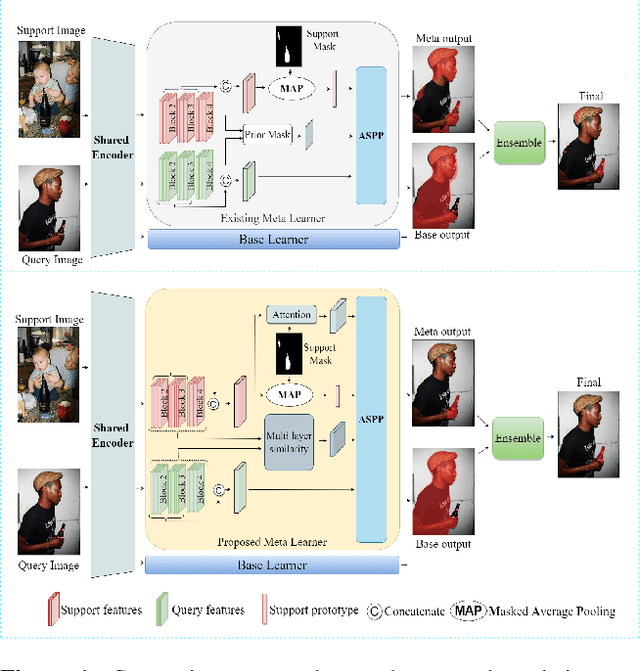
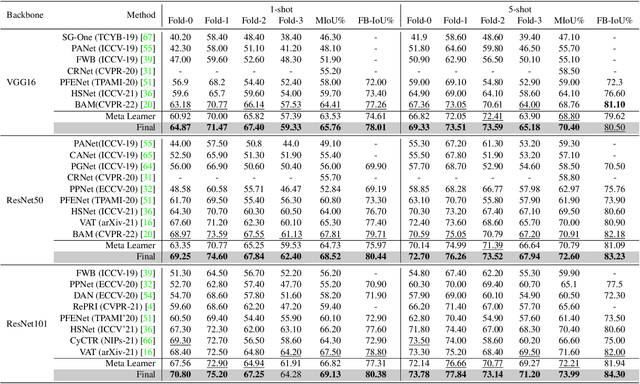
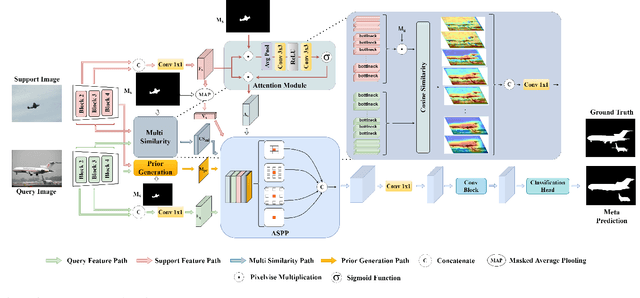
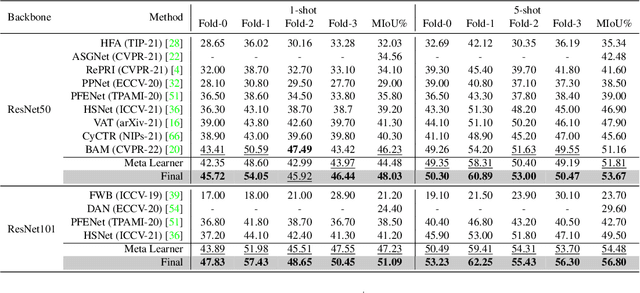
Few-shot segmentation aims to segment unseen-class objects given only a handful of densely labeled samples. Prototype learning, where the support feature yields a singleor several prototypes by averaging global and local object information, has been widely used in FSS. However, utilizing only prototype vectors may be insufficient to represent the features for all training data. To extract abundant features and make more precise predictions, we propose a Multi-Similarity and Attention Network (MSANet) including two novel modules, a multi-similarity module and an attention module. The multi-similarity module exploits multiple feature-maps of support images and query images to estimate accurate semantic relationships. The attention module instructs the network to concentrate on class-relevant information. The network is tested on standard FSS datasets, PASCAL-5i 1-shot, PASCAL-5i 5-shot, COCO-20i 1-shot, and COCO-20i 5-shot. The MSANet with the backbone of ResNet-101 achieves the state-of-the-art performance for all 4-benchmark datasets with mean intersection over union (mIoU) of 69.13%, 73.99%, 51.09%, 56.80%, respectively. Code is available at https://github.com/AIVResearch/MSANet