 Add to Chrome
 Add to Firefox
 Add to Edge
Optimization-based Safe Trajectory Planning for Autonomous Ground Vehicle in Multi-Floor Scenarios
Jun 23, 2026
The development of trajectory planning strategies for autonomous ground vehicles (AGVs) represents a prevailing research interest within the domain of intelligent transportation systems. This paper introduces a trajectory planning framework tailored for multi-floor scenarios. The framework consists of two main modules: the task planning module and the trajectory planning module. The task planning module involves a strategic selection phase, where a task planning strategy based on generalized voronoi diagrams (GVD) and multi-objective algorithms is proposed to select the floor exits for each floor. The trajectory planning module utilizes optimization-based methods to generate high-quality trajectories, and a warm-started hierarchical planning framework is designed to ensure rapid convergence. Additionally, for handling complex obstacle constraints, a correlation constraint calculation method is designed for reducing obstacle constraints in trajectory planning. Finally, the feasibility and effectiveness of the proposed framework are verified through simulations.

A Transformer-based Generative Adversarial Network for Brain Tumor Segmentation
Jul 29, 2022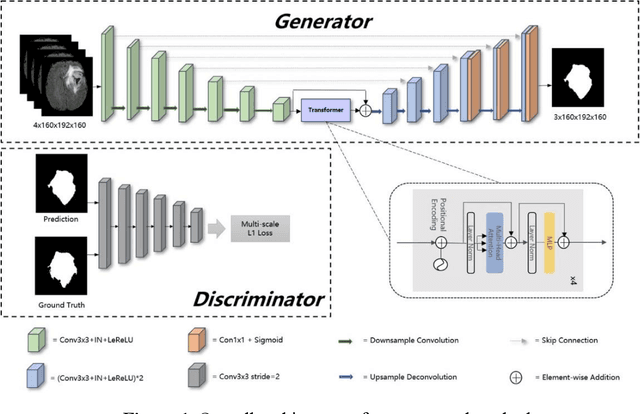
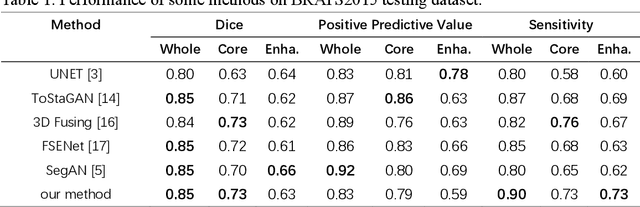
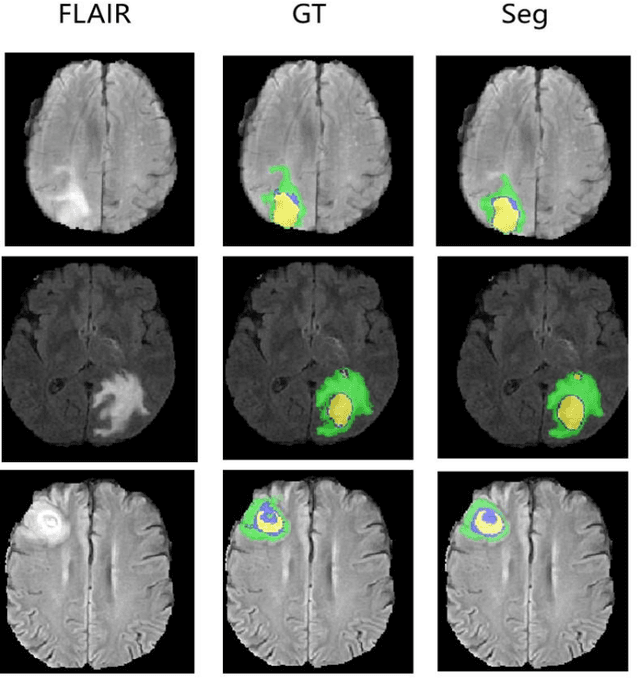
Brain tumor segmentation remains a challenge in medical image segmentation tasks. With the application of transformer in various computer vision tasks, transformer blocks show the capability of learning long-distance dependency in global space, which is complementary with CNNs. In this paper, we proposed a novel transformer-based generative adversarial network to automatically segment brain tumors with multi-modalities MRI. Our architecture consists of a generator and a discriminator, which are trained in min-max game progress. The generator is based on a typical "U-shaped" encoder-decoder architecture, whose bottom layer is composed of transformer blocks with resnet. Besides, the generator is trained with deep supervision technology. The discriminator we designed is a CNN-based network with multi-scale $L_{1}$ loss, which is proved to be effective for medical semantic image segmentation. To validate the effectiveness of our method, we conducted experiments on BRATS2015 dataset, achieving comparable or better performance than previous state-of-the-art methods.