 Add to Chrome
 Add to Firefox
 Add to Edge
Model Predictive Path Integral PID Control for Learning-Based Path Following
Mar 31, 2026
Classical proportional--integral--derivative (PID) control is widely employed in industrial applications; however, achieving higher performance often motivates the adoption of model predictive control (MPC). Although gradient-based methods are the standard for real-time optimization, sampling-based approaches have recently gained attention. In particular, model predictive path integral (MPPI) control enables gradient-free optimization and accommodates non-differentiable models and objective functions. However, directly sampling control input sequences may yield discontinuous inputs and increase the optimization dimensionality in proportion to the prediction horizon. This study proposes MPPI--PID control, which applies MPPI to optimize PID gains at each control step, thereby replacing direct high-dimensional input-sequence optimization with low-dimensional gain-space optimization. This formulation enhances sample efficiency and yields smoother inputs via the PID structure. We also provide theoretical insights, including an information-theoretic interpretation that unifies MPPI and MPPI--PID, an analysis of the effect of optimization dimensionality on sample efficiency, and a characterization of input continuity induced by the PID structure. The proposed method is evaluated on the learning-based path following of a mini forklift using a residual-learning dynamics model that integrates a physical model with a neural network. System identification is performed with real driving data. Numerical path-following experiments demonstrate that MPPI--PID improves tracking performance compared with fixed-gain PID and achieves performance comparable to conventional MPPI while significantly reducing input increments. Furthermore, the proposed method maintains favorable performance even with substantially fewer samples, demonstrating its improved sample efficiency.

Split Matching for Inductive Zero-shot Semantic Segmentation
May 08, 2025Zero-shot Semantic Segmentation (ZSS) aims to segment categories that are not annotated during training. While fine-tuning vision-language models has achieved promising results, these models often overfit to seen categories due to the lack of supervision for unseen classes. As an alternative to fully supervised approaches, query-based segmentation has shown great latent in ZSS, as it enables object localization without relying on explicit labels. However, conventional Hungarian matching, a core component in query-based frameworks, needs full supervision and often misclassifies unseen categories as background in the setting of ZSS. To address this issue, we propose Split Matching (SM), a novel assignment strategy that decouples Hungarian matching into two components: one for seen classes in annotated regions and another for latent classes in unannotated regions (referred to as unseen candidates). Specifically, we partition the queries into seen and candidate groups, enabling each to be optimized independently according to its available supervision. To discover unseen candidates, we cluster CLIP dense features to generate pseudo masks and extract region-level embeddings using CLS tokens. Matching is then conducted separately for the two groups based on both class-level similarity and mask-level consistency. Additionally, we introduce a Multi-scale Feature Enhancement (MFE) module that refines decoder features through residual multi-scale aggregation, improving the model's ability to capture spatial details across resolutions. SM is the first to introduce decoupled Hungarian matching under the inductive ZSS setting, and achieves state-of-the-art performance on two standard benchmarks.
Visual-Based Forklift Learning System Enabling Zero-Shot Sim2Real Without Real-World Data
Dec 16, 2024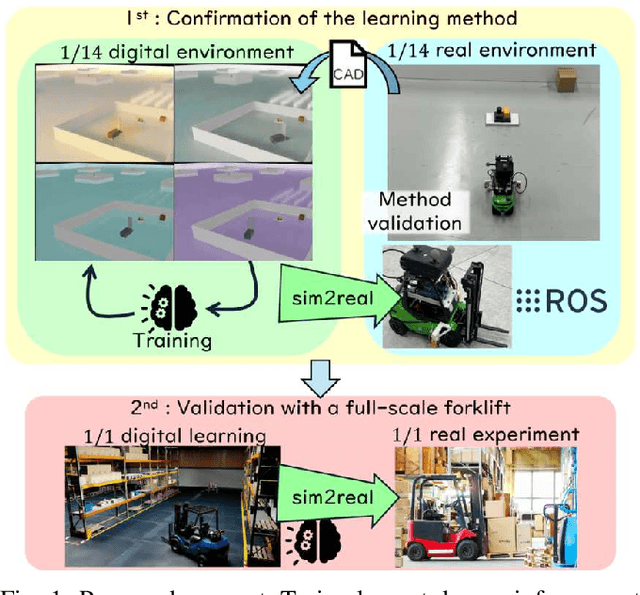
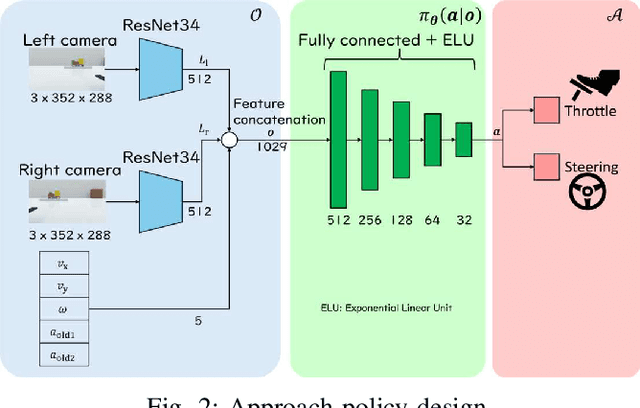
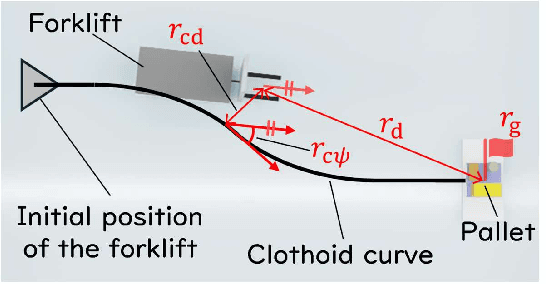
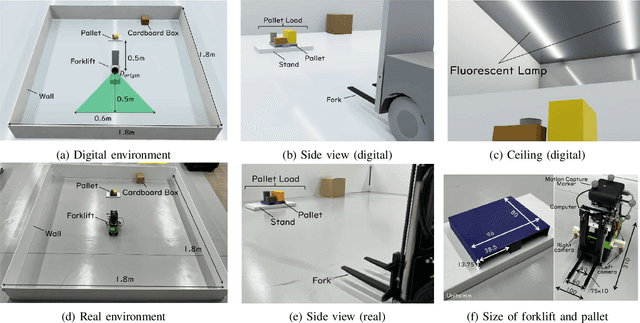
Forklifts are used extensively in various industrial settings and are in high demand for automation. In particular, counterbalance forklifts are highly versatile and employed in diverse scenarios. However, efforts to automate these processes are lacking, primarily owing to the absence of a safe and performance-verifiable development environment. This study proposes a learning system that combines a photorealistic digital learning environment with a 1/14-scale robotic forklift environment to address this challenge. Inspired by the training-based learning approach adopted by forklift operators, we employ an end-to-end vision-based deep reinforcement learning approach. The learning is conducted in a digitalized environment created from CAD data, making it safe and eliminating the need for real-world data. In addition, we safely validate the method in a physical setting utilizing a 1/14-scale robotic forklift with a configuration similar to that of a real forklift. We achieved a 60% success rate in pallet loading tasks in real experiments using a robotic forklift. Our approach demonstrates zero-shot sim2real with a simple method that does not require heuristic additions. This learning-based approach is considered a first step towards the automation of counterbalance forklifts.
Online Multi-Agent Pickup and Delivery with Task Deadlines
Mar 19, 2024Managing delivery deadlines in automated warehouses and factories is crucial for maintaining customer satisfaction and ensuring seamless production. This study introduces the problem of online multi-agent pickup and delivery with task deadlines (MAPD-D), which is an advanced variant of the online MAPD problem incorporating delivery deadlines. MAPD-D presents a dynamic deadline-driven approach that includes task deadlines, with tasks being added at any time (online), thus challenging conventional MAPD frameworks. To tackle MAPD-D, we propose a novel algorithm named deadline-aware token passing (D-TP). The D-TP algorithm is designed to calculate pickup deadlines and assign tasks while balancing execution cost and deadline proximity. Additionally, we introduce the D-TP with task swaps (D-TPTS) method to further reduce task tardiness, enhancing flexibility and efficiency via task-swapping strategies. Numerical experiments were conducted in simulated warehouse environments to showcase the effectiveness of the proposed methods. Both D-TP and D-TPTS demonstrate significant reductions in task tardiness compared to existing methods, thereby contributing to efficient operations in automated warehouses and factories with delivery deadlines.