 Add to Chrome
 Add to Firefox
 Add to Edge
Ray Tracing-Enabled Digital Twin for RIS Phase Optimization: Implementation and Experimental Validation
Apr 20, 2026
Determining the optimal phase configurations of reconfigurable intelligent surface (RIS) elements typically requires complex channel estimation procedures with high pilot overhead, creating a bottleneck for real-time deployment in time-varying wireless environments. In this paper, we propose a digital twin (DT)-driven framework for RIS phase shift optimization that eliminates extensive signaling overhead associated with estimating high-dimensional RIS channels. Leveraging the NVIDIA Sionna ray-tracing library, we construct a DT of the physical environment based on a three-dimensional map. The proposed system utilizes the location information of the transceivers to compute the optimal RIS phase shift configurations within the DT. These computationally generated configurations are then transferred to a physical RIS prototype. Experimental results demonstrate that the phase configurations obtained from the DT significantly enhance the received signal power in the physical environment, validating the fidelity of the ray-tracing model and the feasibility of the proposed optimization strategy.

RIS Optimization Algorithms for Urban Wireless Scenarios in Sionna RT
Jan 10, 2025This paper evaluates the performance of reconfigurable intelligent surface (RIS) optimization algorithms, which utilize channel estimation methods, in ray tracing (RT) simulations within urban digital twin environments. Beyond Sionna's native capabilities, we implement and benchmark additional RIS optimization algorithms based on channel estimation, enabling an evaluation of RIS strategies under various deployment conditions. Coverage maps for RIS-assisted communication systems are generated through the integration of Sionna's RT simulations. Moreover, real-world experimentation underscores the necessity of validating algorithms in near-realistic simulation environments, as minor variations in measurement setups can significantly affect performance.
Measurement-based Characterization of Physical Layer Security for RIS-assisted Wireless Systems
Dec 14, 2022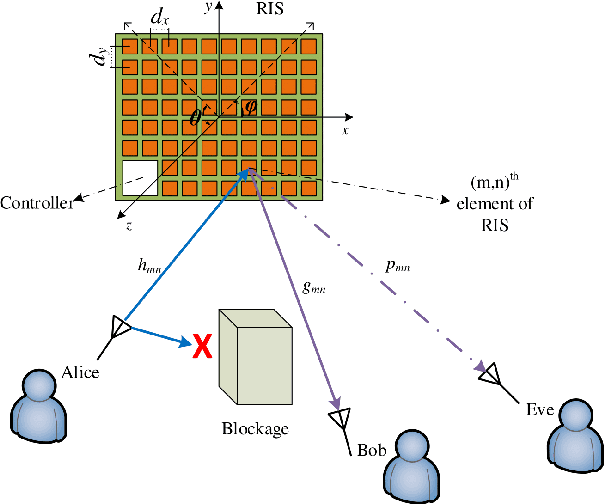
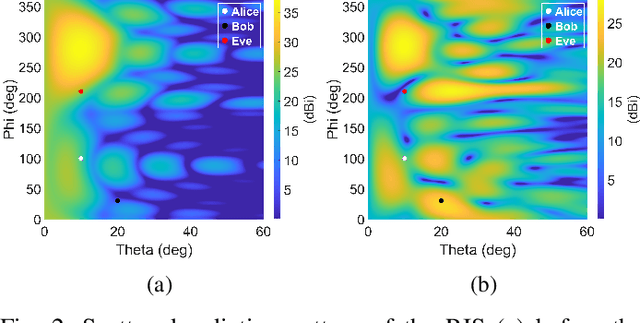

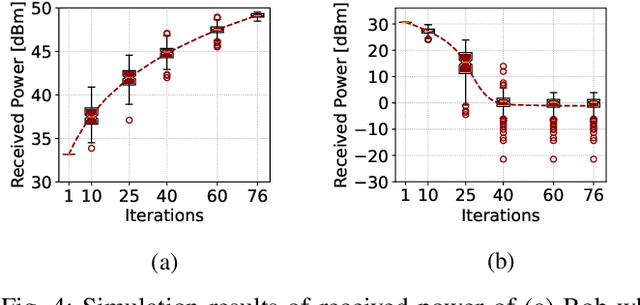
There have been recently many studies demonstrating that the performance of wireless communication systems can be significantly improved by a reconfigurable intelligent surface (RIS), which is an attractive technology due to its low power requirement and low complexity. This paper presents a measurement-based characterization of RISs for providing physical layer security, where the transmitter (Alice), the intended user (Bob), and the eavesdropper (Eve) are deployed in an indoor environment. Each user is equipped with a software-defined radio connected to a horn antenna. The phase shifts of reflecting elements are software controlled to collaboratively determine the amount of received signal power at the locations of Bob and Eve in such a way that the secrecy capacity is aimed to be maximized. An iterative method is utilized to configure a Greenerwave RIS prototype consisting of 76 passive reflecting elements. Computer simulation and measurement results demonstrate that an RIS can be an effective tool to significantly increase the secrecy capacity between Bob and Eve.
Indoor Coverage Enhancement for RIS-Assisted Communication Systems: Practical Measurements and Efficient Grouping
Nov 14, 2022


Reconfigurable intelligent surface (RIS)-empowered communications represent exciting prospects as one of the promising technologies capable of meeting the requirements of the sixth generation networks such as low-latency, reliability, and dense connectivity. However, validation of test cases and real-world experiments of RISs are imperative to their practical viability. To this end, this paper presents a physical demonstration of an RIS-assisted communication system in an indoor environment in order to enhance the coverage by increasing the received signal power. We first analyze the performance of the RIS-assisted system for a set of different locations of the receiver and observe around 10 dB improvement in the received signal power by careful RIS phase adjustments. Then, we employ an efficient codebook design for RIS configurations to adjust the RIS states on the move without feedback channels. We also investigate the impact of an efficient grouping of RIS elements, whose objective is to reduce the training time needed to find the optimal RIS configuration. In our extensive experimental measurements, we demonstrate that with the proposed grouping scheme, training time is reduced from one-half to one-eighth by sacrificing only a few dBs in received signal power.