 Add to Chrome
 Add to Firefox
 Add to Edge
ETSI ISG MAT: Bridging Multiple Access Techniques Research and 6G Standardisation
Jul 27, 2026
Improved spectral efficiency and inter-user interference mitigation are important aspects of IMT-2030 and the ongoing 3GPP 6G study. ETSI established the Industry Specification Group on Multiple Access Techniques (ISG MAT) as a research and pre-standardisation activity to build wider consensus on downlink MAT for 3GPP-based 6G systems. Its first report, ETSI GR MAT 001 V1.1.1, provides a standards-oriented comparison of 3GPP-specified techniques, including OMA, MU-MIMO, and MUST, with candidate techniques comprising power-domain NOMA, RSMA, and cache-aided MU-MIMO. The report identifies operating conditions in which candidate MAT can improve spectral efficiency and assesses implications for transceiver processing, network assistance information, and reference-signal requirements. Ongoing work includes realistic 5G NR link-level evaluations and the study of MAT for non-terrestrial networks, providing timely technical evidence for 3GPP 6G standardisation discussions.

A comparative study of semi- and self-supervised semantic segmentation of biomedical microscopy data
Nov 23, 2020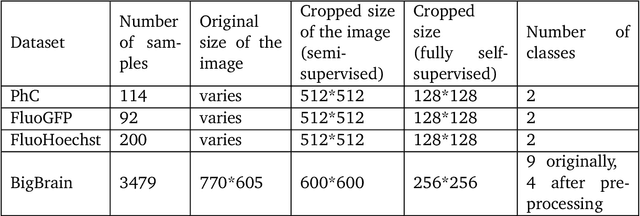
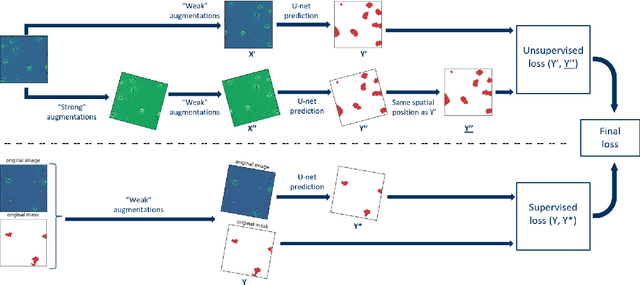
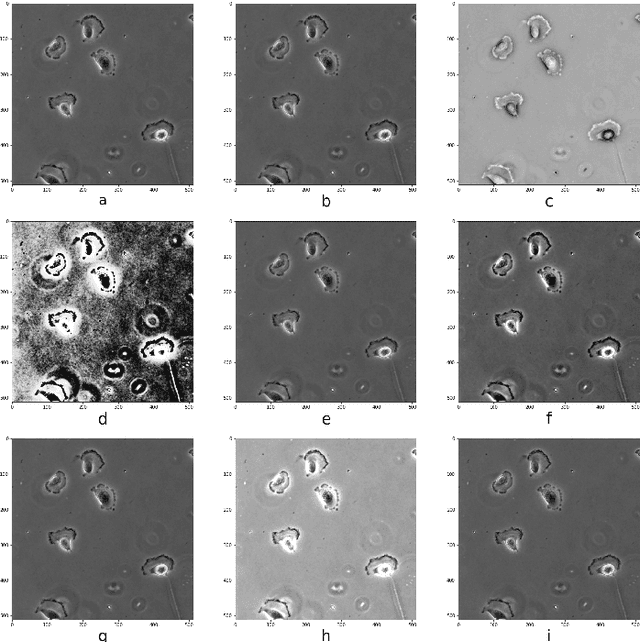
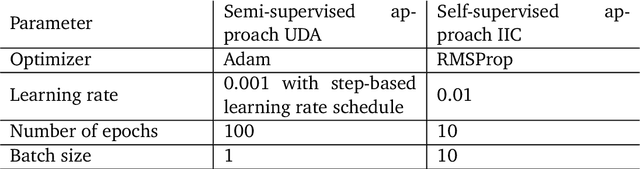
In recent years, Convolutional Neural Networks (CNNs) have become the state-of-the-art method for biomedical image analysis. However, these networks are usually trained in a supervised manner, requiring large amounts of labelled training data. These labelled data sets are often difficult to acquire in the biomedical domain. In this work, we validate alternative ways to train CNNs with fewer labels for biomedical image segmentation using. We adapt two semi- and self-supervised image classification methods and analyse their performance for semantic segmentation of biomedical microscopy images.
Anomaly Detection in Univariate Time-series: A Survey on the State-of-the-Art
Apr 01, 2020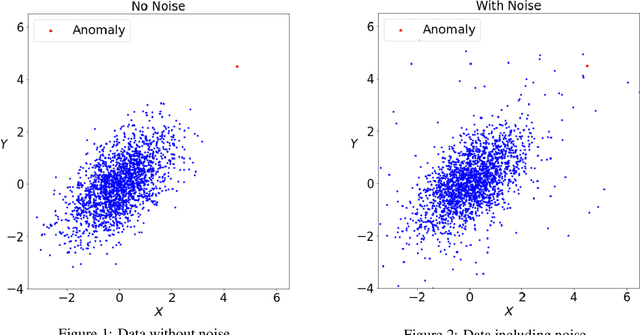

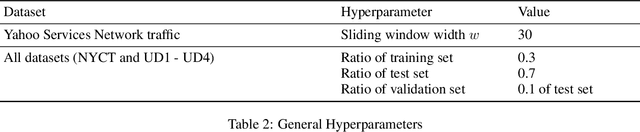
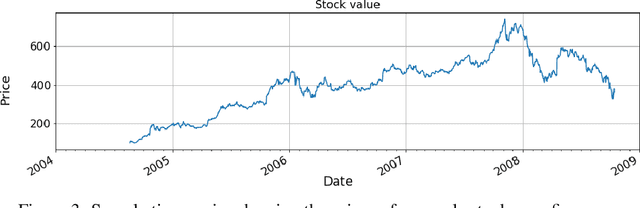
Anomaly detection for time-series data has been an important research field for a long time. Seminal work on anomaly detection methods has been focussing on statistical approaches. In recent years an increasing number of machine learning algorithms have been developed to detect anomalies on time-series. Subsequently, researchers tried to improve these techniques using (deep) neural networks. In the light of the increasing number of anomaly detection methods, the body of research lacks a broad comparative evaluation of statistical, machine learning and deep learning methods. This paper studies 20 univariate anomaly detection methods from the all three categories. The evaluation is conducted on publicly available datasets, which serve as benchmarks for time-series anomaly detection. By analyzing the accuracy of each method as well as the computation time of the algorithms, we provide a thorough insight about the performance of these anomaly detection approaches, alongside some general notion of which method is suited for a certain type of data.