 Add to Chrome
 Add to Firefox
 Add to Edge
ETSI ISG MAT: Bridging Multiple Access Techniques Research and 6G Standardisation
Jul 27, 2026
Improved spectral efficiency and inter-user interference mitigation are important aspects of IMT-2030 and the ongoing 3GPP 6G study. ETSI established the Industry Specification Group on Multiple Access Techniques (ISG MAT) as a research and pre-standardisation activity to build wider consensus on downlink MAT for 3GPP-based 6G systems. Its first report, ETSI GR MAT 001 V1.1.1, provides a standards-oriented comparison of 3GPP-specified techniques, including OMA, MU-MIMO, and MUST, with candidate techniques comprising power-domain NOMA, RSMA, and cache-aided MU-MIMO. The report identifies operating conditions in which candidate MAT can improve spectral efficiency and assesses implications for transceiver processing, network assistance information, and reference-signal requirements. Ongoing work includes realistic 5G NR link-level evaluations and the study of MAT for non-terrestrial networks, providing timely technical evidence for 3GPP 6G standardisation discussions.

SIC-Free Rate-Splitting Multiple Access: Constellation-Constrained Optimization and Application to Large-Scale Systems
Jun 15, 2025Rate-Splitting Multiple Access (RSMA) has been recognized as a promising multiple access technique for future wireless communication systems. Recent research demonstrates that RSMA can maintain its superiority without relying on Successive Interference Cancellation (SIC) receivers. In practical systems, SIC-free receivers are more attractive than SIC receivers because of their low complexity and latency. This paper evaluates the theoretical limits of RSMA with and without SIC receivers under finite constellations. We first derive the constellation-constrained rate expressions for RSMA. We then design algorithms based on projected subgradient ascent to optimize the precoders and maximize the weighted sum-rate or max-min fairness (MMF) among users. To apply the proposed optimization algorithms to large-scale systems, one challenge lies in the exponentially increasing computational complexity brought about by the constellation-constrained rate expressions. In light of this, we propose methods to avoid such computational burden. Numerical results show that, under optimized precoders, SIC-free RSMA leads to minor losses in weighted sum-rate and MMF performance in comparison to RSMA with SIC receivers, making it a viable option for future implementations.
Rate-Splitting Multiple Access: Finite Constellations, Receiver Design, and SIC-free Implementation
May 30, 2023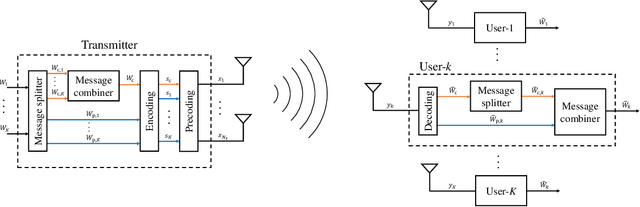
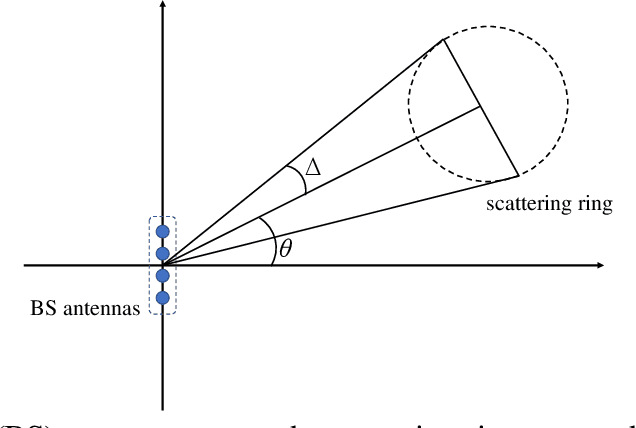
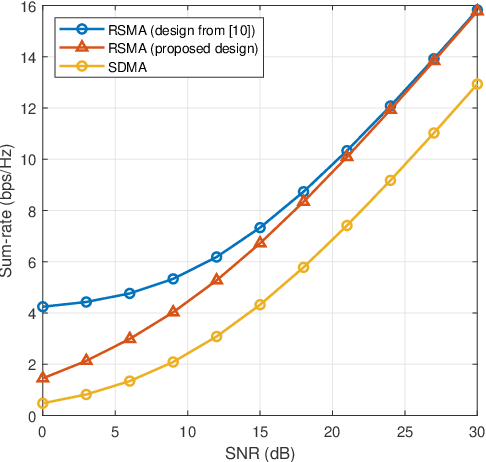
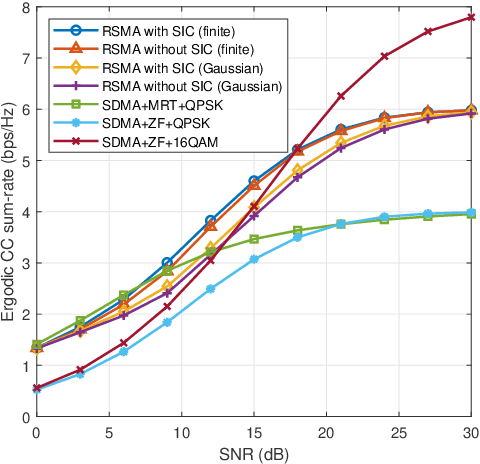
Rate-Splitting Multiple Access (RSMA) has emerged as a novel multiple access technique that enlarges the achievable rate region of Multiple-Input Multiple-Output (MIMO) broadcast channels with linear precoding. In this work, we jointly address three practical but fundamental questions: (1) How to exploit the benefit of RSMA under finite constellations? (2) What are the potential and promising ways to implement RSMA receivers? (3) Can RSMA still retain its superiority in the absence of successive interference cancellers (SIC)? To address these concerns, we first propose low-complexity precoder designs taking finite constellations into account and show that the potential of RSMA is better achieved with such designs than those assuming Gaussian signalling. We then consider some practical receiver designs that can be applied to RSMA. We notice that these receiver designs follow one of two principles: (1) SIC: cancelling upper layer signals before decoding the lower layer and (2) non-SIC: treating upper layer signals as noise when decoding the lower layer. In light of this, we propose to alter the precoder design according to the receiver category. Through link-level simulations, the effectiveness of the proposed precoder and receiver designs are verified. More importantly, we show that it is possible to preserve the superiority of RSMA over Spatial Domain Multiple Access (SDMA), including SDMA with advanced receivers, even without SIC at the receivers. Those results therefore open the door to competitive implementable RSMA strategies for 6G and beyond communications.