 Add to Chrome
 Add to Firefox
 Add to Edge
Bound-Founded Semantics for Answer Set Programming with Difference Constraints: Preliminary Report
Jul 23, 2026
While the integration of linear constraints has significantly expanded the reach of Answer Set Programming (ASP), existing hybrid solvers often rely on disparate semantic underpinnings that lack a unified logical foundation. We address this gap by introducing a many-sorted variant of the Bound-founded Logic of Here-and-There (HTb), providing a versatile framework capable of characterizing equilibrium models across a wide spectrum of alternative semantics for extensions of ASP with linear constraints. We apply this framework to the setting of difference constraints, focusing on the semantic characterization of clingo[DL]. Central to our approach is the formalization of foundedness for numeric variables. By investigating how different hybrid systems - such as clingo[DL], clingcon, and flingo - justify constraint atoms, we uncover the semantic roots of their varying behaviors. This investigation results in a single, consistent framework that not only formalizes the foundations of current systems like clingo[DL] but also facilitates the rigorous study of program simplifications and the future integration of diverse semantic principles.
* In Proceedings ICLP 2026, arXiv:2607.17707

Reasoning about Study Regulations in Answer Set Programming
Aug 08, 2024We are interested in automating reasoning with and about study regulations, catering to various stakeholders, ranging from administrators, over faculty, to students at different stages. Our work builds on an extensive analysis of various study programs at the University of Potsdam. The conceptualization of the underlying principles provides us with a formal account of study regulations. In particular, the formalization reveals the properties of admissible study plans. With these at end, we propose an encoding of study regulations in Answer Set Programming that produces corresponding study plans. Finally, we show how this approach can be extended to a generic user interface for exploring study plans.
Clingo goes Linear Constraints over Reals and Integers
Jul 13, 2017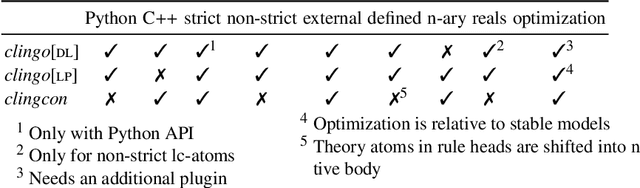
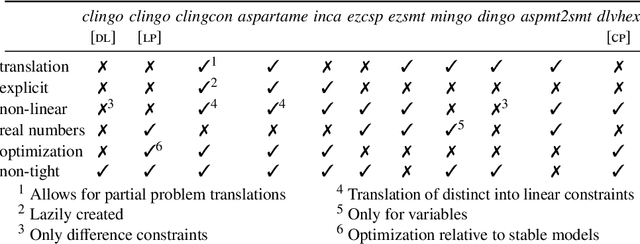
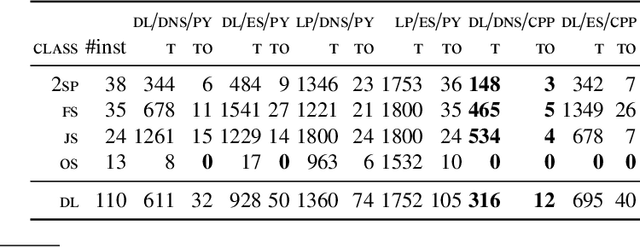
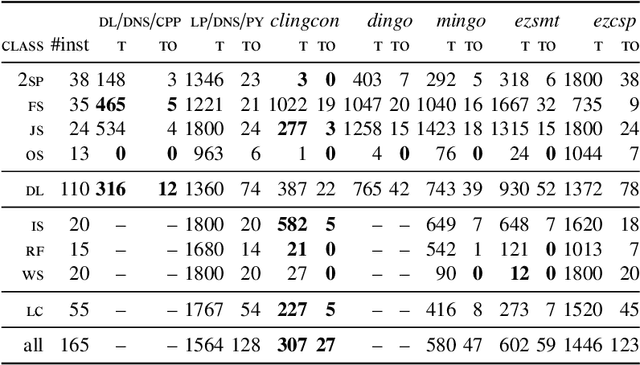
The recent series 5 of the ASP system clingo provides generic means to enhance basic Answer Set Programming (ASP) with theory reasoning capabilities. We instantiate this framework with different forms of linear constraints, discuss the respective implementations, and present techniques of how to use these constraints in a reactive context. More precisely, we introduce extensions to clingo with difference and linear constraints over integers and reals, respectively, and realize them in complementary ways. Finally, we empirically evaluate the resulting clingo derivatives clingo[dl] and clingo[lp] on common fragments and contrast them to related ASP systems. This paper is under consideration for acceptance in TPLP.