 Add to Chrome
 Add to Firefox
 Add to Edge
Mitrasamgraha: A Comprehensive Classical Sanskrit Machine Translation Dataset
Jan 12, 2026
While machine translation is regarded as a "solved problem" for many high-resource languages, close analysis quickly reveals that this is not the case for content that shows challenges such as poetic language, philosophical concepts, multi-layered metaphorical expressions, and more. Sanskrit literature is a prime example of this, as it combines a large number of such challenges in addition to inherent linguistic features like sandhi, compounding, and heavy morphology, which further complicate NLP downstream tasks. It spans multiple millennia of text production time as well as a large breadth of different domains, ranging from ritual formulas via epic narratives, philosophical treatises, poetic verses up to scientific material. As of now, there is a strong lack of publicly available resources that cover these different domains and temporal layers of Sanskrit. We therefore introduce Mitrasamgraha, a high-quality Sanskrit-to-English machine translation dataset consisting of 391,548 bitext pairs, more than four times larger than the largest previously available Sanskrit dataset Itih=asa. It covers a time period of more than three millennia and a broad range of historical Sanskrit domains. In contrast to web-crawled datasets, the temporal and domain annotation of this dataset enables fine-grained study of domain and time period effects on MT performance. We also release a validation set consisting of 5,587 and a test set consisting of 5,552 post-corrected bitext pairs. We conduct experiments benchmarking commercial and open models on this dataset and fine-tune NLLB and Gemma models on the dataset, showing significant improvements, while still recognizing significant challenges in the translation of complex compounds, philosophical concepts, and multi-layered metaphors. We also analyze how in-context learning on this dataset impacts the performance of commercial models

MITRA: A Large-Scale Parallel Corpus and Multilingual Pretrained Language Model for Machine Translation and Semantic Retrieval for Pāli, Sanskrit, Buddhist Chinese, and Tibetan
Jan 10, 2026Ancient Buddhist literature features frequent, yet often unannotated, textual parallels spread across diverse languages: Sanskrit, Pāli, Buddhist Chinese, Tibetan, and more. The scale of this material makes manual examination prohibitive. We present the MITRA framework, which consists of a novel pipeline for multilingual parallel passage mining, MITRA-parallel, a large-scale corpus of 1.74 million parallel sentence pairs between Sanskrit, Chinese, and Tibetan, and the development of the domain-specific pretrained language model Gemma 2 MITRA. We present Gemma 2 MITRA-MT, a version of this base model fine-tuned on machine translation tasks, reaching state-of-the-art performance for machine translation of these languages into English and outperforming even much larger open-source models. We also present Gemma 2 MITRA-E, a semantic embedding model that shows state-of-the-art performance on a novel, detailed semantic embedding benchmark. We make the parallel dataset, model weights, and semantic similarity benchmark openly available to aid both NLP research and philological studies in Buddhist and classical Asian literature.
One Model is All You Need: ByT5-Sanskrit, a Unified Model for Sanskrit NLP Tasks
Sep 20, 2024

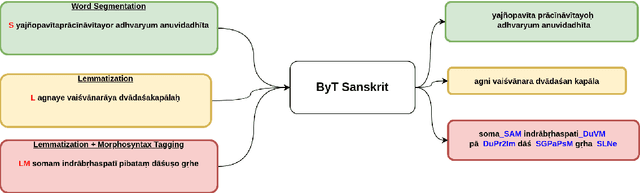
Morphologically rich languages are notoriously challenging to process for downstream NLP applications. This paper presents a new pretrained language model, ByT5-Sanskrit, designed for NLP applications involving the morphologically rich language Sanskrit. We evaluate ByT5-Sanskrit on established Sanskrit word segmentation tasks, where it outperforms previous data-driven approaches by a considerable margin and matches the performance of the current best lexicon-based model. It is easier to deploy and more robust to data not covered by external linguistic resources. It also achieves new state-of-the-art results in Vedic Sanskrit dependency parsing and OCR post-correction tasks. Additionally, based on the Digital Corpus of Sanskrit, we introduce a novel multitask dataset for the joint training of Sanskrit word segmentation, lemmatization, and morphosyntactic tagging tasks. We fine-tune ByT5-Sanskrit on this dataset, creating a versatile multitask model for various downstream Sanskrit applications. We have used this model in Sanskrit linguistic annotation projects, in information retrieval setups, and as a preprocessing step in a Sanskrit machine translation pipeline. We also show that our approach yields new best scores for lemmatization and dependency parsing of other morphologically rich languages. We thus demonstrate that byte-level pretrained language models can achieve excellent performance for morphologically rich languages, outperforming tokenizer-based models and presenting an important vector of exploration when constructing NLP pipelines for such languages.