 Add to Chrome
 Add to Firefox
 Add to Edge
Observable Geometry of Singular Statistical Models
Apr 01, 2026
Singular statistical models arise whenever different parameter values induce the same distribution, leading to non-identifiability and a breakdown of classical asymptotic theory. While existing approaches analyze these phenomena in parameter space, the resulting descriptions depend heavily on parameterization and obscure the intrinsic statistical structure of the model. In this paper, we introduce an invariant framework based on \emph{observable charts}: collections of functionals of the data distribution that distinguish probability measures. These charts define local coordinate systems directly on the model space, independent of parameterization. We formalize \emph{observable completeness} as the ability of such charts to detect identifiable directions, and introduce \emph{observable order} to quantify higher-order distinguishability along analytic perturbations. Our main result establishes that, under mild regularity conditions, observable order provides a lower bound on the rate at which Kullback-Leibler divergence vanishes along analytic paths. This connects intrinsic geometric structure in model space to statistical distinguishability and recovers classical behavior in regular models while extending naturally to singular settings. We illustrate the framework in reduced-rank regression and Gaussian mixture models, where observable coordinates reveal both identifiable structure and singular degeneracies. These results suggest that observable charts provide a unified and parameterization-invariant language for studying singular models and offer a pathway toward intrinsic formulations of invariants such as learning coefficients.

Functional Bias and Tangent-Space Geometry in Variational Inference
Mar 09, 2026Variational inference approximates Bayesian posterior distributions by projecting onto a tractable family of distributions. While most theoretical analyses evaluate the quality of this approximation using global divergence measures, many applications rely on specific posterior summaries such as expectations, variances, or tail probabilities. We develop a geometric framework for analyzing the bias of posterior functionals under variational approximations. We show that the leading-order bias of a posterior functional is determined by its component orthogonal to the variational tangent space induced by the variational family. Functionals aligned with this space incur only second-order bias. For structured mean-field variational families we characterize the tangent space explicitly and show that it consists of block-additive functions of the parameter blocks, while interaction components determine the leading-order bias. Under standard local asymptotic normality conditions we further derive explicit asymptotic expansions for the bias of posterior functionals and show that omitted interaction directions produce first-order distortion of cross-block dependence measures. These results provide a geometric explanation for several well-known properties of mean-field variational inference, including the systematic distortion of cross-block dependencies.
Thermodynamic Response Functions in Singular Bayesian Models
Mar 05, 2026Singular statistical models-including mixtures, matrix factorization, and neural networks-violate regular asymptotics due to parameter non-identifiability and degenerate Fisher geometry. Although singular learning theory characterizes marginal likelihood behavior through invariants such as the real log canonical threshold and singular fluctuation, these quantities remain difficult to interpret operationally. At the same time, widely used criteria such as WAIC and WBIC appear disconnected from underlying singular geometry. We show that posterior tempering induces a one-parameter deformation of the posterior distribution whose associated observables generate a hierarchy of thermodynamic response functions. A universal covariance identity links derivatives of tempered expectations to posterior fluctuations, placing WAIC, WBIC, and singular fluctuation within a unified response framework. Within this framework, classical quantities from singular learning theory acquire natural thermodynamic interpretations: RLCT governs the leading free-energy slope, singular fluctuation corresponds to curvature of the tempered free energy, and WAIC measures predictive fluctuation. We formalize an observable algebra that quotients out non-identifiable directions, allowing structurally meaningful order parameters to be constructed in singular models. Across canonical singular examples-including symmetric Gaussian mixtures, reduced-rank regression, and overparameterized neural networks-we empirically demonstrate phase-transition-like behavior under tempering. Order parameters collapse, susceptibilities peak, and complexity measures align with structural reorganization in posterior geometry. Our results suggest that thermodynamic response theory provides a natural organizing framework for interpreting complexity, predictive variability, and structural reorganization in singular Bayesian learning.
Hypothesis Testing over Observable Regimes in Singular Models
Feb 27, 2026Hypothesis testing in singular statistical models is often regarded as inherently problematic due to non-identifiability and degeneracy of the Fisher information. We show that the fundamental obstruction to testing in such models is not singularity itself, but the formulation of hypotheses on non-identifiable parameter quantities. Testing is inherently a problem in distribution space: if two hypotheses induce overlapping subsets of the model class, then no uniformly consistent test exists. We formalize this overlap obstruction and show that hypotheses depending on non-identifiable parameter functions necessarily fail in this sense. In contrast, hypotheses formulated over identifiable observables-quantities that are determined by the induced distribution-reduce entirely to classical testing theory. When the corresponding distributional regimes are separated in Hellinger distance, uniformly consistent tests exist and posterior contraction follows from standard testing-based arguments. Near singular boundaries, separation may collapse locally, leading to scale-dependent detectability governed jointly by sample size and distance to the singular stratum. We illustrate these phenomena in Gaussian mixture models and reduced-rank regression, exhibiting both untestable non-identifiable hypotheses and classically testable identifiable ones. The results provide a structural classification of which hypotheses in singular models are statistically meaningful.
Feasibility Preservation under Monotone Retrieval Truncation
Jan 21, 2026Retrieval-based systems approximate access to a corpus by exposing only a truncated subset of available evidence. Even when relevant information exists in the corpus, truncation can prevent compatible evidence from co-occurring, leading to failures that are not captured by relevance-based evaluation. This paper studies retrieval from a structural perspective, modeling query answering as a feasibility problem under truncation. We formalize retrieval as a sequence of candidate evidence sets and characterize conditions under which feasibility in the limit implies feasibility at finite retrieval depth. We show that monotone truncation suffices to guarantee finite witnessability for individual queries. For classes of queries, we identify finite generation of witness certificates as the additional condition required to obtain a uniform retrieval bound, and we show that this condition is necessary. We further exhibit sharp counterexamples demonstrating failure under non-monotone truncation, non-finitely-generated query classes, and purely slotwise coverage. Together, these results isolate feasibility preservation as a correctness criterion for retrieval independent of relevance scoring or optimization, and clarify structural limitations inherent to truncation-based retrieval.
Thermodynamic Characterizations of Singular Bayesian Models: Specific Heat, Susceptibility, and Entropy Flow in Posterior Geometry
Dec 24, 2025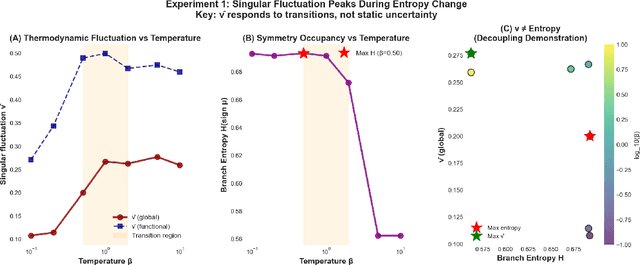
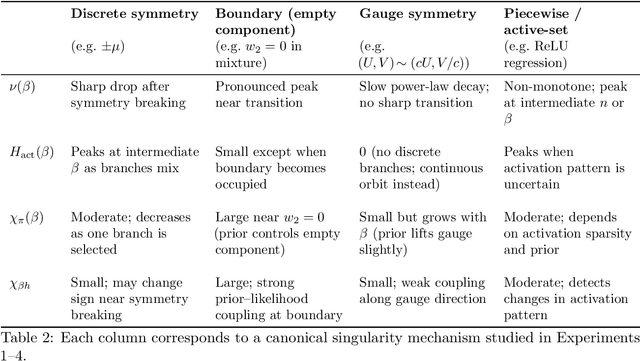
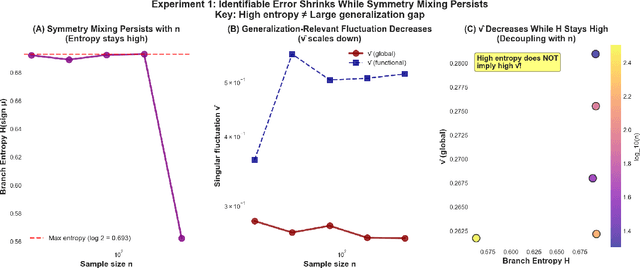
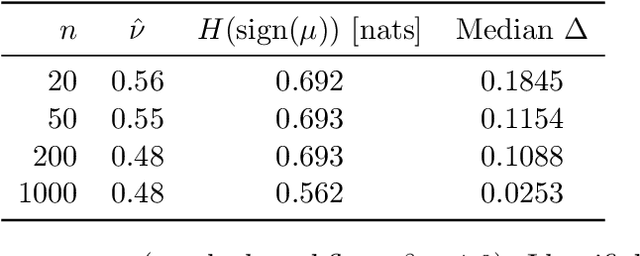
Singular learning theory (SLT) \citep{watanabe2009algebraic,watanabe2018mathematical} provides a rigorous asymptotic framework for Bayesian models with non-identifiable parameterizations, yet the statistical meaning of its second-order invariant, the \emph{singular fluctuation}, has remained unclear. In this work, we show that singular fluctuation admits a precise and natural interpretation as a \emph{specific heat}: the second derivative of the Bayesian free energy with respect to temperature. Equivalently, it measures the posterior variance of the log-likelihood observable under the tempered Gibbs posterior. We further introduce a collection of related thermodynamic quantities, including entropy flow, prior susceptibility, and cross-susceptibility, that together provide a detailed geometric diagnosis of singular posterior structure. Through extensive numerical experiments spanning discrete symmetries, boundary singularities, continuous gauge freedoms, and piecewise (ReLU) models, we demonstrate that these thermodynamic signatures cleanly distinguish singularity types, exhibit stable finite-sample behavior, and reveal phase-transition--like phenomena as temperature varies. We also show empirically that the widely used WAIC estimator \citep{watanabe2010asymptotic, watanabe2013widely} is exactly twice the thermodynamic specific heat at unit temperature, clarifying its robustness in singular models.Our results establish a concrete bridge between singular learning theory and statistical mechanics, providing both theoretical insight and practical diagnostics for modern Bayesian models.
Statistical Guarantees for Transformation Based Models with Applications to Implicit Variational Inference
Nov 04, 2020Transformation-based methods have been an attractive approach in non-parametric inference for problems such as unconditional and conditional density estimation due to their unique hierarchical structure that models the data as flexible transformation of a set of common latent variables. More recently, transformation-based models have been used in variational inference (VI) to construct flexible implicit families of variational distributions. However, their use in both non-parametric inference and variational inference lacks theoretical justification. We provide theoretical justification for the use of non-linear latent variable models (NL-LVMs) in non-parametric inference by showing that the support of the transformation induced prior in the space of densities is sufficiently large in the $L_1$ sense. We also show that, when a Gaussian process (GP) prior is placed on the transformation function, the posterior concentrates at the optimal rate up to a logarithmic factor. Adopting the flexibility demonstrated in the non-parametric setting, we use the NL-LVM to construct an implicit family of variational distributions, deemed GP-IVI. We delineate sufficient conditions under which GP-IVI achieves optimal risk bounds and approximates the true posterior in the sense of the Kullback-Leibler divergence. To the best of our knowledge, this is the first work on providing theoretical guarantees for implicit variational inference.