 Add to Chrome
 Add to Firefox
 Add to Edge
Stability of Sequential and Parallel Coordinate Ascent Variational Inference
Mar 21, 2026
We highlight a striking difference in behavior between two widely used variants of coordinate ascent variational inference: the sequential and parallel algorithms. While such differences were known in the numerical analysis literature in simpler settings, they remain largely unexplored in the optimization-focused literature on variational inference in more complex models. Focusing on the moderately high-dimensional linear regression problem, we show that the sequential algorithm, although typically slower, enjoys convergence guarantees under more relaxed conditions than the parallel variant, which is often employed to facilitate block-wise updates and improve computational efficiency.

Frequentist Regret Analysis of Gaussian Process Thompson Sampling via Fractional Posteriors
Feb 16, 2026We study Gaussian Process Thompson Sampling (GP-TS) for sequential decision-making over compact, continuous action spaces and provide a frequentist regret analysis based on fractional Gaussian process posteriors, without relying on domain discretization as in prior work. We show that the variance inflation commonly assumed in existing analyses of GP-TS can be interpreted as Thompson Sampling with respect to a fractional posterior with tempering parameter $α\in (0,1)$. We derive a kernel-agnostic regret bound expressed in terms of the information gain parameter $γ_t$ and the posterior contraction rate $ε_t$, and identify conditions on the Gaussian process prior under which $ε_t$ can be controlled. As special cases of our general bound, we recover regret of order $\tilde{\mathcal{O}}(T^{\frac{1}{2}})$ for the squared exponential kernel, $\tilde{\mathcal{O}}(T^{\frac{2ν+3d}{2(2ν+d)}} )$ for the Matérn-$ν$ kernel, and a bound of order $\tilde{\mathcal{O}}(T^{\frac{2ν+3d}{2(2ν+d)}})$ for the rational quadratic kernel. Overall, our analysis provides a unified and discretization-free regret framework for GP-TS that applies broadly across kernel classes.
Adaptive finite element type decomposition of Gaussian processes
May 29, 2025In this paper, we investigate a class of approximate Gaussian processes (GP) obtained by taking a linear combination of compactly supported basis functions with the basis coefficients endowed with a dependent Gaussian prior distribution. This general class includes a popular approach that uses a finite element approximation of the stochastic partial differential equation (SPDE) associated with Mat\'ern GP. We explored another scalable alternative popularly used in the computer emulation literature where the basis coefficients at a lattice are drawn from a Gaussian process with an inverse-Gamma bandwidth. For both approaches, we study concentration rates of the posterior distribution. We demonstrated that the SPDE associated approach with a fixed smoothness parameter leads to a suboptimal rate despite how the number of basis functions and bandwidth are chosen when the underlying true function is sufficiently smooth. On the flip side, we showed that the later approach is rate-optimal adaptively over all smoothness levels of the underlying true function if an appropriate prior is placed on the number of basis functions. Efficient computational strategies are developed and numerics are provided to illustrate the theoretical results.
Constrained Reweighting of Distributions: an Optimal Transport Approach
Oct 19, 2023
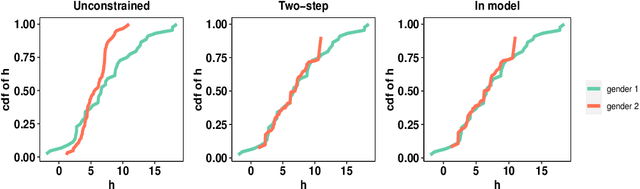

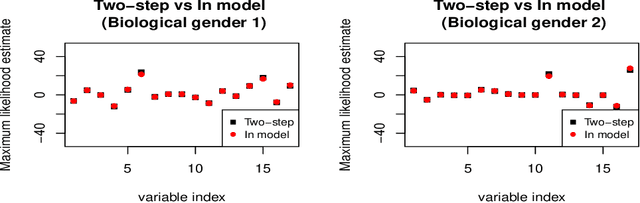
We commonly encounter the problem of identifying an optimally weight adjusted version of the empirical distribution of observed data, adhering to predefined constraints on the weights. Such constraints often manifest as restrictions on the moments, tail behaviour, shapes, number of modes, etc., of the resulting weight adjusted empirical distribution. In this article, we substantially enhance the flexibility of such methodology by introducing a nonparametrically imbued distributional constraints on the weights, and developing a general framework leveraging the maximum entropy principle and tools from optimal transport. The key idea is to ensure that the maximum entropy weight adjusted empirical distribution of the observed data is close to a pre-specified probability distribution in terms of the optimal transport metric while allowing for subtle departures. The versatility of the framework is demonstrated in the context of three disparate applications where data re-weighting is warranted to satisfy side constraints on the optimization problem at the heart of the statistical task: namely, portfolio allocation, semi-parametric inference for complex surveys, and ensuring algorithmic fairness in machine learning algorithms.
Generalized Regret Analysis of Thompson Sampling using Fractional Posteriors
Sep 12, 2023Thompson sampling (TS) is one of the most popular and earliest algorithms to solve stochastic multi-armed bandit problems. We consider a variant of TS, named $\alpha$-TS, where we use a fractional or $\alpha$-posterior ($\alpha\in(0,1)$) instead of the standard posterior distribution. To compute an $\alpha$-posterior, the likelihood in the definition of the standard posterior is tempered with a factor $\alpha$. For $\alpha$-TS we obtain both instance-dependent $\mathcal{O}\left(\sum_{k \neq i^*} \Delta_k\left(\frac{\log(T)}{C(\alpha)\Delta_k^2} + \frac{1}{2} \right)\right)$ and instance-independent $\mathcal{O}(\sqrt{KT\log K})$ frequentist regret bounds under very mild conditions on the prior and reward distributions, where $\Delta_k$ is the gap between the true mean rewards of the $k^{th}$ and the best arms, and $C(\alpha)$ is a known constant. Both the sub-Gaussian and exponential family models satisfy our general conditions on the reward distribution. Our conditions on the prior distribution just require its density to be positive, continuous, and bounded. We also establish another instance-dependent regret upper bound that matches (up to constants) to that of improved UCB [Auer and Ortner, 2010]. Our regret analysis carefully combines recent theoretical developments in the non-asymptotic concentration analysis and Bernstein-von Mises type results for the $\alpha$-posterior distribution. Moreover, our analysis does not require additional structural properties such as closed-form posteriors or conjugate priors.
Memory Efficient And Minimax Distribution Estimation Under Wasserstein Distance Using Bayesian Histograms
Jul 19, 2023We study Bayesian histograms for distribution estimation on $[0,1]^d$ under the Wasserstein $W_v, 1 \leq v < \infty$ distance in the i.i.d sampling regime. We newly show that when $d < 2v$, histograms possess a special \textit{memory efficiency} property, whereby in reference to the sample size $n$, order $n^{d/2v}$ bins are needed to obtain minimax rate optimality. This result holds for the posterior mean histogram and with respect to posterior contraction: under the class of Borel probability measures and some classes of smooth densities. The attained memory footprint overcomes existing minimax optimal procedures by a polynomial factor in $n$; for example an $n^{1 - d/2v}$ factor reduction in the footprint when compared to the empirical measure, a minimax estimator in the Borel probability measure class. Additionally constructing both the posterior mean histogram and the posterior itself can be done super--linearly in $n$. Due to the popularity of the $W_1,W_2$ metrics and the coverage provided by the $d < 2v$ case, our results are of most practical interest in the $(d=1,v =1,2), (d=2,v=2), (d=3,v=2)$ settings and we provide simulations demonstrating the theory in several of these instances.
On the Convergence of Coordinate Ascent Variational Inference
Jun 01, 2023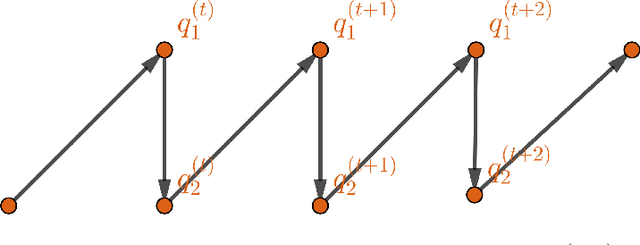
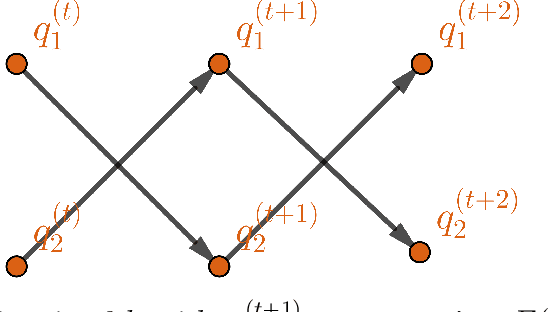
As a computational alternative to Markov chain Monte Carlo approaches, variational inference (VI) is becoming more and more popular for approximating intractable posterior distributions in large-scale Bayesian models due to its comparable efficacy and superior efficiency. Several recent works provide theoretical justifications of VI by proving its statistical optimality for parameter estimation under various settings; meanwhile, formal analysis on the algorithmic convergence aspects of VI is still largely lacking. In this paper, we consider the common coordinate ascent variational inference (CAVI) algorithm for implementing the mean-field (MF) VI towards optimizing a Kullback--Leibler divergence objective functional over the space of all factorized distributions. Focusing on the two-block case, we analyze the convergence of CAVI by leveraging the extensive toolbox from functional analysis and optimization. We provide general conditions for certifying global or local exponential convergence of CAVI. Specifically, a new notion of generalized correlation for characterizing the interaction between the constituting blocks in influencing the VI objective functional is introduced, which according to the theory, quantifies the algorithmic contraction rate of two-block CAVI. As illustrations, we apply the developed theory to a number of examples, and derive explicit problem-dependent upper bounds on the algorithmic contraction rate.
Fair Clustering via Hierarchical Fair-Dirichlet Process
May 27, 2023The advent of ML-driven decision-making and policy formation has led to an increasing focus on algorithmic fairness. As clustering is one of the most commonly used unsupervised machine learning approaches, there has naturally been a proliferation of literature on {\em fair clustering}. A popular notion of fairness in clustering mandates the clusters to be {\em balanced}, i.e., each level of a protected attribute must be approximately equally represented in each cluster. Building upon the original framework, this literature has rapidly expanded in various aspects. In this article, we offer a novel model-based formulation of fair clustering, complementing the existing literature which is almost exclusively based on optimizing appropriate objective functions.
Robust probabilistic inference via a constrained transport metric
Mar 17, 2023
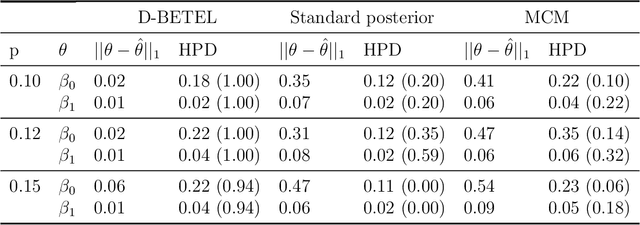
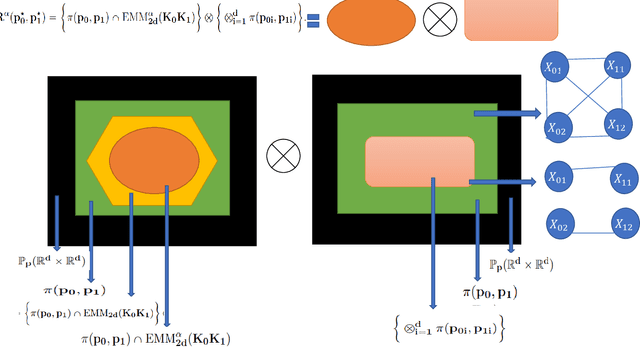

Flexible Bayesian models are typically constructed using limits of large parametric models with a multitude of parameters that are often uninterpretable. In this article, we offer a novel alternative by constructing an exponentially tilted empirical likelihood carefully designed to concentrate near a parametric family of distributions of choice with respect to a novel variant of the Wasserstein metric, which is then combined with a prior distribution on model parameters to obtain a robustified posterior. The proposed approach finds applications in a wide variety of robust inference problems, where we intend to perform inference on the parameters associated with the centering distribution in presence of outliers. Our proposed transport metric enjoys great computational simplicity, exploiting the Sinkhorn regularization for discrete optimal transport problems, and being inherently parallelizable. We demonstrate superior performance of our methodology when compared against state-of-the-art robust Bayesian inference methods. We also demonstrate equivalence of our approach with a nonparametric Bayesian formulation under a suitable asymptotic framework, testifying to its flexibility. The constrained entropy maximization that sits at the heart of our likelihood formulation finds its utility beyond robust Bayesian inference; an illustration is provided in a trustworthy machine learning application.
Factorized Fusion Shrinkage for Dynamic Relational Data
Sep 30, 2022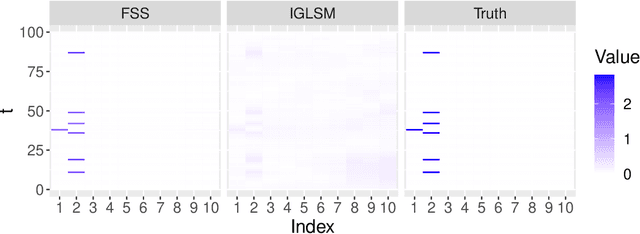
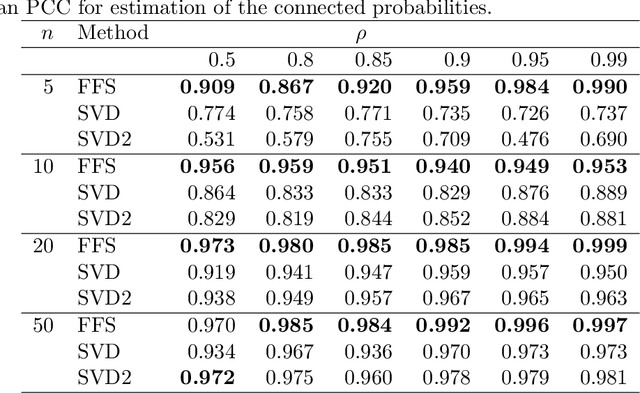
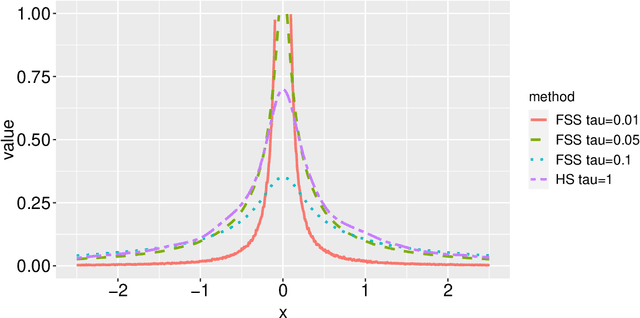
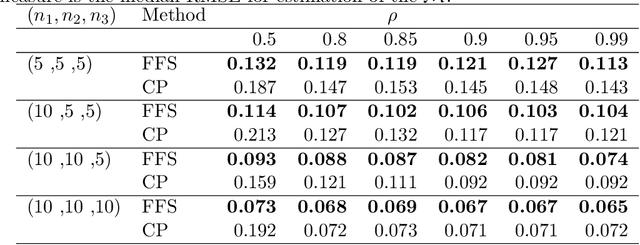
Modern data science applications often involve complex relational data with dynamic structures. An abrupt change in such dynamic relational data is typically observed in systems that undergo regime changes due to interventions. In such a case, we consider a factorized fusion shrinkage model in which all decomposed factors are dynamically shrunk towards group-wise fusion structures, where the shrinkage is obtained by applying global-local shrinkage priors to the successive differences of the row vectors of the factorized matrices. The proposed priors enjoy many favorable properties in comparison and clustering of the estimated dynamic latent factors. Comparing estimated latent factors involves both adjacent and long-term comparisons, with the time range of comparison considered as a variable. Under certain conditions, we demonstrate that the posterior distribution attains the minimax optimal rate up to logarithmic factors. In terms of computation, we present a structured mean-field variational inference framework that balances optimal posterior inference with computational scalability, exploiting both the dependence among components and across time. The framework can accommodate a wide variety of models, including dynamic matrix factorization, latent space models for networks and low-rank tensors. The effectiveness of our methodology is demonstrated through extensive simulations and real-world data analysis.