 Add to Chrome
 Add to Firefox
 Add to Edge
Automated Hardware Validation Test Plan Generation for Large Scale AI Datacenter Platforms Using a Generative AI Multi-Agents Architecture
Jul 17, 2026
Large-scale AI datacenter platforms comprise thousands of heterogeneous hardware components whose validation requires comprehensive fault injection test plans. Today these plans are authored manually: engineers review hardware self-healing validation documents and bills of materials, enumerate failure modes per field-replaceable unit, and produce flat lists of single-layer test cases. This process is labor-intensive, error-prone, and dependent on institutional knowledge; coverage gaps surface late, traceability to source specifications is implicit, and the effort is largely repeated per platform. This paper presents a generative AI multi-agent architecture that automates the generation of structured hardware validation test plans from two canonical inputs: self-healing validation documents, which enumerate known failure modes and their detection and remediation behaviors per field-replaceable unit, and component Bills of Material. An ingestion agent normalizes heterogeneous inputs into a canonical representation; a classification agent maps components to functional domains via contextual reasoning over part descriptions and sub-category hierarchies; and a generation agent synthesizes test cases by combining normalized failure modes with domain-classified data, filling gaps and producing edge cases. The output conforms to a standardized schema for direct import into internal validation software. Evaluated on two production platforms against manual baselines, the framework achieves coverage expansions of 74.2% and 51.4%, cutting authoring from days to hours. It yields fully traceable mappings from each test case to its source specification, and its multi-agent decomposition is portable across platform generations. Automated and expert evaluations confirm 100% extraction fidelity and high acceptance of new scenarios, validating the framework as a robust human-in-the-loop force multiplier.

Confidential Machine Learning within Graphcore IPUs
May 20, 2022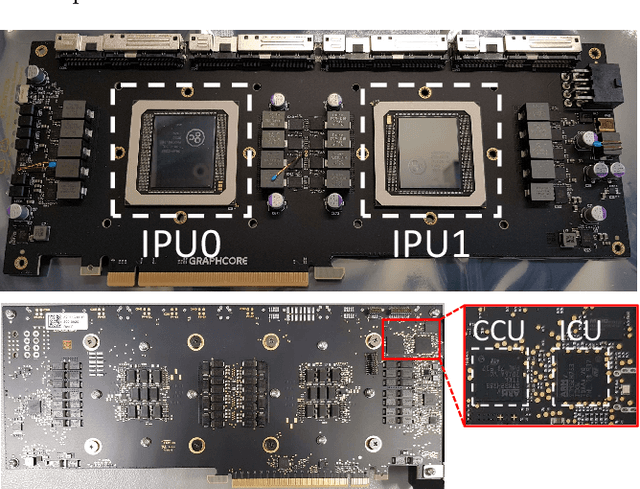
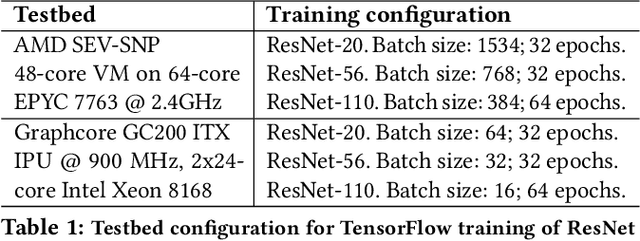
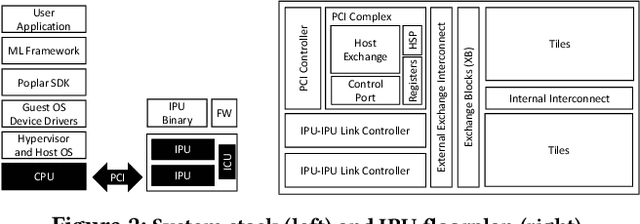
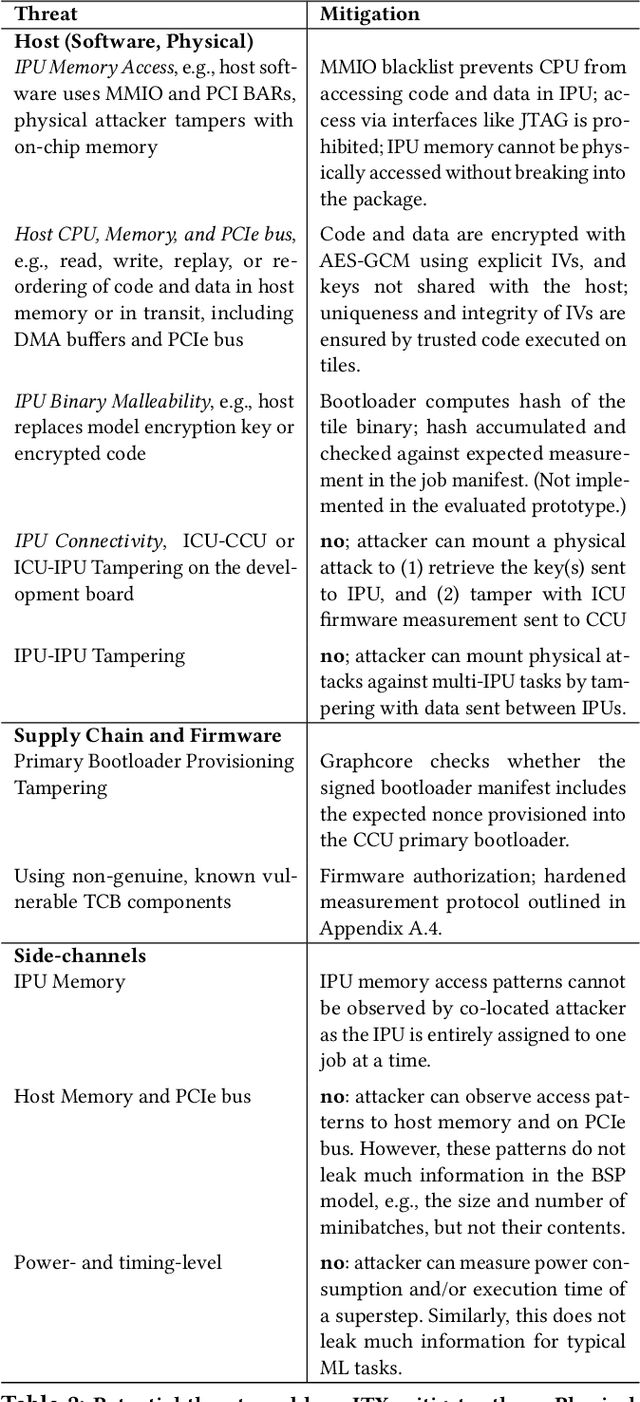
We present IPU Trusted Extensions (ITX), a set of experimental hardware extensions that enable trusted execution environments in Graphcore's AI accelerators. ITX enables the execution of AI workloads with strong confidentiality and integrity guarantees at low performance overheads. ITX isolates workloads from untrusted hosts, and ensures their data and models remain encrypted at all times except within the IPU. ITX includes a hardware root-of-trust that provides attestation capabilities and orchestrates trusted execution, and on-chip programmable cryptographic engines for authenticated encryption of code and data at PCIe bandwidth. We also present software for ITX in the form of compiler and runtime extensions that support multi-party training without requiring a CPU-based TEE. Experimental support for ITX is included in Graphcore's GC200 IPU taped out at TSMC's 7nm technology node. Its evaluation on a development board using standard DNN training workloads suggests that ITX adds less than 5% performance overhead, and delivers up to 17x better performance compared to CPU-based confidential computing systems relying on AMD SEV-SNP.