 Add to Chrome
 Add to Firefox
 Add to Edge
Automated Hardware Validation Test Plan Generation for Large Scale AI Datacenter Platforms Using a Generative AI Multi-Agents Architecture
Jul 17, 2026
Large-scale AI datacenter platforms comprise thousands of heterogeneous hardware components whose validation requires comprehensive fault injection test plans. Today these plans are authored manually: engineers review hardware self-healing validation documents and bills of materials, enumerate failure modes per field-replaceable unit, and produce flat lists of single-layer test cases. This process is labor-intensive, error-prone, and dependent on institutional knowledge; coverage gaps surface late, traceability to source specifications is implicit, and the effort is largely repeated per platform. This paper presents a generative AI multi-agent architecture that automates the generation of structured hardware validation test plans from two canonical inputs: self-healing validation documents, which enumerate known failure modes and their detection and remediation behaviors per field-replaceable unit, and component Bills of Material. An ingestion agent normalizes heterogeneous inputs into a canonical representation; a classification agent maps components to functional domains via contextual reasoning over part descriptions and sub-category hierarchies; and a generation agent synthesizes test cases by combining normalized failure modes with domain-classified data, filling gaps and producing edge cases. The output conforms to a standardized schema for direct import into internal validation software. Evaluated on two production platforms against manual baselines, the framework achieves coverage expansions of 74.2% and 51.4%, cutting authoring from days to hours. It yields fully traceable mappings from each test case to its source specification, and its multi-agent decomposition is portable across platform generations. Automated and expert evaluations confirm 100% extraction fidelity and high acceptance of new scenarios, validating the framework as a robust human-in-the-loop force multiplier.

DEBATE: Devil's Advocate-Based Assessment and Text Evaluation
May 16, 2024As natural language generation (NLG) models have become prevalent, systematically assessing the quality of machine-generated texts has become increasingly important. Recent studies introduce LLM-based evaluators that operate as reference-free metrics, demonstrating their capability to adeptly handle novel tasks. However, these models generally rely on a single-agent approach, which, we argue, introduces an inherent limit to their performance. This is because there exist biases in LLM agent's responses, including preferences for certain text structure or content. In this work, we propose DEBATE, an NLG evaluation framework based on multi-agent scoring system augmented with a concept of Devil's Advocate. Within the framework, one agent is instructed to criticize other agents' arguments, potentially resolving the bias in LLM agent's answers. DEBATE substantially outperforms the previous state-of-the-art methods in two meta-evaluation benchmarks in NLG evaluation, SummEval and TopicalChat. We also show that the extensiveness of debates among agents and the persona of an agent can influence the performance of evaluators.
Corporate Bankruptcy Prediction with Domain-Adapted BERT
Dec 06, 2023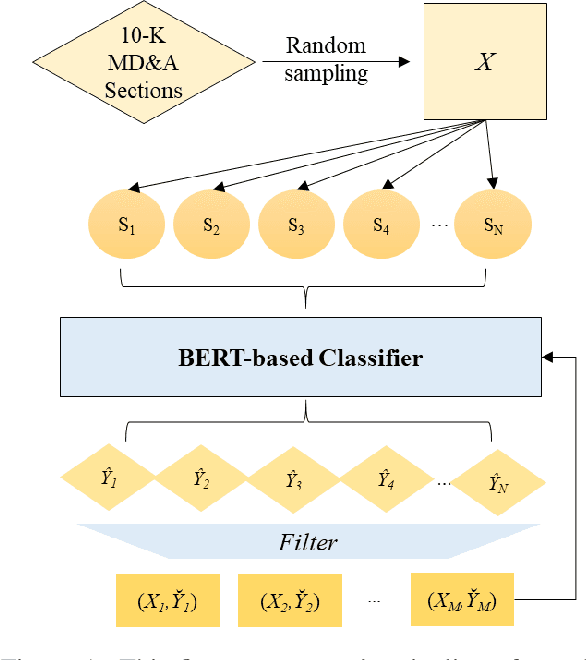
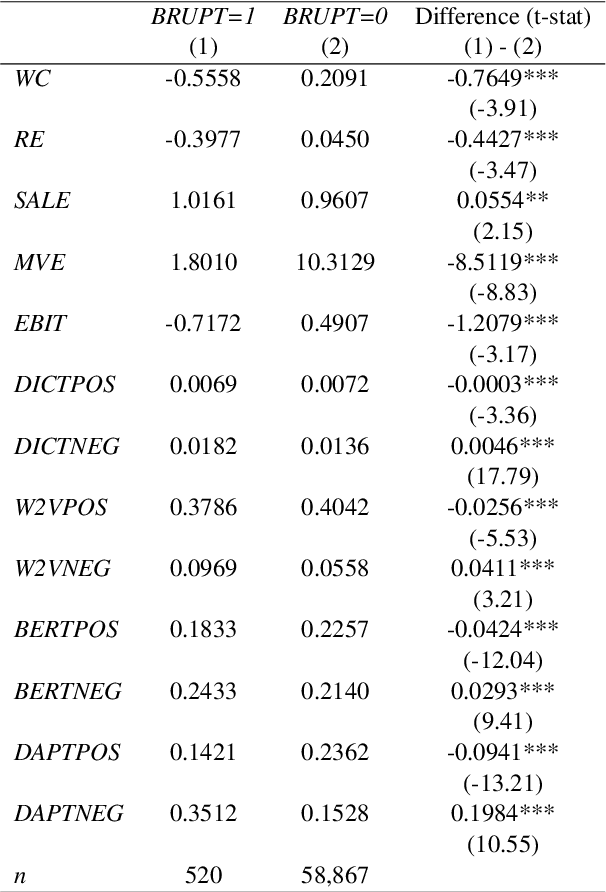
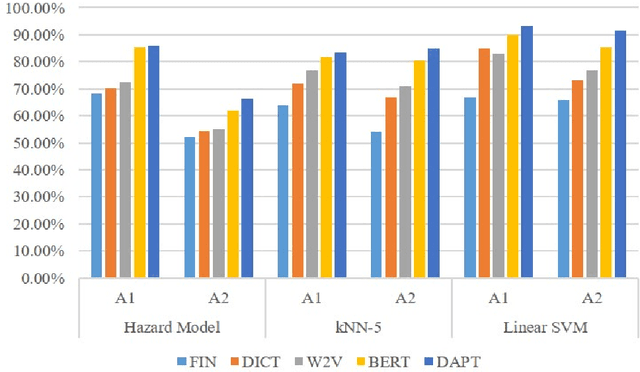
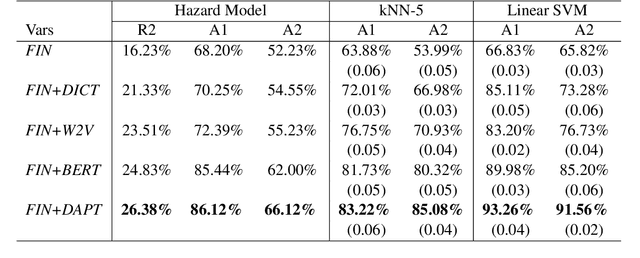
This study performs BERT-based analysis, which is a representative contextualized language model, on corporate disclosure data to predict impending bankruptcies. Prior literature on bankruptcy prediction mainly focuses on developing more sophisticated prediction methodologies with financial variables. However, in our study, we focus on improving the quality of input dataset. Specifically, we employ BERT model to perform sentiment analysis on MD&A disclosures. We show that BERT outperforms dictionary-based predictions and Word2Vec-based predictions in terms of adjusted R-square in logistic regression, k-nearest neighbor (kNN-5), and linear kernel support vector machine (SVM). Further, instead of pre-training the BERT model from scratch, we apply self-learning with confidence-based filtering to corporate disclosure data (10-K). We achieve the accuracy rate of 91.56% and demonstrate that the domain adaptation procedure brings a significant improvement in prediction accuracy.
Detecting Rumor Veracity with Only Textual Information by Double-Channel Structure
Dec 06, 2023
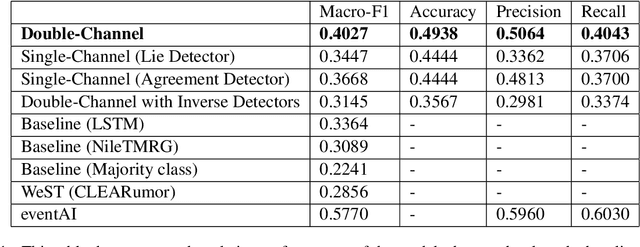

Kyle (1985) proposes two types of rumors: informed rumors which are based on some private information and uninformed rumors which are not based on any information (i.e. bluffing). Also, prior studies find that when people have credible source of information, they are likely to use a more confident textual tone in their spreading of rumors. Motivated by these theoretical findings, we propose a double-channel structure to determine the ex-ante veracity of rumors on social media. Our ultimate goal is to classify each rumor into true, false, or unverifiable category. We first assign each text into either certain (informed rumor) or uncertain (uninformed rumor) category. Then, we apply lie detection algorithm to informed rumors and thread-reply agreement detection algorithm to uninformed rumors. Using the dataset of SemEval 2019 Task 7, which requires ex-ante threefold classification (true, false, or unverifiable) of social media rumors, our model yields a macro-F1 score of 0.4027, outperforming all the baseline models and the second-place winner (Gorrell et al., 2019). Furthermore, we empirically validate that the double-channel structure outperforms single-channel structures which use either lie detection or agreement detection algorithm to all posts.