 Add to Chrome
 Add to Firefox
 Add to Edge
Object-Centric Framework for Video Moment Retrieval
Dec 20, 2025
Most existing video moment retrieval methods rely on temporal sequences of frame- or clip-level features that primarily encode global visual and semantic information. However, such representations often fail to capture fine-grained object semantics and appearance, which are crucial for localizing moments described by object-oriented queries involving specific entities and their interactions. In particular, temporal dynamics at the object level have been largely overlooked, limiting the effectiveness of existing approaches in scenarios requiring detailed object-level reasoning. To address this limitation, we propose a novel object-centric framework for moment retrieval. Our method first extracts query-relevant objects using a scene graph parser and then generates scene graphs from video frames to represent these objects and their relationships. Based on the scene graphs, we construct object-level feature sequences that encode rich visual and semantic information. These sequences are processed by a relational tracklet transformer, which models spatio-temporal correlations among objects over time. By explicitly capturing object-level state changes, our framework enables more accurate localization of moments aligned with object-oriented queries. We evaluated our method on three benchmarks: Charades-STA, QVHighlights, and TACoS. Experimental results demonstrate that our method outperforms existing state-of-the-art methods across all benchmarks.

KFS-Bench: Comprehensive Evaluation of Key Frame Sampling in Long Video Understanding
Dec 16, 2025We propose KFS-Bench, the first benchmark for key frame sampling in long video question answering (QA), featuring multi-scene annotations to enable direct and robust evaluation of sampling strategies. Key frame sampling is crucial for efficient long-form video understanding. In long video QA, selecting informative frames enables multimodal large language models (MLLMs) to improve both accuracy and efficiency. KFS-Bench addresses the limitation of prior works that only indirectly assess frame selection quality via QA accuracy. By providing ground-truth annotations of multiple disjoint scenes required per question, KFS-Bench allows us to directly analyze how different sampling approaches capture essential content across an entire long video. Using KFS-Bench, we conduct a comprehensive study of key frame sampling methods and identify that not only sampling precision but also scene coverage and sampling balance are the key factors influencing QA performance. Regarding all the factors, we design a novel sampling quality metric that correlates with QA accuracy. Furthermore, we develop a novel key frame sampling method that leverages question-video relevance to balance sampling diversity against question-frame similarity, thereby improving coverage of relevant scenes. Our adaptively balanced sampling approach achieves superior performance in both key frame sampling and QA performance. The benchmark is available at https://github.com/NEC-VID/KFS-Bench.
Enhanced Data Transfer Cooperating with Artificial Triplets for Scene Graph Generation
Jun 27, 2024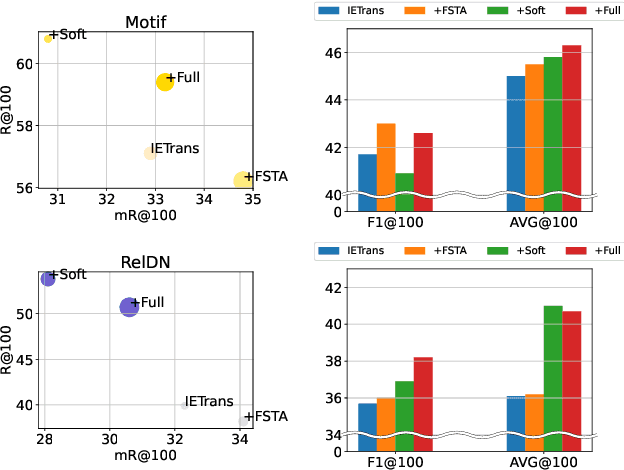
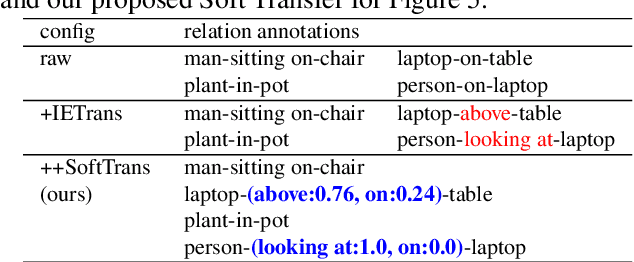
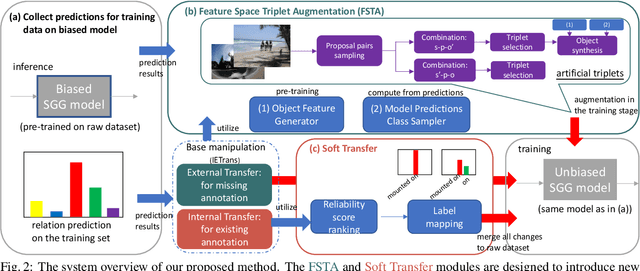
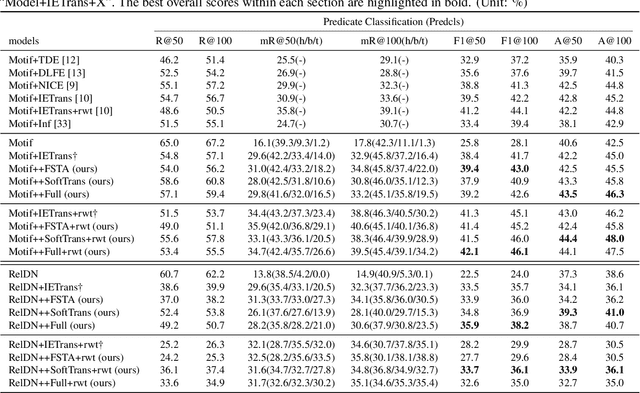
This work focuses on training dataset enhancement of informative relational triplets for Scene Graph Generation (SGG). Due to the lack of effective supervision, the current SGG model predictions perform poorly for informative relational triplets with inadequate training samples. Therefore, we propose two novel training dataset enhancement modules: Feature Space Triplet Augmentation (FSTA) and Soft Transfer. FSTA leverages a feature generator trained to generate representations of an object in relational triplets. The biased prediction based sampling in FSTA efficiently augments artificial triplets focusing on the challenging ones. In addition, we introduce Soft Transfer, which assigns soft predicate labels to general relational triplets to make more supervisions for informative predicate classes effectively. Experimental results show that integrating FSTA and Soft Transfer achieve high levels of both Recall and mean Recall in Visual Genome dataset. The mean of Recall and mean Recall is the highest among all the existing model-agnostic methods.
Tabular Two-Dimensional Correlation Analysis for Multifaceted Characterization Data
Nov 27, 2023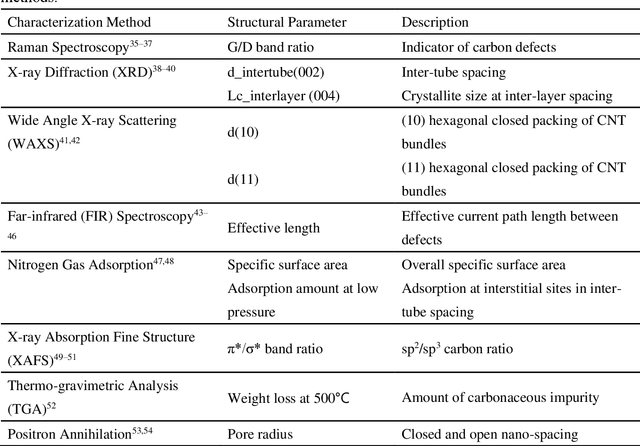
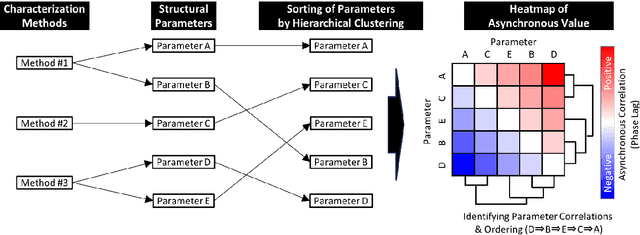
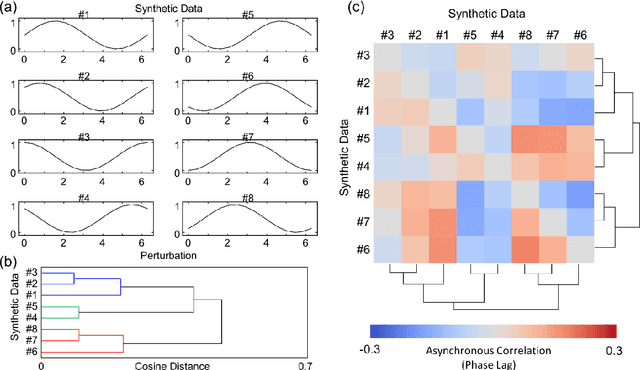
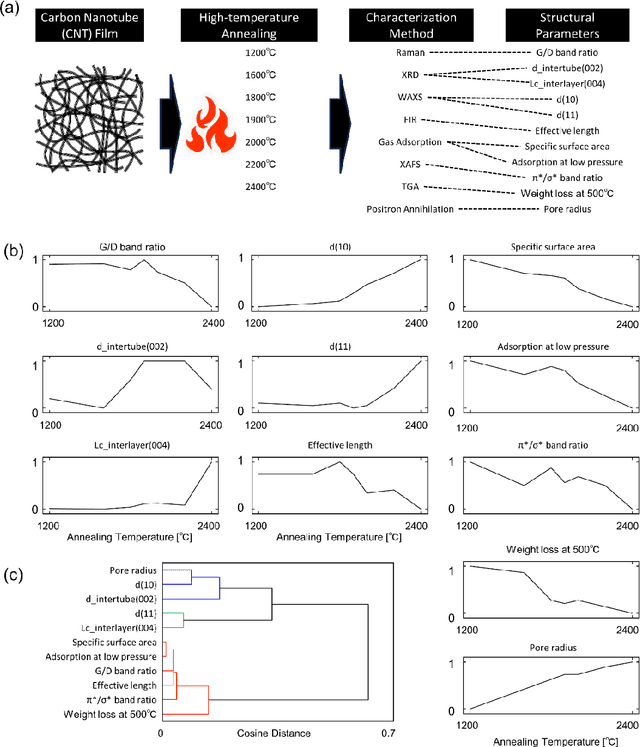
We propose tabular two-dimensional correlation analysis for extracting features from multifaceted characterization data, essential for understanding material properties. This method visualizes similarities and phase lags in structural parameter changes through heatmaps, combining hierarchical clustering and asynchronous correlations. We applied the proposed method to datasets of carbon nanotube (CNTs) films annealed at various temperatures and revealed the complexity of their hierarchical structures, which include elements like voids, bundles, and amorphous carbon. Our analysis addresses the challenge of attempting to understand the sequence of structural changes, especially in multifaceted characterization data where 11 structural parameters derived from 8 characterization methods interact with complex behavior. The results show how phase lags (asynchronous changes from stimuli) and parameter similarities can illuminate the sequence of structural changes in materials, providing insights into phenomena like the removal of amorphous carbon and graphitization in annealed CNTs. This approach is beneficial even with limited data and holds promise for a wide range of material analyses, demonstrating its potential in elucidating complex material behaviors and properties.