 Add to Chrome
 Add to Firefox
 Add to Edge
Adaptive Temporal Gating of Longitudinal Magnetic Resonance Imaging for Alzheimer's Prediction
May 27, 2026
Predicting conversion from Mild Cognitive Impairment (MCI) to Alzheimer's Disease (AD) is critical for early intervention. Current deep learning paradigms predominantly rely on cross-sectional structural MRI, neglecting prognostic value in patient-specific anatomical trajectories. We introduce the Temporal Adaptive Fusion Network (TAF-Net), a hybrid CNN-Transformer architecture that models paired longitudinal 3D MRI scans. Central to TAF-Net is a Temporal Fusion Module governed by an Adaptive Temporal Gate, which learns patient-specific weightings to synthesize three spatiotemporal representations: explicit structural change, region-to-region temporal cross-attention, and bilateral feature concatenation. Evaluated on the Alzheimer's Disease Neuroimaging Initiative cohort for three-year MCI-to-AD conversion prediction, TAF-Net achieved the highest discriminative performance among all evaluated methods using only structural MRI, significantly outperforming the strongest baseline and approaching multimodal methods requiring PET, CSF, or genetic data. The architecture exhibited exceptional data efficiency, matching baseline performance with a fraction of training data. Ablation studies demonstrate that longitudinal fusion improves discrimination while reducing predictive variance by 48% compared to single-timepoint evaluation. Interpretability analyses reveal spatial attention aligned with established AD pathology in the medial temporal lobe and ventricles, while the gating mechanism prioritizes explicit volumetric change with strong positive correlation to conversion risk.

Dual Model Deep Learning for Alzheimer Prognostication
Dec 22, 2025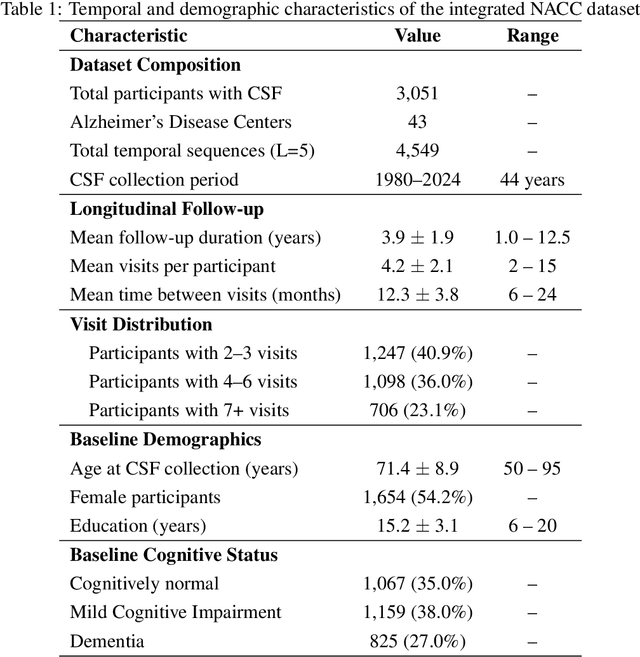
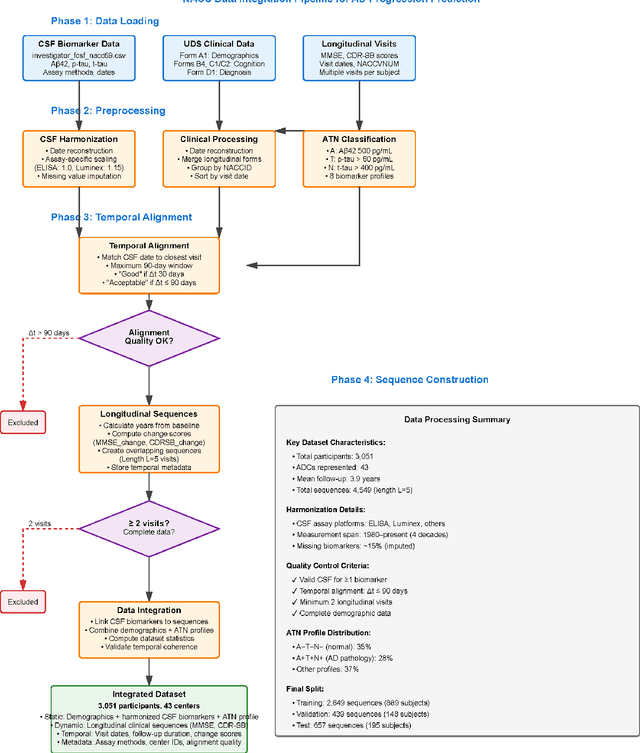
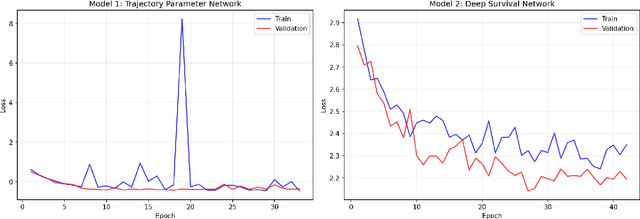
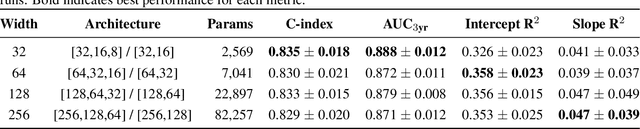
Disease modifying therapies for Alzheimer's disease demand precise timing decisions, yet current predictive models require longitudinal observations and provide no uncertainty quantification, rendering them impractical at the critical first visit when treatment decisions must be made. We developed PROGRESS (PRognostic Generalization from REsting Static Signatures), a dual-model deep learning framework that transforms a single baseline cerebrospinal fluid biomarker assessment into actionable prognostic estimates without requiring prior clinical history. The framework addresses two complementary clinical questions: a probabilistic trajectory network predicts individualized cognitive decline with calibrated uncertainty bounds achieving near-nominal coverage, enabling honest prognostic communication; and a deep survival model estimates time to conversion from mild cognitive impairment to dementia. Using data from over 3,000 participants across 43 Alzheimer's Disease Research Centers in the National Alzheimer's Coordinating Center database, PROGRESS substantially outperforms Cox proportional hazards, Random Survival Forests, and gradient boosting methods for survival prediction. Risk stratification identifies patient groups with seven-fold differences in conversion rates, enabling clinically meaningful treatment prioritization. Leave-one-center-out validation demonstrates robust generalizability, with survival discrimination remaining strong across held-out sites despite heterogeneous measurement conditions spanning four decades of assay technologies. By combining superior survival prediction with trustworthy trajectory uncertainty quantification, PROGRESS bridges the gap between biomarker measurement and personalized clinical decision-making.
Alzheimer's Disease Brain Network Mining
Dec 19, 2025Machine learning approaches for Alzheimer's disease (AD) diagnosis face a fundamental challenges. Clinical assessments are expensive and invasive, leaving ground truth labels available for only a fraction of neuroimaging datasets. We introduce Multi view Adaptive Transport Clustering for Heterogeneous Alzheimer's Disease (MATCH-AD), a semi supervised framework that integrates deep representation learning, graph-based label propagation, and optimal transport theory to address this limitation. The framework leverages manifold structure in neuroimaging data to propagate diagnostic information from limited labeled samples to larger unlabeled populations, while using Wasserstein distances to quantify disease progression between cognitive states. Evaluated on nearly five thousand subjects from the National Alzheimer's Coordinating Center, encompassing structural MRI measurements from hundreds of brain regions, cerebrospinal fluid biomarkers, and clinical variables MATCHAD achieves near-perfect diagnostic accuracy despite ground truth labels for less than one-third of subjects. The framework substantially outperforms all baseline methods, achieving kappa indicating almost perfect agreement compared to weak agreement for the best baseline, a qualitative transformation in diagnostic reliability. Performance remains clinically useful even under severe label scarcity, and we provide theoretical convergence guarantees with proven bounds on label propagation error and transport stability. These results demonstrate that principled semi-supervised learning can unlock the diagnostic potential of the vast repositories of partially annotated neuroimaging data accumulating worldwide, substantially reducing annotation burden while maintaining accuracy suitable for clinical deployment.