 Add to Chrome
 Add to Firefox
 Add to Edge
OperatorSHAP: Fast and Accurate Shapley Value Estimation for Neural Operators
Jun 26, 2026
Understanding model predictions is essential for physical applications, where outputs often inform safety-critical decisions, such as structural load assessment, weather warnings, and clinical diagnosis. Shapley values satisfy many desirable properties as an attribution method, but their computational cost during inference hinders their practical use. Current amortized explainers, such as FastSHAP, are limited to homogeneous inputs, which is problematic for physical applications where data often comes from irregular grids and geometries. We introduce OperatorSHAP, a grid-agnostic attribution method and training procedure that allows us to train FastSHAP-like explainers for neural operators. We establish a theoretical framework for attributions in function space, connecting to Aumann-Shapley values. We further show that OperatorSHAP's explanations are consistent with state-of-the-art discrete Shapley values across resolutions and transfer across grid sizes without retraining.

Calibrated Preference Learning: The Case of Label Ranking
May 28, 2026Calibration, the alignment of predicted probabilities with true outcome frequencies, is essential for reliable decision-making. While extensively studied for classification and regression, calibration has not been formally addressed for probabilistic label ranking, where the goal is to predict a distribution over orderings of a label set. Naively treating rankings as classes ignores their structure and fails to capture important modalities such as pairwise and top-k predictions. We formalize calibration for label ranking and develop a hierarchy of notions covering full rankings, sub-rankings, and top-k rankings. We prove that full-rank calibration implies the others but not conversely, and sub-ranking and top-k calibration are incomparable. Empirically, we find popular label ranking models are often poorly calibrated, with substantial differences between sub-ranking and top-k metrics. Applying our framework to RLHF reward models, we find that calibration correlates strongly but not perfectly with benchmark accuracy, suggesting it captures a meaningful quality dimension beyond top-1 accuracy. These findings motivate future work on understanding the downstream effects of miscalibration and developing methods to correct it.
Proxy-Based Approximation of Shapley and Banzhaf Interactions
May 21, 2026Shapley and Banzhaf interactions capture the complex dynamics inherent in modern machine learning applications. However, current estimators for these higher-order interactions trade off between speed and accuracy. To overcome this limitation, we introduce ProxySHAP. ProxySHAP reconciles the high sample efficiency of tree-based proxy models with a principled path to consistency via residual correction. On a theoretical level, we derive a polynomial-time generalization of interventional TreeSHAP to compute exact interaction indices for tree ensembles, successfully bypassing exponential tree-depth dependencies in prior methods. Furthermore, we formally analyze the residual adjustment strategy, characterizing the specific conditions under which Maximum Sample Reuse (MSR) corrects proxy bias without its variance scaling exponentially with interaction size. Extensive benchmarking demonstrates that ProxySHAP sets a new state-of-the-art standard for approximation quality, including in large-scale applications with thousands of features. By achieving the lowest error in both small- and large-budget regimes, ProxySHAP significantly outperforms the prior best estimators ProxySPEX and KernelSHAP-IQ, while also delivering superior performance on downstream explainability tasks.
ConfoundingSHAP: Quantifying confounding strength in causal inference
May 11, 2026In causal inference, confounders are variables that influence both treatment decisions and outcomes. However, unlike as in randomized clinical trials, the treatment assignment mechanism in observational studies is not known, and it is thus unclear which covariates act as confounders. Here, we aim to generate insight for causal inference and answer: which of the observed covariates act as confounders? We introduce ConfoundingSHAP, a Shapley-based method for attributing confounding strength to individual covariates. Our contributions are twofold. First, we propose a Shapley game targeted to infer the confounding strength of the covariates. Our resulting Shapley values differ from the standard applications of SHAP explanations on causal targets, such as understanding treatment effect heterogeneity, which are ill-suited for our task. Second, as our task requires evaluating the value function over many adjustment sets, we provide a scalable TabPFN-based estimation that avoids exhaustive refitting. We demonstrate the practical value across various datasets, where ConfoundingSHAP provides informative explanations of which observed covariates drive confounding and thereby helps to provide more insight for causal inference in practice.
Optimal Conformal Prediction under Epistemic Uncertainty
May 25, 2025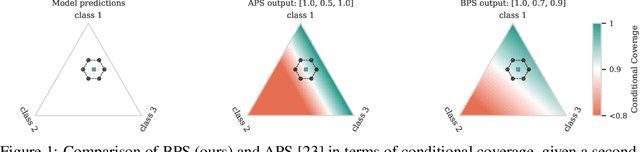

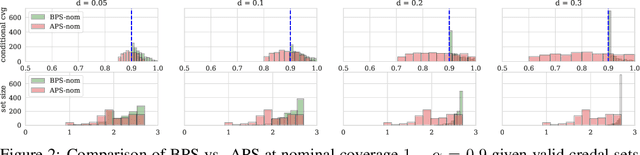
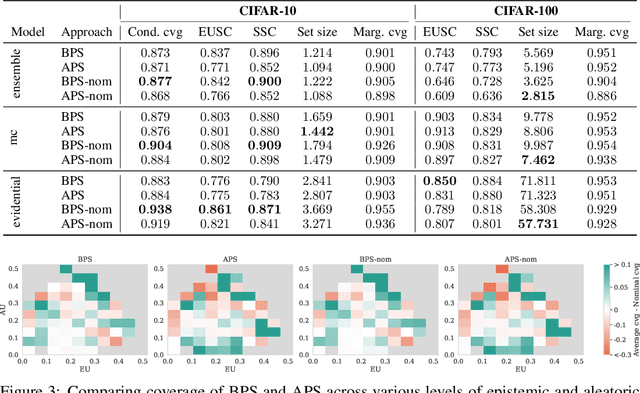
Conformal prediction (CP) is a popular frequentist framework for representing uncertainty by providing prediction sets that guarantee coverage of the true label with a user-adjustable probability. In most applications, CP operates on confidence scores coming from a standard (first-order) probabilistic predictor (e.g., softmax outputs). Second-order predictors, such as credal set predictors or Bayesian models, are also widely used for uncertainty quantification and are known for their ability to represent both aleatoric and epistemic uncertainty. Despite their popularity, there is still an open question on ``how they can be incorporated into CP''. In this paper, we discuss the desiderata for CP when valid second-order predictions are available. We then introduce Bernoulli prediction sets (BPS), which produce the smallest prediction sets that ensure conditional coverage in this setting. When given first-order predictions, BPS reduces to the well-known adaptive prediction sets (APS). Furthermore, when the validity assumption on the second-order predictions is compromised, we apply conformal risk control to obtain a marginal coverage guarantee while still accounting for epistemic uncertainty.