 Add to Chrome
 Add to Firefox
 Add to Edge
Bridging the gap between Performance and Interpretability: An Explainable Disentangled Multimodal Framework for Cancer Survival Prediction
Mar 02, 2026
While multimodal survival prediction models are increasingly more accurate, their complexity often reduces interpretability, limiting insight into how different data sources influence predictions. To address this, we introduce DIMAFx, an explainable multimodal framework for cancer survival prediction that produces disentangled, interpretable modality-specific and modality-shared representations from histopathology whole-slide images and transcriptomics data. Across multiple cancer cohorts, DIMAFx achieves state-of-the-art performance and improved representation disentanglement. Leveraging its interpretable design and SHapley Additive exPlanations, DIMAFx systematically reveals key multimodal interactions and the biological information encoded in the disentangled representations. In breast cancer survival prediction, the most predictive features contain modality-shared information, including one capturing solid tumor morphology contextualized primarily by late estrogen response, where higher-grade morphology aligned with pathway upregulation and increased risk, consistent with known breast cancer biology. Key modality-specific features capture microenvironmental signals from interacting adipose and stromal morphologies. These results show that multimodal models can overcome the traditional trade-off between performance and explainability, supporting their application in precision medicine.

PLM-eXplain: Divide and Conquer the Protein Embedding Space
Apr 09, 2025Protein language models (PLMs) have revolutionised computational biology through their ability to generate powerful sequence representations for diverse prediction tasks. However, their black-box nature limits biological interpretation and translation to actionable insights. We present an explainable adapter layer - PLM-eXplain (PLM-X), that bridges this gap by factoring PLM embeddings into two components: an interpretable subspace based on established biochemical features, and a residual subspace that preserves the model's predictive power. Using embeddings from ESM2, our adapter incorporates well-established properties, including secondary structure and hydropathy while maintaining high performance. We demonstrate the effectiveness of our approach across three protein-level classification tasks: prediction of extracellular vesicle association, identification of transmembrane helices, and prediction of aggregation propensity. PLM-X enables biological interpretation of model decisions without sacrificing accuracy, offering a generalisable solution for enhancing PLM interpretability across various downstream applications. This work addresses a critical need in computational biology by providing a bridge between powerful deep learning models and actionable biological insights.
Disentangled and Interpretable Multimodal Attention Fusion for Cancer Survival Prediction
Mar 20, 2025To improve the prediction of cancer survival using whole-slide images and transcriptomics data, it is crucial to capture both modality-shared and modality-specific information. However, multimodal frameworks often entangle these representations, limiting interpretability and potentially suppressing discriminative features. To address this, we propose Disentangled and Interpretable Multimodal Attention Fusion (DIMAF), a multimodal framework that separates the intra- and inter-modal interactions within an attention-based fusion mechanism to learn distinct modality-specific and modality-shared representations. We introduce a loss based on Distance Correlation to promote disentanglement between these representations and integrate Shapley additive explanations to assess their relative contributions to survival prediction. We evaluate DIMAF on four public cancer survival datasets, achieving a relative average improvement of 1.85% in performance and 23.7% in disentanglement compared to current state-of-the-art multimodal models. Beyond improved performance, our interpretable framework enables a deeper exploration of the underlying interactions between and within modalities in cancer biology.
PatchProt: Hydrophobic patch prediction using protein foundation models
May 24, 2024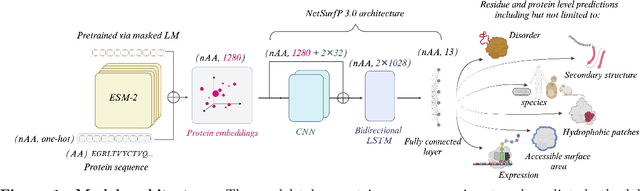
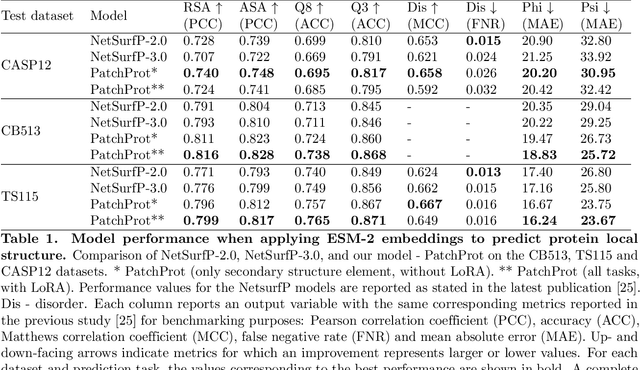
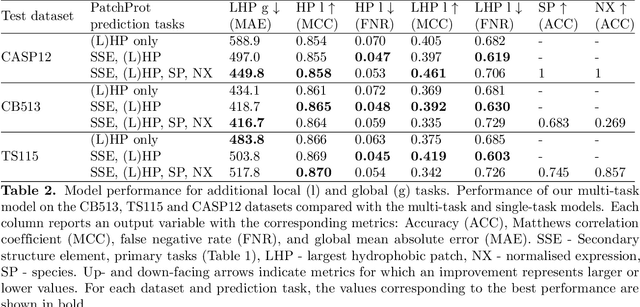
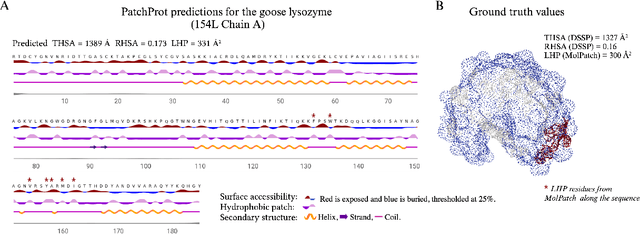
Hydrophobic patches on protein surfaces play important functional roles in protein-protein and protein-ligand interactions. Large hydrophobic surfaces are also involved in the progression of aggregation diseases. Predicting exposed hydrophobic patches from a protein sequence has been shown to be a difficult task. Fine-tuning foundation models allows for adapting a model to the specific nuances of a new task using a much smaller dataset. Additionally, multi-task deep learning offers a promising solution for addressing data gaps, simultaneously outperforming single-task methods. In this study, we harnessed a recently released leading large language model ESM-2. Efficient fine-tuning of ESM-2 was achieved by leveraging a recently developed parameter-efficient fine-tuning method. This approach enabled comprehensive training of model layers without excessive parameters and without the need to include a computationally expensive multiple sequence analysis. We explored several related tasks, at local (residue) and global (protein) levels, to improve the representation of the model. As a result, our fine-tuned ESM-2 model, PatchProt, cannot only predict hydrophobic patch areas but also outperforms existing methods at predicting primary tasks, including secondary structure and surface accessibility predictions. Importantly, our analysis shows that including related local tasks can improve predictions on more difficult global tasks. This research sets a new standard for sequence-based protein property prediction and highlights the remarkable potential of fine-tuning foundation models enriching the model representation by training over related tasks.