 Add to Chrome
 Add to Firefox
 Add to Edge
Deep Learning for Remote Sensing to Improve Flood Inundation Mapping
Jun 01, 2026
Flooding is the most pervasive natural disaster worldwide. Timely and accurate flood inundation mapping are essential for informing disaster risk management. Optical satellite missions provide high-resolution, multispectral observations critical for flood detection and inundation mapping. However, their operational utility is severely constrained by cloud cover during extreme precipitation events. Conventional cloud-removal techniques based on temporal compositing or interpolation often fail to capture inundation dynamics. In this study, we introduce a cloud-removal framework for flood imagery based on Denoising Diffusion Probabilistic Models, leveraging the Masked Diffusion Transformer architecture. The proposed approach exploits self-attention mechanisms to capture wider spatial context and employs masked token modeling to explicitly learn the reconstruction of cloud-obscured regions. Trained on multispectral Sentinel-2B flood scenes with realistic cloud patterns, the model generates cloud-free image realizations that preserve both visual fidelity and hydrological consistency. Reconstruction performance is evaluated using standard image quality metrics alongside flood-specific hydrological measures, demonstrating improved continuity of water bodies and preservation of spectral signatures critical for water detection indices. The results indicate that diffusion-based generative modeling offers a robust and physically consistent alternative for cloud removal in optical flood monitoring, enabling more reliable, continuous observations to support disaster risk management and flood-related decision making.

pathfinder: A Semantic Framework for Literature Review and Knowledge Discovery in Astronomy
Aug 02, 2024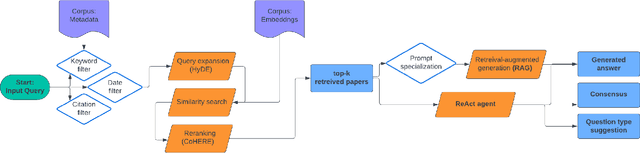


The exponential growth of astronomical literature poses significant challenges for researchers navigating and synthesizing general insights or even domain-specific knowledge. We present Pathfinder, a machine learning framework designed to enable literature review and knowledge discovery in astronomy, focusing on semantic searching with natural language instead of syntactic searches with keywords. Utilizing state-of-the-art large language models (LLMs) and a corpus of 350,000 peer-reviewed papers from the Astrophysics Data System (ADS), Pathfinder offers an innovative approach to scientific inquiry and literature exploration. Our framework couples advanced retrieval techniques with LLM-based synthesis to search astronomical literature by semantic context as a complement to currently existing methods that use keywords or citation graphs. It addresses complexities of jargon, named entities, and temporal aspects through time-based and citation-based weighting schemes. We demonstrate the tool's versatility through case studies, showcasing its application in various research scenarios. The system's performance is evaluated using custom benchmarks, including single-paper and multi-paper tasks. Beyond literature review, Pathfinder offers unique capabilities for reformatting answers in ways that are accessible to various audiences (e.g. in a different language or as simplified text), visualizing research landscapes, and tracking the impact of observatories and methodologies. This tool represents a significant advancement in applying AI to astronomical research, aiding researchers at all career stages in navigating modern astronomy literature.
Designing an Evaluation Framework for Large Language Models in Astronomy Research
May 30, 2024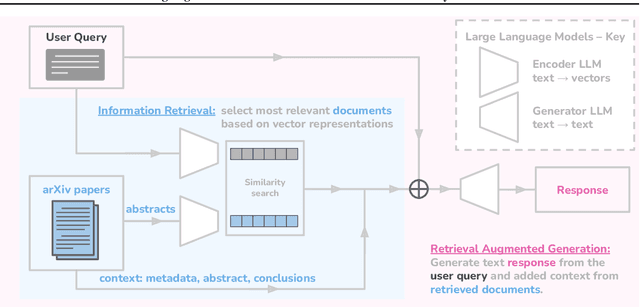
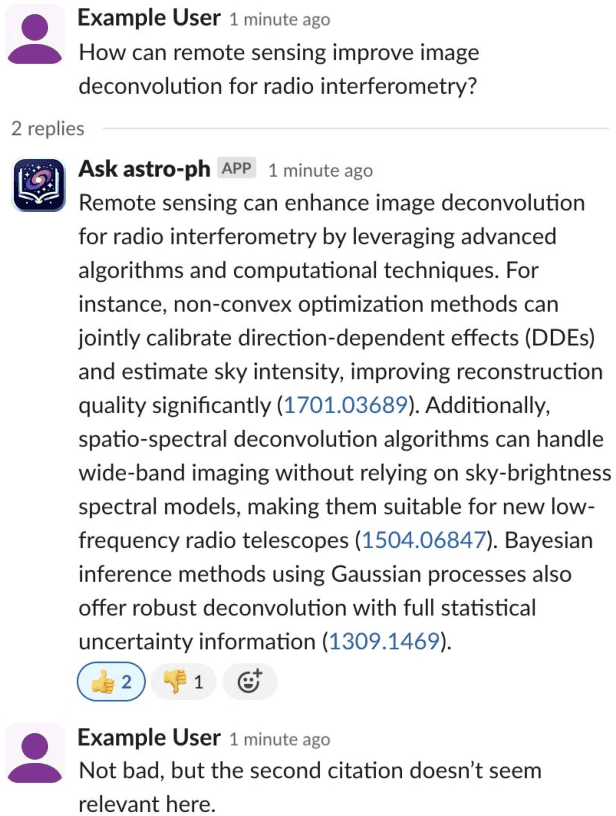
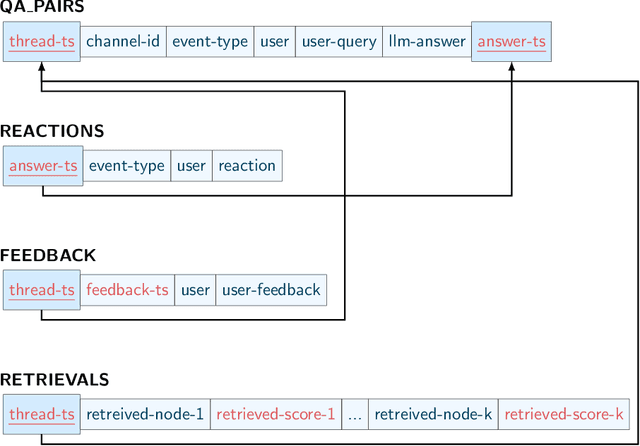
Large Language Models (LLMs) are shifting how scientific research is done. It is imperative to understand how researchers interact with these models and how scientific sub-communities like astronomy might benefit from them. However, there is currently no standard for evaluating the use of LLMs in astronomy. Therefore, we present the experimental design for an evaluation study on how astronomy researchers interact with LLMs. We deploy a Slack chatbot that can answer queries from users via Retrieval-Augmented Generation (RAG); these responses are grounded in astronomy papers from arXiv. We record and anonymize user questions and chatbot answers, user upvotes and downvotes to LLM responses, user feedback to the LLM, and retrieved documents and similarity scores with the query. Our data collection method will enable future dynamic evaluations of LLM tools for astronomy.
Machine Learning for Postprocessing Ensemble Streamflow Forecasts
Jun 15, 2021


Skillful streamflow forecasting informs decisions in various areas of water policy and management. We integrate dynamical modeling with machine learning to demonstrate the enhanced quality of streamflow forecasts at short-to medium-range timescales (1 - 7 days). Dynamical modeling generates ensemble streamflow forecasts by forcing a hydrological model with numerical weather prediction model outputs. We employ a Long Short-Term Memory (LSTM) neural network to correct forecast biases in raw ensemble streamflow forecasts obtained from dynamical modeling. For forecast verification, we use different metrics such as skill score and reliability diagram conditioned upon the lead time, flow threshold, and season. The verification results show that the LSTM can improve streamflow forecasts relative to climatological, temporal persistence, deterministic, and raw ensemble forecasts. The LSTM demonstrates improvement across all lead times, flow thresholds, and seasons. As compared to the raw ensembles, relative gain in forecast skill from LSTM is generally higher at medium-range timescales compared to initial lead time; high flows compared to low-moderate flows; and warm-season compared to the cool ones. Overall, our results highlight the benefits of LSTM for improving both the skill and reliability of streamflow forecasts.