 Add to Chrome
 Add to Firefox
 Add to Edge
Consolidator: Learning Persistent Routed Memory Across Context Boundaries
Aug 12, 2026
Copying short-term memory (STM) into a slower store can preserve state across a context boundary, but persistence alone does not ensure that the retained state influences subsequent memory access. We test this distinction in a Phasor Memory Network (PMNet) using Consolidator, a shared slot-local operator that transforms routed STM before accumulating it into long-term memory (LTM), without replaying the source tokens. After each consolidation, the KV cache and STM are cleared. The retained LTM can still be read and is also fed into the hierarchical router, thereby conditioning which explicit-memory slots subsequent inputs access. We evaluate this mechanism on a two-segment modulo-10 mapping task in which the second segment updates the mapping at the same memory address. Following a second consolidation and reset, a held-out query must recover the updated mapping from LTM. The backbone and memory interface are frozen, leaving only 12.35K Consolidator parameters trainable (0.041\% of a 29.95M model). Across five paired runs from the same STM-pretraining checkpoint, direct LTM routing raises updated-mapping recall from $44.38\pm1.94\%$ to $87.02\pm1.76\%$ ($+42.64\pm1.10$ percentage points), while immediate STM recall remains 89.90\% in both conditions; both train separate Consolidators and retain the same LTM read paths. Learned consolidation outperforms forced identity accumulation by $21.40\pm1.91$ percentage points without routing and $68.70\pm1.76$ with routing. Thus, on this task, consolidated LTM serves as both retrievable content and an access state that shapes subsequent slot selection.

Phasor Attention: Mean Root Square Normalization for Phase Manifold Preservation
Jul 20, 2026While Root Mean Square Normalization has become the de facto standard for accelerating modern sequence models, its reliance on the quadratic accumulation of independent scalars ($\sum x^2$) inherently triggers outlier-induced numerical instability, gradient starvation, and anisotropic phase distortion. We introduce Mean Root Square Normalization (MRSNorm). By structurally pairing channels into 2D phasors, MRSNorm mathematically inverts the traditional scaling paradigm: it computes the localized $L_2$ magnitudes (Root Square) before aggregating them via a global $L_1$ average (Mean). This operational inversion strictly constrains activations to a phasor manifold, preserving conformal invariance. By sharing a single affine weight across phasor components, MRSNorm halves the total number of learnable parameters, proving that unconstrained spatial scaling in standard norms is a harmful redundancy. We analytically demonstrate that this geometric constraint yields a built-in, trigonometric gradient clipper governed by the Pythagorean identity, unconditionally equalizing the local gradient norm to ensure Gradient Homogeneity. Empirical evaluations on a ResNet with CIFAR-100 show that despite halved parameters, MRSNorm provides critical structural stability under rigorous stress tests. Under extreme hyperparameter settings where standard normalizations suffer from gradient divergence, MRSNorm successfully prevents numerical explosion and secures stable optimization trajectories. Our findings propose a fundamental paradigm shift toward phasor-based deep representation learning. The implementation of MRSNorm is available at Appendix C.
Z-Plane Neural Networks: Bounded Geometric Activation Replaces ReLU and LayerNorm
Jun 14, 2026Modern deep neural networks rely on Euclidean scalar activations (e.g., ReLU) and global normalization techniques (e.g., LayerNorm) to prevent gradient instability in deep architectures. However, these mechanisms inherently cause dead neurons, discard critical directional information, and destroy the orthogonality of feature representations. Inspired by the frequency-modulation transmission of biological axons, we propose the Z-Plane Neural Network, which maps hidden states into 2D phasor bundles on a hypersphere. We introduce a novel geometric activation function, Radial Bounding($\mathbf{x} / \max(1, \|\mathbf{x}\|_2)$), which limits the energy magnitude while preserving the phase (direction). We demonstrate mathematically that this isotropic activation maintains 1-Lipschitz continuity and prevents gradient vanishing by preserving tangential gradients. Empirically, a 100-layer Z-Plane Multi-Layer Perceptron (MLP)-entirely devoid of ReLU and LayerNorm-successfully converges on the MNIST dataset with 98.34% accuracy and absolute numerical stability, proving that bounded geometric activation alone is sufficient for stable deep learning.
Phasor Memory Networks: Stable Backpropagation Through Time for Scalable Explicit Memory
May 13, 2026For over a decade, explicit memory architectures like the Neural Turing Machine have remained theoretically appealing yet practically intractable for language modeling due to catastrophic gradient instability during Backpropagation Through Time. In this work, we break this stalemate with \textit{Phasor Memory Network} (PMNet), a novel architecture that structurally resolves memory volatility through \textit{Unitary Phasor Dynamics} and \textit{Hierarchical Learnable Anchors}. Rather than relying on brute-force scaling, we present a mechanistic proof-of-concept in a controlled byte-level setting. By constraining recurrent state updates to phase rotations on a complex unit circle, PMNet preserves gradient norms and inherently prevents divergence without the need for specialized initialization. We empirically demonstrate the active actuation of the memory module through a synthetic Copy-Paste task, where PMNet utilizes an expansive \textit{85-slot hierarchical memory tree} ($=\sum^{4}_{h=1}4^{h-1}$) to achieve near 100\% exact retrieval across temporal distances that completely exceed the local sliding window attention's receptive field. Furthermore, despite being a compact 119M parameter model trained on 18.8B tokens, PMNet matches the zero-shot long-context robustness of a Mamba model that is three times larger. Our ablation studies and gradient analyses confirm that the historical failure of explicit memory was a structural alignment problem, which PMNet effectively overcomes, providing a theoretically grounded foundation for scalable sequence modeling.
LED: A Benchmark for Evaluating Layout Error Detection in Document Analysis
Mar 18, 2026Recent advances in Large Language Models (LLMs) and Large Multimodal Models (LMMs) have improved Document Layout Analysis (DLA), yet structural errors such as region merging, splitting, and omission remain persistent. Conventional overlap-based metrics (e.g., IoU, mAP) fail to capture such logical inconsistencies. To overcome this limitation, we propose Layout Error Detection (LED), a benchmark that evaluates structural reasoning in DLA predictions beyond surface-level accuracy. LED defines eight standardized error types (Missing, Hallucination, Size Error, Split, Merge, Overlap, Duplicate, and Misclassification) and provides quantitative rules and injection algorithms for realistic error simulation. Using these definitions, we construct LED-Dataset and design three evaluation tasks: document-level error detection, document-level error-type classification, and element-level error-type classification. Experiments with state-of-the-art multimodal models show that LED enables fine-grained and interpretable assessment of structural understanding, revealing clear weaknesses across modalities and architectures. Overall, LED establishes a unified and explainable benchmark for diagnosing the structural robustness and reasoning capability of document understanding models.
LANGALIGN: Enhancing Non-English Language Models via Cross-Lingual Embedding Alignment
Mar 25, 2025While Large Language Models have gained attention, many service developers still rely on embedding-based models due to practical constraints. In such cases, the quality of fine-tuning data directly impacts performance, and English datasets are often used as seed data for training non-English models. In this study, we propose LANGALIGN, which enhances target language processing by aligning English embedding vectors with those of the target language at the interface between the language model and the task header. Experiments on Korean, Japanese, and Chinese demonstrate that LANGALIGN significantly improves performance across all three languages. Additionally, we show that LANGALIGN can be applied in reverse to convert target language data into a format that an English-based model can process.
Like Father, Like Son: Kinship-Aware Preference Mapping (KARMA) for Automatic Alignment in Large Language Models
Feb 26, 2025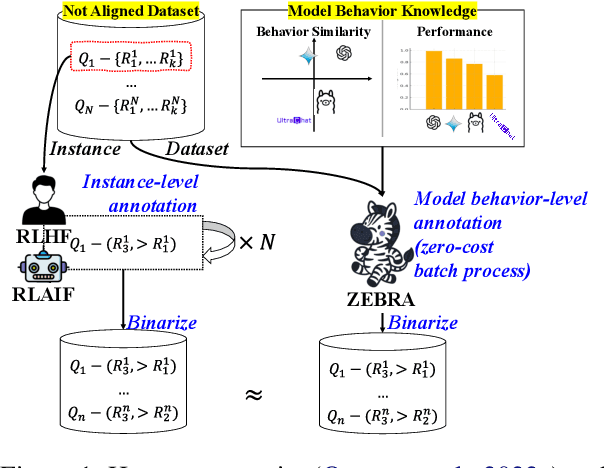

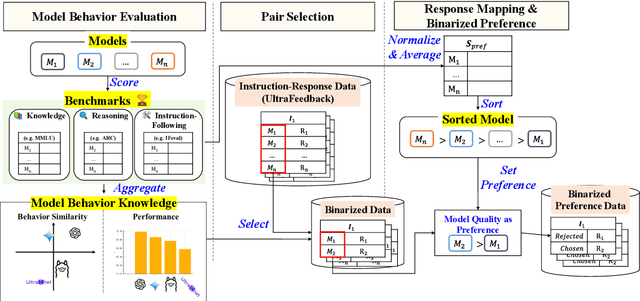
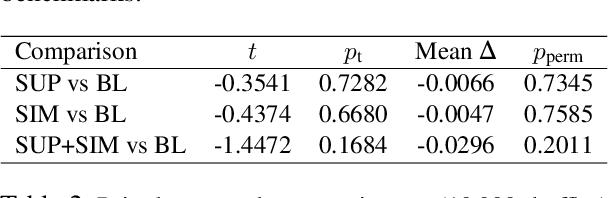
Recent advancements in Large Language Model (LLM) alignment have sought to mitigate the cost of human annotations by leveraging pretrained models to generate preference data. However, existing methods often compare responses from models with substantially different capabilities, yielding superficial distinctions that fail to provide meaningful guidance on what constitutes a superior response. To address this limitation, we propose Kinship-Aware pReference MApping (KARMA), a novel framework that systematically pairs responses from models with comparable competencies. By constraining preference comparisons to outputs of similar complexity and quality, KARMA enhances the informativeness of preference data and improves the granularity of alignment signals. Empirical evaluations demonstrate that our kinship-aware approach leads to more consistent and interpretable alignment outcomes, ultimately facilitating a more principled and reliable pathway for aligning LLM behavior with human preferences.
Guidance-Based Prompt Data Augmentation in Specialized Domains for Named Entity Recognition
Jul 26, 2024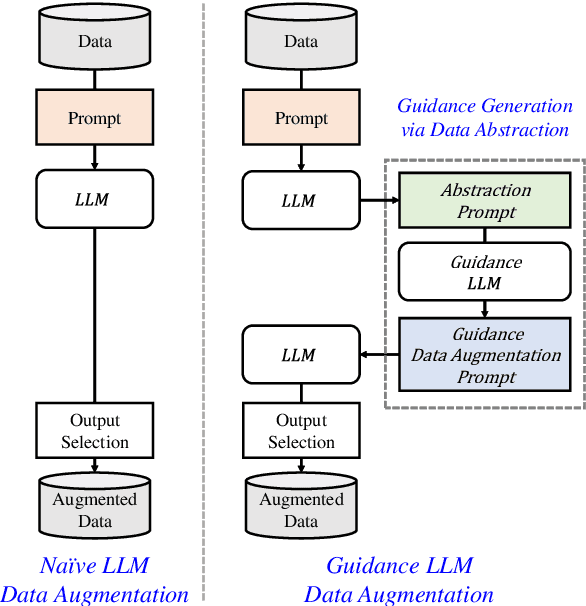
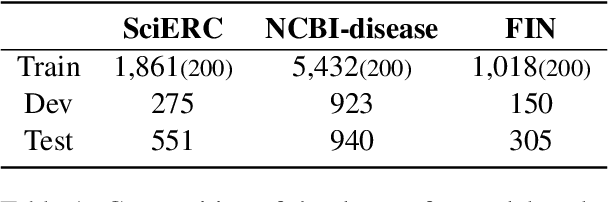
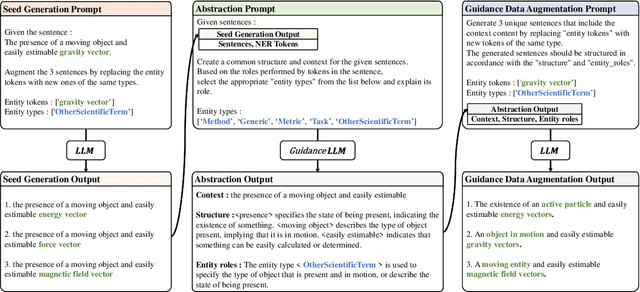
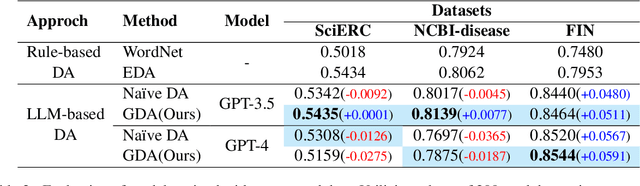
While the abundance of rich and vast datasets across numerous fields has facilitated the advancement of natural language processing, sectors in need of specialized data types continue to struggle with the challenge of finding quality data. Our study introduces a novel guidance data augmentation technique utilizing abstracted context and sentence structures to produce varied sentences while maintaining context-entity relationships, addressing data scarcity challenges. By fostering a closer relationship between context, sentence structure, and role of entities, our method enhances data augmentation's effectiveness. Consequently, by showcasing diversification in both entity-related vocabulary and overall sentence structure, and simultaneously improving the training performance of named entity recognition task.
Exploring Domain Robust Lightweight Reward Models based on Router Mechanism
Jul 24, 2024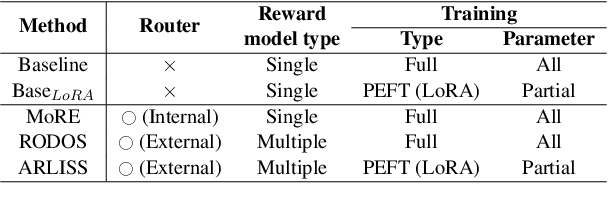
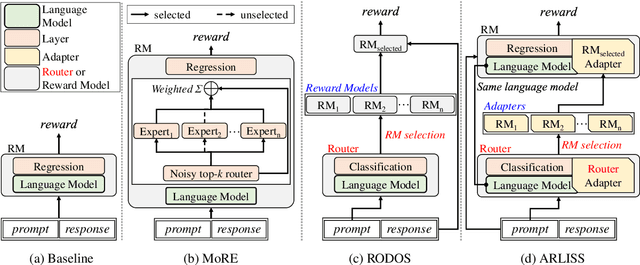
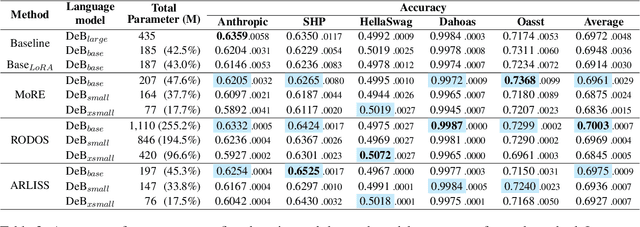

Recent advancements in large language models have heavily relied on the large reward model from reinforcement learning from human feedback for fine-tuning. However, the use of a single reward model across various domains may not always be optimal, often requiring retraining from scratch when new domain data is introduced. To address these challenges, we explore the utilization of small language models operating in a domain-specific manner based on router mechanisms. Our three approaches are: 1) utilize mixture of experts to form a single reward model by modularizing an internal router and experts, 2) employing external router to select the appropriate reward model from multiple domain-specific models, and 3) the framework reduces parameter size by loading reward models and router adapters onto a single small language model using adapters. Experimental validation underscores the effectiveness of our approach, demonstrating performance comparable to baseline methods while also reducing the total parameter size.
Does Incomplete Syntax Influence Korean Language Model? Focusing on Word Order and Case Markers
Jul 12, 2024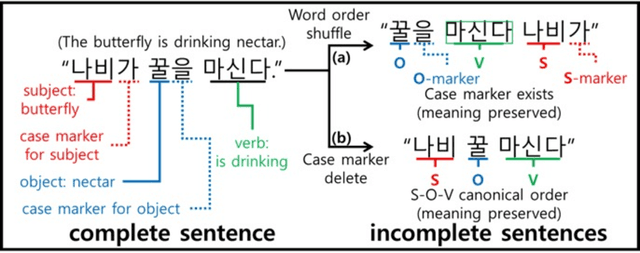


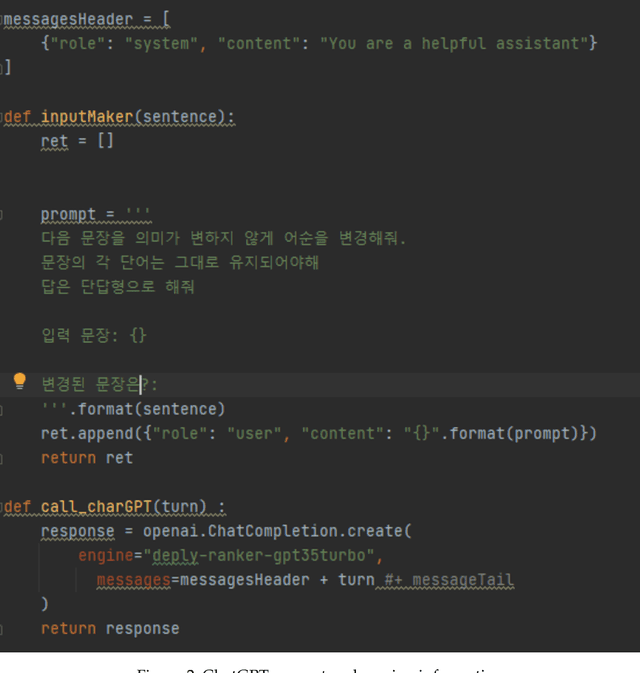
Syntactic elements, such as word order and case markers, are fundamental in natural language processing. Recent studies show that syntactic information boosts language model performance and offers clues for people to understand their learning mechanisms. Unlike languages with a fixed word order such as English, Korean allows for varied word sequences, despite its canonical structure, due to case markers that indicate the functions of sentence components. This study explores whether Korean language models can accurately capture this flexibility. We note that incomplete word orders and omitted case markers frequently appear in ordinary Korean communication. To investigate this further, we introduce the Syntactically Incomplete Korean (SIKO) dataset. Through SIKO, we assessed Korean language models' flexibility with incomplete syntax and confirmed the dataset's training value. Results indicate these models reflect Korean's inherent flexibility, accurately handling incomplete inputs. Moreover, fine-tuning with SIKO enhances the ability to handle common incomplete Korean syntactic forms. The dataset's simple construction process, coupled with significant performance enhancements, solidifies its standing as an effective data augmentation technique.