 Add to Chrome
 Add to Firefox
 Add to Edge
LED: A Benchmark for Evaluating Layout Error Detection in Document Analysis
Mar 18, 2026
Recent advances in Large Language Models (LLMs) and Large Multimodal Models (LMMs) have improved Document Layout Analysis (DLA), yet structural errors such as region merging, splitting, and omission remain persistent. Conventional overlap-based metrics (e.g., IoU, mAP) fail to capture such logical inconsistencies. To overcome this limitation, we propose Layout Error Detection (LED), a benchmark that evaluates structural reasoning in DLA predictions beyond surface-level accuracy. LED defines eight standardized error types (Missing, Hallucination, Size Error, Split, Merge, Overlap, Duplicate, and Misclassification) and provides quantitative rules and injection algorithms for realistic error simulation. Using these definitions, we construct LED-Dataset and design three evaluation tasks: document-level error detection, document-level error-type classification, and element-level error-type classification. Experiments with state-of-the-art multimodal models show that LED enables fine-grained and interpretable assessment of structural understanding, revealing clear weaknesses across modalities and architectures. Overall, LED establishes a unified and explainable benchmark for diagnosing the structural robustness and reasoning capability of document understanding models.

FEAT: A Preference Feedback Dataset through a Cost-Effective Auto-Generation and Labeling Framework for English AI Tutoring
Jun 24, 2025
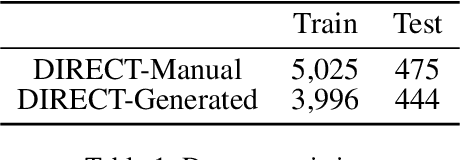
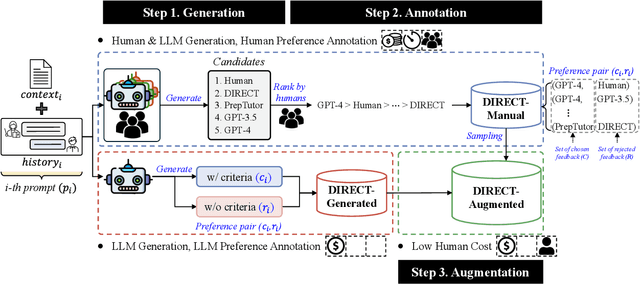
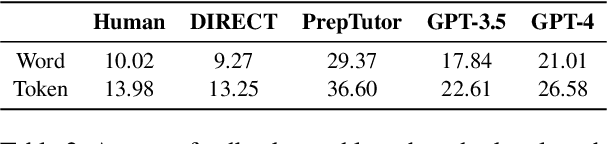
In English education tutoring, teacher feedback is essential for guiding students. Recently, AI-based tutoring systems have emerged to assist teachers; however, these systems require high-quality and large-scale teacher feedback data, which is both time-consuming and costly to generate manually. In this study, we propose FEAT, a cost-effective framework for generating teacher feedback, and have constructed three complementary datasets: (1) DIRECT-Manual (DM), where both humans and large language models (LLMs) collaboratively generate high-quality teacher feedback, albeit at a higher cost; (2) DIRECT-Generated (DG), an LLM-only generated, cost-effective dataset with lower quality;, and (3) DIRECT-Augmented (DA), primarily based on DG with a small portion of DM added to enhance quality while maintaining cost-efficiency. Experimental results showed that incorporating a small portion of DM (5-10%) into DG leads to superior performance compared to using 100% DM alone.
Employing Layerwised Unsupervised Learning to Lessen Data and Loss Requirements in Forward-Forward Algorithms
Apr 23, 2024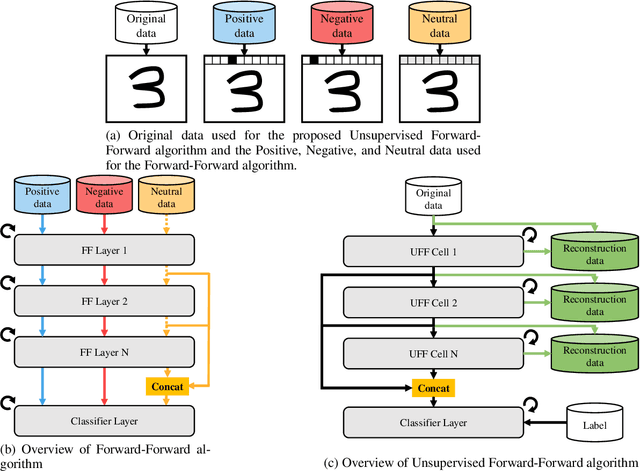
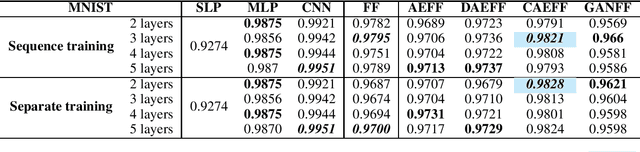
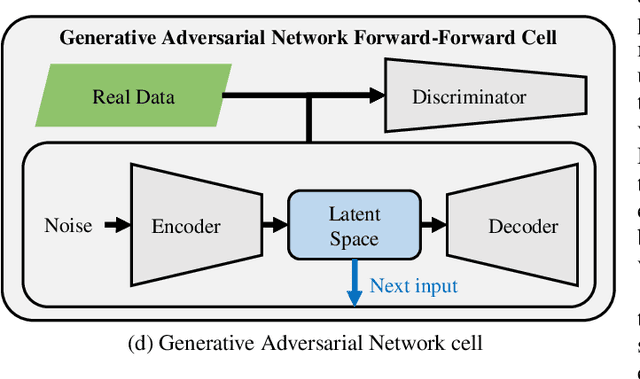
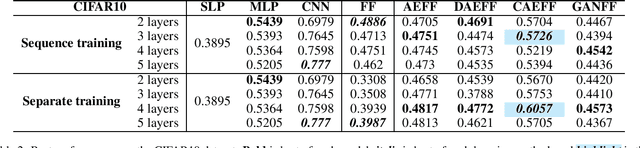
Recent deep learning models such as ChatGPT utilizing the back-propagation algorithm have exhibited remarkable performance. However, the disparity between the biological brain processes and the back-propagation algorithm has been noted. The Forward-Forward algorithm, which trains deep learning models solely through the forward pass, has emerged to address this. Although the Forward-Forward algorithm cannot replace back-propagation due to limitations such as having to use special input and loss functions, it has the potential to be useful in special situations where back-propagation is difficult to use. To work around this limitation and verify usability, we propose an Unsupervised Forward-Forward algorithm. Using an unsupervised learning model enables training with usual loss functions and inputs without restriction. Through this approach, we lead to stable learning and enable versatile utilization across various datasets and tasks. From a usability perspective, given the characteristics of the Forward-Forward algorithm and the advantages of the proposed method, we anticipate its practical application even in scenarios such as federated learning, where deep learning layers need to be trained separately in physically distributed environments.