 Add to Chrome
 Add to Firefox
 Add to Edge
KCSAT-ML: Probing Reasoning Models with Nationwide-Cohort Human Difficulty
Jun 09, 2026
Math reasoning benchmarks have proliferated, yet most lack a per-item difficulty signal grounded in actual human performance. We introduce KCSAT-ML, a decade (2014-2025) of Korean College Scholastic Ability Test (KCSAT; Suneung) mathematics: 664 problems with a 339-item core set carrying official per-item error rates from nationwide cohorts of hundreds of thousands of examinees. We pair the benchmark with Difficulty-aligned Reasoning Gain (DRG): a score-orthogonal metric that asks whether a model's mistakes concentrate on the items humans found hard, or on items humans found easy. Together they expose, across a wide range of VLMs (and LLMs via OCR), three patterns: (i) low-budget accuracy collapses on the high-human-error tail at every model size; (ii) test-time scaling (TTS) raises token use roughly linearly with cohort error rate, while accuracy gains follow a non-monotonic curve; (iii) within a single family, TTS flips between anti-scaling on the hardest items and overthinking on easier ones -- two faces of the same alignment failure. On DRG, models with near-identical accuracy can sit at near-opposite values: one model gets wrong what humans also find hard, while another solves the hardest items yet fails on items humans find easy -- a contrast that aggregate accuracy hides. Our code and dataset builder will be open-sourced at https://github.com/naver-ai/KCSAT-ML.

MM-JudgeBias: A Benchmark for Evaluating Compositional Biases in MLLM-as-a-Judge
Apr 21, 2026Multimodal Large Language Models (MLLMs) have been increasingly used as automatic evaluators-a paradigm known as MLLM-as-a-Judge. However, their reliability and vulnerabilities to biases remain underexplored. We find that many MLLM judges fail to reliably integrate key visual or textual cues, yielding unreliable evaluations when evidence is missing or mismatched, and exhibiting instability under semantically irrelevant perturbations. To address this, we systematically define Compositional Bias in MLLM-as-a-Judge systems and introduce MM-JudgeBias, a benchmark for evaluating it. MM-JudgeBias introduces controlled perturbations across Query, Image, and Response, and evaluates model behavior via two complementary metrics: Bias-Deviation (BD) for sensitivity and Bias-Conformity (BC) for stability. Our dataset of over 1,800 curated and refined multimodal samples, drawn from 29 source benchmarks, enables a fine-grained diagnosis of nine bias types across diverse tasks and domains. Experiments on 26 state-of-the-art MLLMs reveal systematic modality neglect and asymmetric evaluation tendencies, underscoring the need for more reliable judges.
Evaluating Multimodal Generative AI with Korean Educational Standards
Feb 21, 2025This paper presents the Korean National Educational Test Benchmark (KoNET), a new benchmark designed to evaluate Multimodal Generative AI Systems using Korean national educational tests. KoNET comprises four exams: the Korean Elementary General Educational Development Test (KoEGED), Middle (KoMGED), High (KoHGED), and College Scholastic Ability Test (KoCSAT). These exams are renowned for their rigorous standards and diverse questions, facilitating a comprehensive analysis of AI performance across different educational levels. By focusing on Korean, KoNET provides insights into model performance in less-explored languages. We assess a range of models - open-source, open-access, and closed APIs - by examining difficulties, subject diversity, and human error rates. The code and dataset builder will be made fully open-sourced at https://github.com/naver-ai/KoNET.
Cream: Visually-Situated Natural Language Understanding with Contrastive Reading Model and Frozen Large Language Models
May 24, 2023
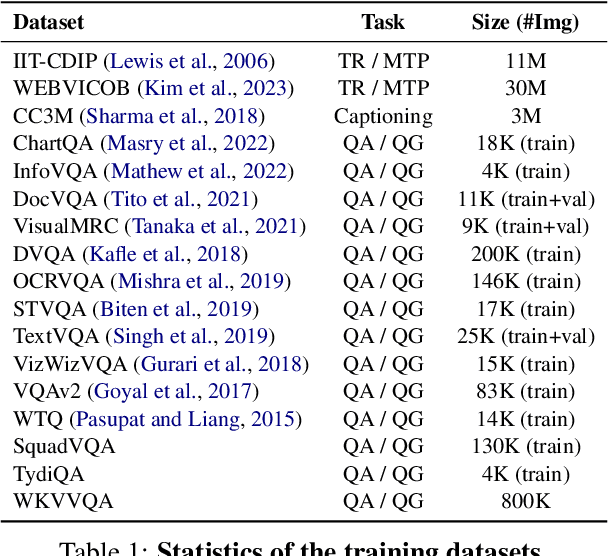

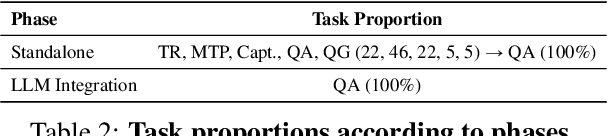
Advances in Large Language Models (LLMs) have inspired a surge of research exploring their expansion into the visual domain. While recent models exhibit promise in generating abstract captions for images and conducting natural conversations, their performance on text-rich images leaves room for improvement. In this paper, we propose the Contrastive Reading Model (Cream), a novel neural architecture designed to enhance the language-image understanding capability of LLMs by capturing intricate details typically overlooked by existing methods. Cream integrates vision and auxiliary encoders, complemented by a contrastive feature alignment technique, resulting in a more effective understanding of textual information within document images. Our approach, thus, seeks to bridge the gap between vision and language understanding, paving the way for more sophisticated Document Intelligence Assistants. Rigorous evaluations across diverse tasks, such as visual question answering on document images, demonstrate the efficacy of Cream as a state-of-the-art model in the field of visual document understanding. We provide our codebase and newly-generated datasets at https://github.com/naver-ai/cream