 Add to Chrome
 Add to Firefox
 Add to Edge
Asymptotic Theory for Graphical SLOPE: Precision Estimation and Pattern Convergence
Apr 14, 2026
This paper studies Graphical SLOPE for precision matrix estimation, with emphasis on its ability to recover both sparsity and clusters of edges with equal or similar strength. In a fixed-dimensional regime, we establish that the root-$n$ scaled estimation error converges to the unique minimizer of a strictly convex optimization problem defined through the directional derivative of the SLOPE penalty. We also establish convergence of the induced SLOPE pattern, thereby obtaining an asymptotic characterization of the clustering structure selected by the estimator. A comparison with GLASSO shows that the grouping property of SLOPE can substantially improve estimation accuracy when the precision matrix exhibits structured edge patterns. To assess the effect of departures from Gaussianity, we then analyze Gaussian-loss precision matrix estimation under elliptical distributions. In this setting, we derive the limiting distribution and quantify the inflation in variability induced by heavy tails relative to the Gaussian benchmark. We also study TSLOPE, based on the multivariate $t$-loss, and derive its limiting distribution. The results show that TSLOPE offers clear advantages over GSLOPE under heavy-tailed data-generating mechanisms. Simulation evidence suggests that these qualitative conclusions persist in high-dimensional settings, and an empirical application shows that SLOPE-based estimators, especially TSLOPE, can uncover economically meaningful clustered dependence structures.

Stock Price Prediction Using Temporal Graph Model with Value Chain Data
Mar 07, 2023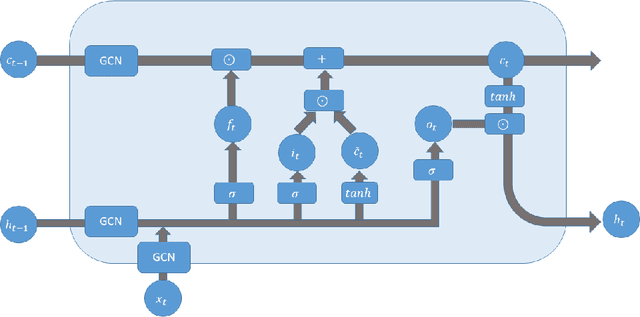
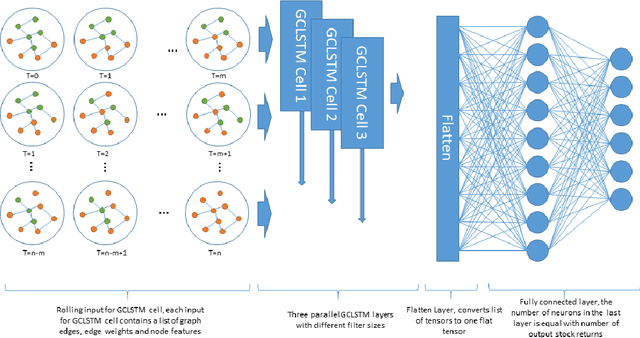
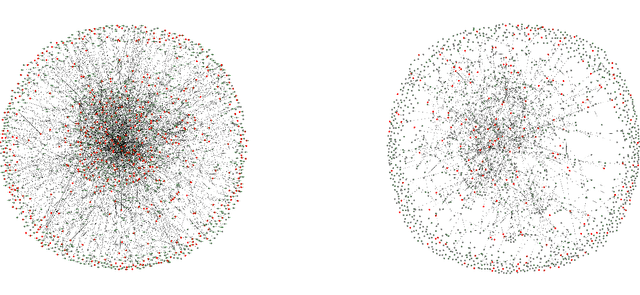
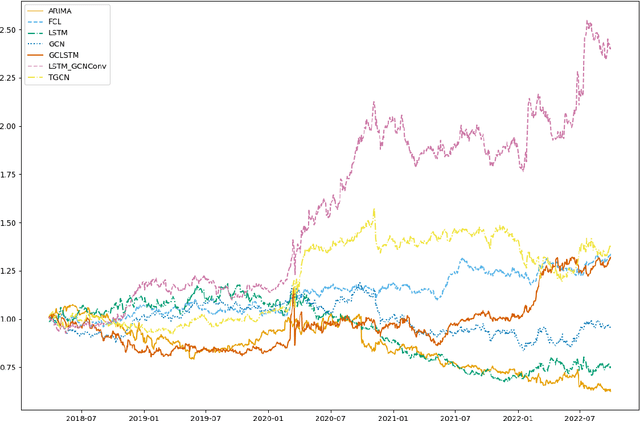
Stock price prediction is a crucial element in financial trading as it allows traders to make informed decisions about buying, selling, and holding stocks. Accurate predictions of future stock prices can help traders optimize their trading strategies and maximize their profits. In this paper, we introduce a neural network-based stock return prediction method, the Long Short-Term Memory Graph Convolutional Neural Network (LSTM-GCN) model, which combines the Graph Convolutional Network (GCN) and Long Short-Term Memory (LSTM) Cells. Specifically, the GCN is used to capture complex topological structures and spatial dependence from value chain data, while the LSTM captures temporal dependence and dynamic changes in stock returns data. We evaluated the LSTM-GCN model on two datasets consisting of constituents of Eurostoxx 600 and S&P 500. Our experiments demonstrate that the LSTM-GCN model can capture additional information from value chain data that are not fully reflected in price data, and the predictions outperform baseline models on both datasets.