 Add to Chrome
 Add to Firefox
 Add to Edge
MarkushGlyph and OCSRGlyph: Improved Chemical Structure Recognition
Jul 30, 2026
Chemical structures appear in patents and the scientific literature as images. For programmatic usage, such as indexing in databases or constructing machine learning model training sets, they must be transformed into line notations. The two common forms of this task are translating an image of a single molecule (optical chemical structure recognition - OCSR) and translating a Markush structure that represents a family of molecules. While prior work in the former case is quite mature, Markush structure parsing remains a challenging task. In this work, we treat both tasks as an image-to-text translation problem. We then propose OCSRGlyph, a state-of-the-art OCSR model, improving performance over prior methods by carefully considering stereochemistry. For the Markush task, we introduce MarkushGlyph, a vision-language model that reads the entire Markush structure as an image. This contrasts with prior systems, which often use multiple stages to separately process visual and text input content. Finally, we introduce a new metric for determining the accuracy of Markush structure translations, handling failure modes present in prior metrics.

BioPlanner: Automatic Evaluation of LLMs on Protocol Planning in Biology
Oct 16, 2023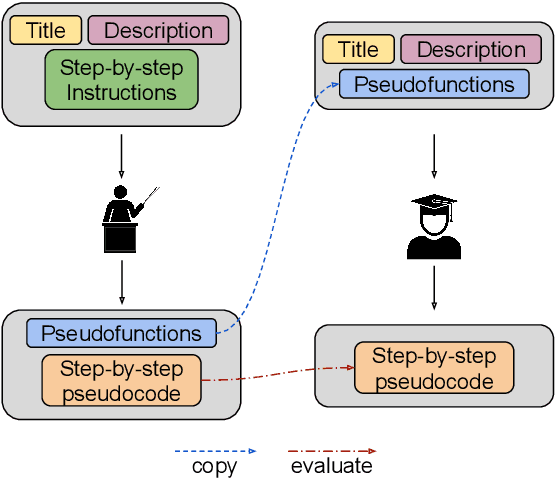
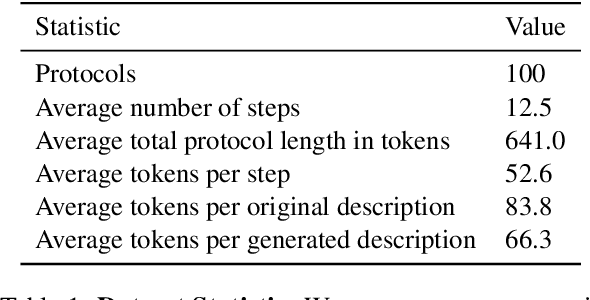


The ability to automatically generate accurate protocols for scientific experiments would represent a major step towards the automation of science. Large Language Models (LLMs) have impressive capabilities on a wide range of tasks, such as question answering and the generation of coherent text and code. However, LLMs can struggle with multi-step problems and long-term planning, which are crucial for designing scientific experiments. Moreover, evaluation of the accuracy of scientific protocols is challenging, because experiments can be described correctly in many different ways, require expert knowledge to evaluate, and cannot usually be executed automatically. Here we present an automatic evaluation framework for the task of planning experimental protocols, and we introduce BioProt: a dataset of biology protocols with corresponding pseudocode representations. To measure performance on generating scientific protocols, we use an LLM to convert a natural language protocol into pseudocode, and then evaluate an LLM's ability to reconstruct the pseudocode from a high-level description and a list of admissible pseudocode functions. We evaluate GPT-3 and GPT-4 on this task and explore their robustness. We externally validate the utility of pseudocode representations of text by generating accurate novel protocols using retrieved pseudocode, and we run a generated protocol successfully in our biological laboratory. Our framework is extensible to the evaluation and improvement of language model planning abilities in other areas of science or other areas that lack automatic evaluation.