 Add to Chrome
 Add to Firefox
 Add to Edge
MIRA: A Score for Conditional Distribution Accuracy and Model Comparison
May 03, 2026
We introduce Mira, a sample-based score for assessing the accuracy of a candidate conditional distribution using only joint samples from the true data-generating process. Relying on the principle that distributions coincide if they assign equal probability mass to all regions, we derive an analytic expression for the Mira statistic, whose average defines the Mira score. This formulation further allows us to compute theoretical reference values and uncertainty estimates when the candidate distribution matches the true one. This framework enables model comparison by quantifying the alignment between the conditional distribution of a candidate model and the true data generating process. Consequently, Mira enables Bayesian model comparison through direct posterior validation, bypassing the challenging evidence computation. We demonstrate its effectiveness across several toy problems and Bayesian inference tasks.

PQMass: Probabilistic Assessment of the Quality of Generative Models using Probability Mass Estimation
Feb 06, 2024

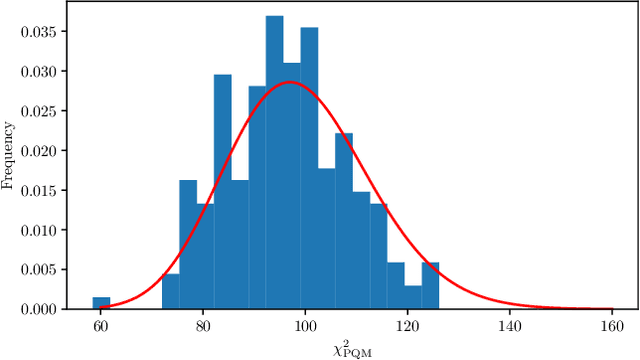
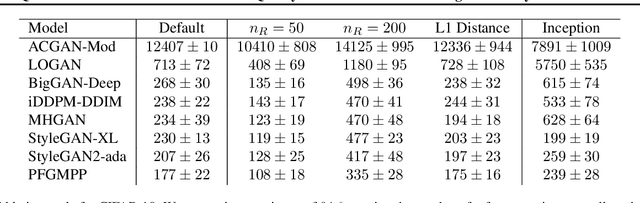
We propose a comprehensive sample-based method for assessing the quality of generative models. The proposed approach enables the estimation of the probability that two sets of samples are drawn from the same distribution, providing a statistically rigorous method for assessing the performance of a single generative model or the comparison of multiple competing models trained on the same dataset. This comparison can be conducted by dividing the space into non-overlapping regions and comparing the number of data samples in each region. The method only requires samples from the generative model and the test data. It is capable of functioning directly on high-dimensional data, obviating the need for dimensionality reduction. Significantly, the proposed method does not depend on assumptions regarding the density of the true distribution, and it does not rely on training or fitting any auxiliary models. Instead, it focuses on approximating the integral of the density (probability mass) across various sub-regions within the data space.