 Add to Chrome
 Add to Firefox
 Add to Edge
MIRA: A Score for Conditional Distribution Accuracy and Model Comparison
May 03, 2026
We introduce Mira, a sample-based score for assessing the accuracy of a candidate conditional distribution using only joint samples from the true data-generating process. Relying on the principle that distributions coincide if they assign equal probability mass to all regions, we derive an analytic expression for the Mira statistic, whose average defines the Mira score. This formulation further allows us to compute theoretical reference values and uncertainty estimates when the candidate distribution matches the true one. This framework enables model comparison by quantifying the alignment between the conditional distribution of a candidate model and the true data generating process. Consequently, Mira enables Bayesian model comparison through direct posterior validation, bypassing the challenging evidence computation. We demonstrate its effectiveness across several toy problems and Bayesian inference tasks.

Blind Strong Gravitational Lensing Inversion: Joint Inference of Source and Lens Mass with Score-Based Models
Nov 06, 2025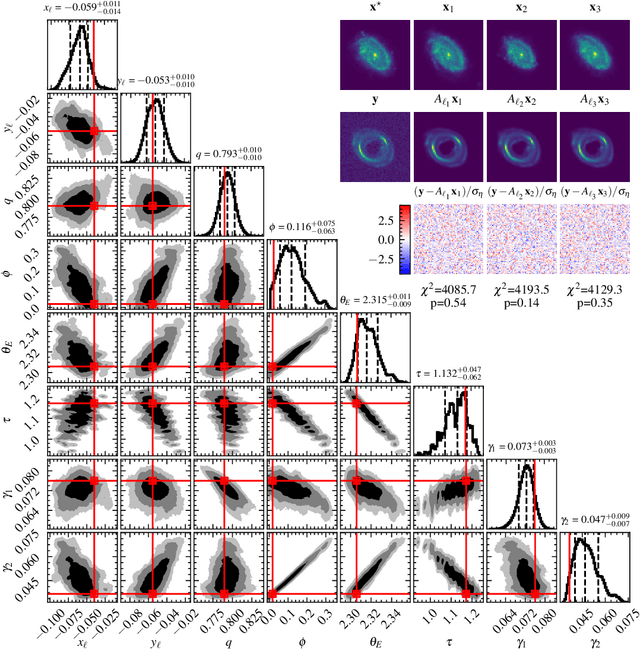
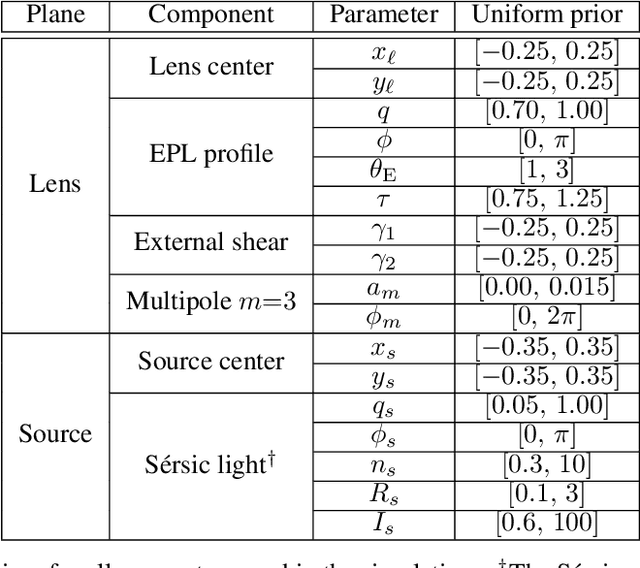
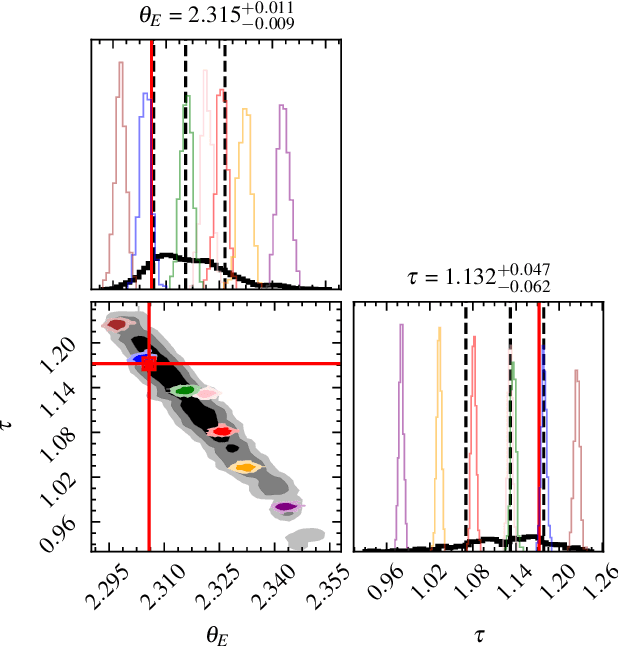
Score-based models can serve as expressive, data-driven priors for scientific inverse problems. In strong gravitational lensing, they enable posterior inference of a background galaxy from its distorted, multiply-imaged observation. Previous work, however, assumes that the lens mass distribution (and thus the forward operator) is known. We relax this assumption by jointly inferring the source and a parametric lens-mass profile, using a sampler based on GibbsDDRM but operating in continuous time. The resulting reconstructions yield residuals consistent with the observational noise, and the marginal posteriors of the lens parameters recover true values without systematic bias. To our knowledge, this is the first successful demonstration of joint source-and-lens inference with a score-based prior.
Tackling the Problem of Distributional Shifts: Correcting Misspecified, High-Dimensional Data-Driven Priors for Inverse Problems
Jul 24, 2024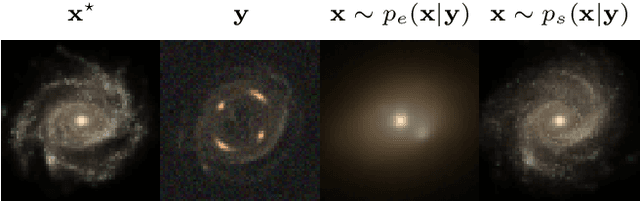
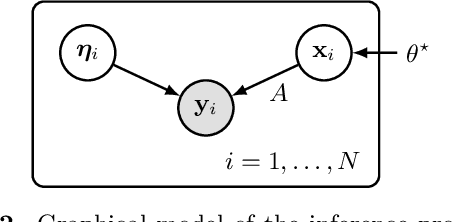
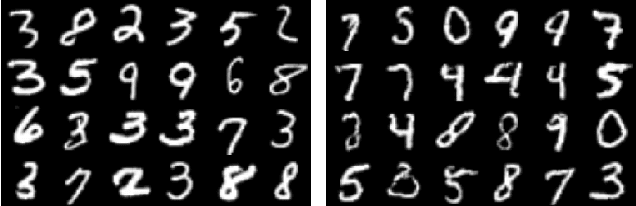
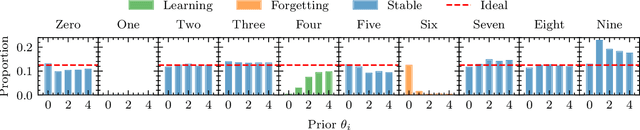
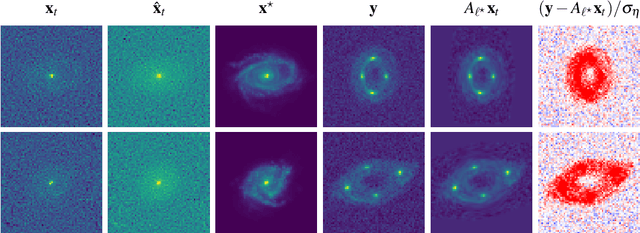
Bayesian inference for inverse problems hinges critically on the choice of priors. In the absence of specific prior information, population-level distributions can serve as effective priors for parameters of interest. With the advent of machine learning, the use of data-driven population-level distributions (encoded, e.g., in a trained deep neural network) as priors is emerging as an appealing alternative to simple parametric priors in a variety of inverse problems. However, in many astrophysical applications, it is often difficult or even impossible to acquire independent and identically distributed samples from the underlying data-generating process of interest to train these models. In these cases, corrupted data or a surrogate, e.g. a simulator, is often used to produce training samples, meaning that there is a risk of obtaining misspecified priors. This, in turn, can bias the inferred posteriors in ways that are difficult to quantify, which limits the potential applicability of these models in real-world scenarios. In this work, we propose addressing this issue by iteratively updating the population-level distributions by retraining the model with posterior samples from different sets of observations and showcase the potential of this method on the problem of background image reconstruction in strong gravitational lensing when score-based models are used as data-driven priors. We show that starting from a misspecified prior distribution, the updated distribution becomes progressively closer to the underlying population-level distribution, and the resulting posterior samples exhibit reduced bias after several updates.