 Add to Chrome
 Add to Firefox
 Add to Edge
Exploring Agentic Workflows for Generating High Quality Math Visual Aids
Jul 10, 2026
Mathematical diagrams play a crucial role in K 12 education, both as problem components and as scaffolding for student comprehension. However, current AI tools, including Large Language Models (LLMs), struggle to reliably generate accurate and pedagogically sound visual diagrams, even when provided with detailed descriptions. A significant gap therefore remains in the reliable generation of diagrams for middle school mathematics. To address this, we introduce an agentic workflow that enables LLM agents to evaluate the quality of generated visuals and use this feedback to iteratively improve their outputs. This self improvement loop aims to enhance the accuracy and educational appropriateness of AI generated diagrams. Our research investigates two questions. First, can LLMs accurately generate quality assurance questions for a visual aid given specific criteria for visual quality? Second, given valid quality assurance questions, can Vision Language Models effectively evaluate generated K 12 visual aids and use the resulting feedback to improve them iteratively? We conduct an exploratory evaluation of our agentic workflow and identify key areas for improvement, including stronger spatial reasoning and more comprehensive coverage of diagram features in the generated quality assurance questions. Our results provide preliminary evidence that this approach can improve the reliability and educational value of AI generated mathematical diagrams.

Using Vision + Language Models to Predict Item Difficulty
Mar 04, 2026This project investigates the capabilities of large language models (LLMs) to determine the difficulty of data visualization literacy test items. We explore whether features derived from item text (question and answer options), the visualization image, or a combination of both can predict item difficulty (proportion of correct responses) for U.S. adults. We use GPT-4.1-nano to analyze items and generate predictions based on these distinct feature sets. The multimodal approach, using both visual and text features, yields the lowest mean absolute error (MAE) (0.224), outperforming the unimodal vision-only (0.282) and text-only (0.338) approaches. The best-performing multimodal model was applied to a held-out test set for external evaluation and achieved a mean squared error of 0.10805, demonstrating the potential of LLMs for psychometric analysis and automated item development.
Unlimited Road-scene Synthetic Annotation (URSA) Dataset
Jul 16, 2018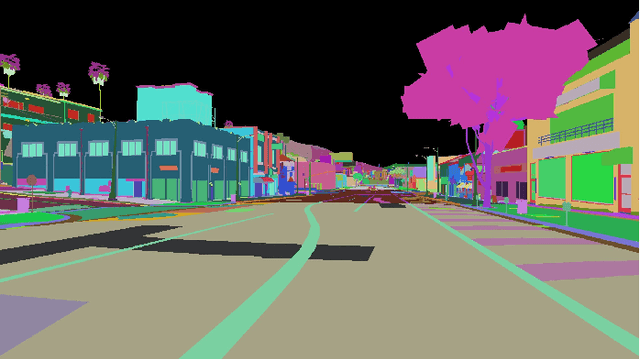
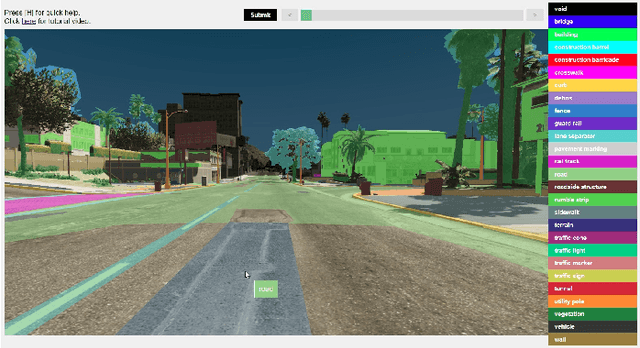
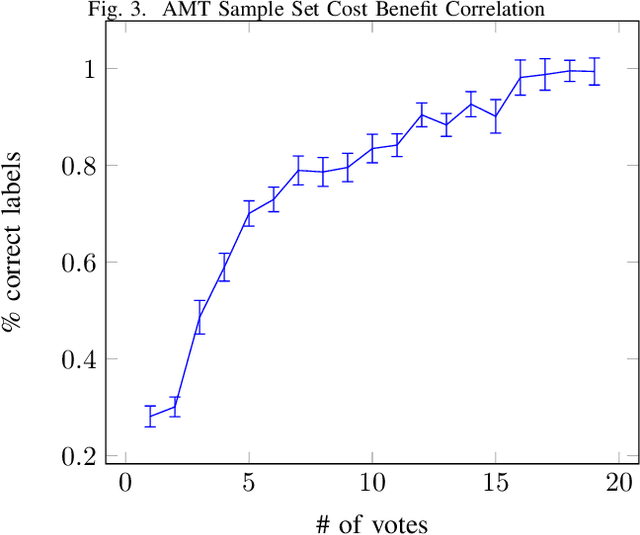
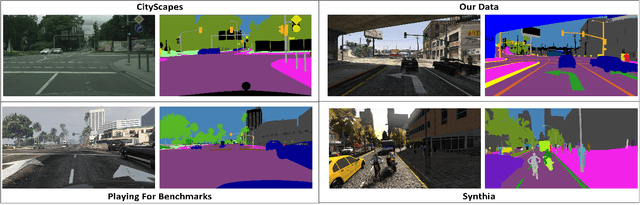
In training deep neural networks for semantic segmentation, the main limiting factor is the low amount of ground truth annotation data that is available in currently existing datasets. The limited availability of such data is due to the time cost and human effort required to accurately and consistently label real images on a pixel level. Modern sandbox video game engines provide open world environments where traffic and pedestrians behave in a pseudo-realistic manner. This caters well to the collection of a believable road-scene dataset. Utilizing open-source tools and resources found in single-player modding communities, we provide a method for persistent, ground truth, asset annotation of a game world. By collecting a synthetic dataset containing upwards of $1,000,000$ images, we demonstrate real-time, on-demand, ground truth data annotation capability of our method. Supplementing this synthetic data to Cityscapes dataset, we show that our data generation method provides qualitative as well as quantitative improvements---for training networks---over previous methods that use video games as surrogate.