 Add to Chrome
 Add to Firefox
 Add to Edge
MULTISEISMO: A Multimodal Seismic Dataset and Model for Cross-Modal Seismic Understanding
May 25, 2026
The application of generalist multimodal models (GMMs) to specialized scientific domains remains limited due to the scarcity of comprehensive domain-specific datasets that integrate multiple data modalities beyond text and images. In seismology, understanding earthquake phenomena requires the synthesis of timeseries waveform data, geographical imagery, and contextual metadata, a multimodal integration absent in existing seismic datasets. We present MultiSeismo, a large scale structured multimodal seismic dataset, comprising over 16K seismic events spanning 13 years (2010 to 2023) across diverse geographical regions. Each event data integrates waveform recordings from global station networks, intensity maps, population exposure visualizations, and a comprehensive textual description within a standardized JSON format. We additionally develop MISCE, a multimodal instruction set on top of raw data to enable supervised training and evaluation of GMMs on seismic reasoning tasks ranging from basic information retrieval to complex cross modal analysis. We leverage MISCE to finetune an existing multimodal model (Unified IO 2) enhanced with a specialized timeseries encoder, which yields SeisModal, the first domain specific multimodal model for comprehensive seismic analysis. Evaluation of state of the art multimodal models on MultiSeismo reveals significant challenges, particularly with time-series data processing for general purpose models, while demonstrating SeisModal's superior performance on seismic multimodal reasoning tasks. These results prove that MultiSeismo provides a rigorous benchmark for future multimodal research in seismology and validate the success of our domain specific architectural adaptations.

SCICONVBENCH: Benchmarking LLMs on Multi-Turn Clarification for Task Formulation in Computational Science
May 18, 2026Large Language Models (LLMs) are increasingly deployed as scientific AI as- sistants, and a growing body of benchmarks evaluates their capabilities across knowledge retrieval, reasoning, code generation, and tool use. These evaluations, however, typically assume the scientific problem is already well-posed, whereas practical scientific assistance often begins with an ill-posed user request that must be refined through dialogue before any computation, analysis, or experiment can be carried out reliably. We introduce SCICONVBENCH, a benchmark for multi- turn clarification in scientific task formulation across four computational science problem domains: fluid mechanics, solid mechanics, materials science, and par- tial differential equations (PDEs). SCICONVBENCH targets two complementary capabilities: eliciting missing information (disambiguation) and detecting and correcting erroneous requests containing internally contradictory information (in- consistency resolution). Our benchmark pairs a structured task ontology with a rubric-based evaluation framework, enabling systematic measurement of LLM per- formance across three dimensions: clarification behavior, conversational grounding, and final-specification fidelity. Current frontier models perform relatively well on inconsistency resolution, but even the best model resolves only 52.7% of the disambiguation cases in fluid mechanics. We further find that frontier LLMs fre- quently make silent assumptions and perform implicit specification repairs that are not grounded in the conversation with users. SCICONVBENCH establishes a foundation for evaluating the upstream conversational reasoning that a reliable computational science assistant requires. The code and data can be found at https://github.com/csml-rpi/SciConvBench.
Reward Design for Physical Reasoning in Vision-Language Models
Apr 15, 2026Physical reasoning over visual inputs demands tight integration of visual perception, domain knowledge, and multi-step symbolic inference. Yet even state-of-the-art Vision Language Models (VLMs) fall far short of human performance on physics benchmarks. While post-training algorithms such as Supervised Fine-Tuning (SFT) and Group Relative Policy Optimization (GRPO) have demonstrated strong reasoning gains in language models, how reward design shapes VLM physical reasoning behavior remains poorly understood. We present a systematic reward ablation study for GRPO-based VLM training on physical reasoning. We compare four reward signals of increasing semantic richness: format compliance, answer accuracy, a composite rubric reward (answer correctness, physics principle identification, and unit consistency), and a novel internal reward derived from model attention weights over input image regions. We evaluate on PhyX, a 3,000-problem benchmark spanning six physics domains and six reasoning types across multiple-choice and open-ended formats, using IBM Granite Vision 3.3 (2B). Across both formats, GRPO with accuracy-based rewards outperforms SFT on most domains, though gains vary substantially by reward type and domain. Reward design does not uniformly improve performance. Instead, it induces domain-specific reasoning behaviors. Accuracy-based rewards provide the strongest overall gains. Rubric rewards improve structured reasoning quality without consistent accuracy improvements. Attention-based rewards enhance spatial reasoning while degrading performance in symbolic domains. Our internal attention-weight reward requires no spatial annotations and improves spatial relation accuracy from 0.27 to 0.50, suggesting that supervising where the model attends during generation is a promising direction for visually grounded physical reasoning.
Back to the Barn with LLAMAs: Evolving Pretrained LLM Backbones in Finetuning Vision Language Models
Apr 13, 2026Vision-Language Models (VLMs) have rapidly advanced by leveraging powerful pre-trained Large Language Models (LLMs) as core reasoning backbones. As new and more capable LLMs emerge with improved reasoning, instruction-following, and generalization, there is a pressing need to efficiently update existing VLMs to incorporate these advancements. However, the integration of new LLMs into VLMs, particularly how the evolving LLMs contribute to multimodal reasoning, alignment, and task-specific performance remains underexplored. Addressing this gap is important for VLM development, given the rapid evolution of pretrained LLM backbones. This study presents a controlled and systematic investigation of how changes in the pretrained LLM backbone affect downstream VLM task performance. By having the vision encoder, training data, and post-training algorithm remain same across LLAMA-1, LLAMA-2, and LLAMA-3 based VLMs, we find that newer LLM backbones do not always lead to better VLMs, but the performance depends on the downstream VLM task. For example, in visual question and answering tasks, newer LLM backbones tend to solve different questions rather than just more questions, and our analysis shows this is driven by differences in how the models process information, including better calibrated confidence and more stable internal representations. We also find that some VLM capabilities appear only in the newest LLM generation, while tasks that depend mainly on visual understanding see little benefit from a newer LLM backbone.
Surprisingly Fragile: Assessing and Addressing Prompt Instability in Multimodal Foundation Models
Aug 26, 2024
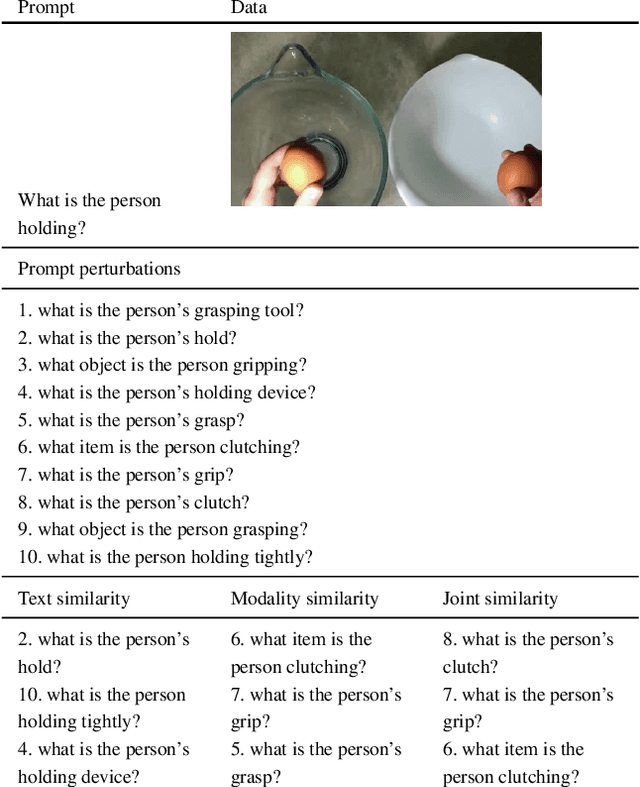
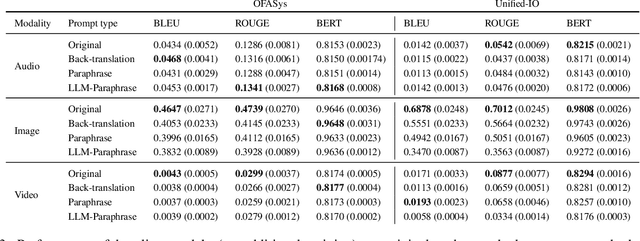
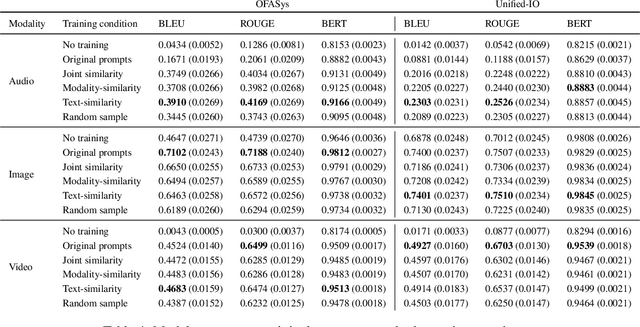
Multimodal foundation models (MFMs) such as OFASys show the potential to unlock analysis of complex data such as images, videos, and audio data via text prompts alone. However, their performance may suffer in the face of text input that differs even slightly from their training distribution, which is surprising considering the use of modality-specific data to "ground" the text input. This study demonstrates that prompt instability is a major concern for MFMs, leading to a consistent drop in performance across all modalities, but that instability can be mitigated with additional training with augmented data. We evaluate several methods for grounded prompt perturbation, where we generate perturbations and filter based on similarity to text and/or modality data. After re-training the models on the augmented data, we find improved accuracy and more stable performance on the perturbed test data regardless of perturbation condition, suggesting that the data augmentation strategy helps the models handle domain shifts more effectively. In error analysis, we find consistent patterns of performance improvement across domains, suggesting that retraining on prompt perturbations tends to help general reasoning capabilities in MFMs.
PermitQA: A Benchmark for Retrieval Augmented Generation in Wind Siting and Permitting domain
Aug 21, 2024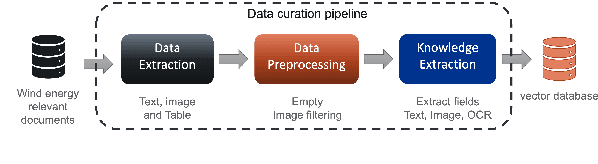
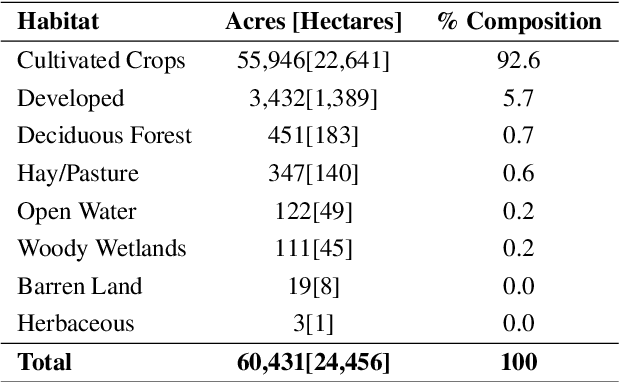
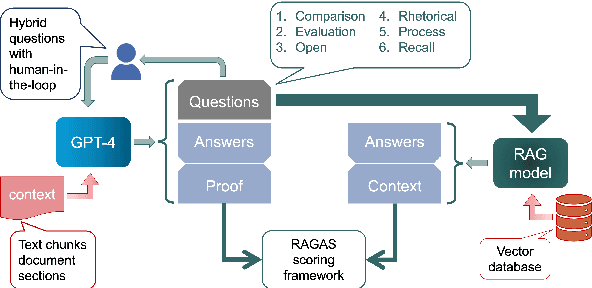
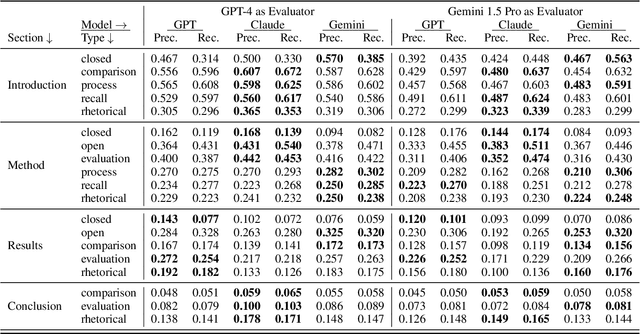
In the rapidly evolving landscape of Natural Language Processing (NLP) and text generation, the emergence of Retrieval Augmented Generation (RAG) presents a promising avenue for improving the quality and reliability of generated text by leveraging information retrieved from user specified database. Benchmarking is essential to evaluate and compare the performance of the different RAG configurations in terms of retriever and generator, providing insights into their effectiveness, scalability, and suitability for the specific domain and applications. In this paper, we present a comprehensive framework to generate a domain relevant RAG benchmark. Our framework is based on automatic question-answer generation with Human (domain experts)-AI Large Language Model (LLM) teaming. As a case study, we demonstrate the framework by introducing PermitQA, a first-of-its-kind benchmark on the wind siting and permitting domain which comprises of multiple scientific documents/reports related to environmental impact of wind energy projects. Our framework systematically evaluates RAG performance using diverse metrics and multiple question types with varying complexity level. We also demonstrate the performance of different models on our benchmark.
RAG vs. Long Context: Examining Frontier Large Language Models for Environmental Review Document Comprehension
Jul 10, 2024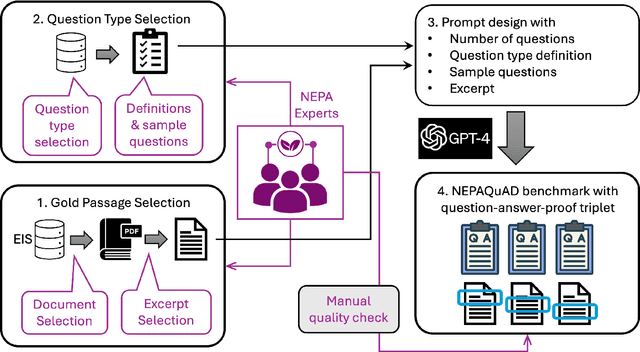
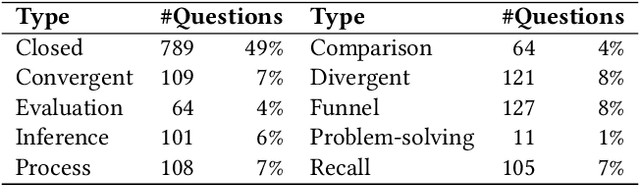
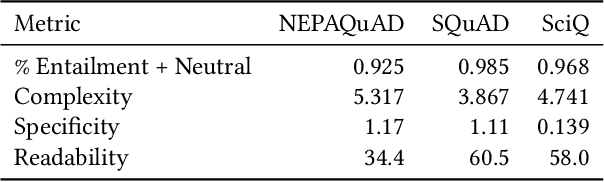
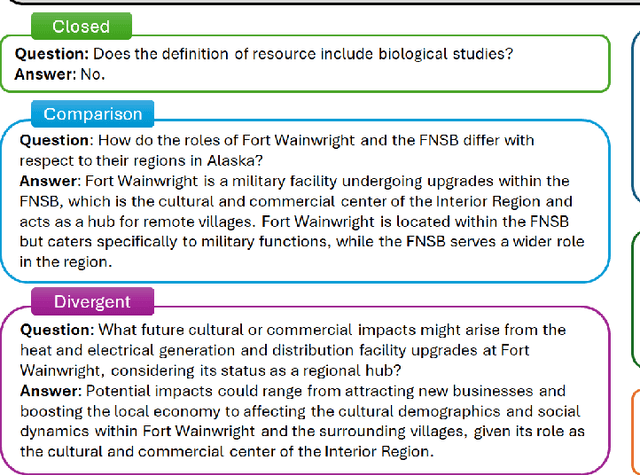
Large Language Models (LLMs) have been applied to many research problems across various domains. One of the applications of LLMs is providing question-answering systems that cater to users from different fields. The effectiveness of LLM-based question-answering systems has already been established at an acceptable level for users posing questions in popular and public domains such as trivia and literature. However, it has not often been established in niche domains that traditionally require specialized expertise. To this end, we construct the NEPAQuAD1.0 benchmark to evaluate the performance of three frontier LLMs -- Claude Sonnet, Gemini, and GPT-4 -- when answering questions originating from Environmental Impact Statements prepared by U.S. federal government agencies in accordance with the National Environmental Environmental Act (NEPA). We specifically measure the ability of LLMs to understand the nuances of legal, technical, and compliance-related information present in NEPA documents in different contextual scenarios. For example, we test the LLMs' internal prior NEPA knowledge by providing questions without any context, as well as assess how LLMs synthesize the contextual information present in long NEPA documents to facilitate the question/answering task. We compare the performance of the long context LLMs and RAG powered models in handling different types of questions (e.g., problem-solving, divergent). Our results suggest that RAG powered models significantly outperform the long context models in the answer accuracy regardless of the choice of the frontier LLM. Our further analysis reveals that many models perform better answering closed questions than divergent and problem-solving questions.
Generalist Multimodal AI: A Review of Architectures, Challenges and Opportunities
Jun 08, 2024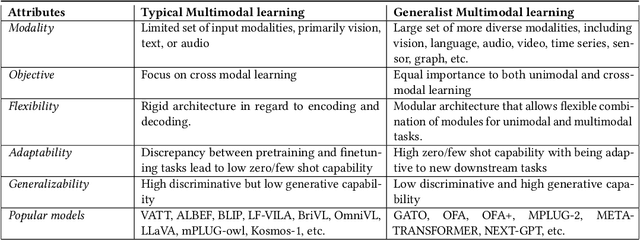
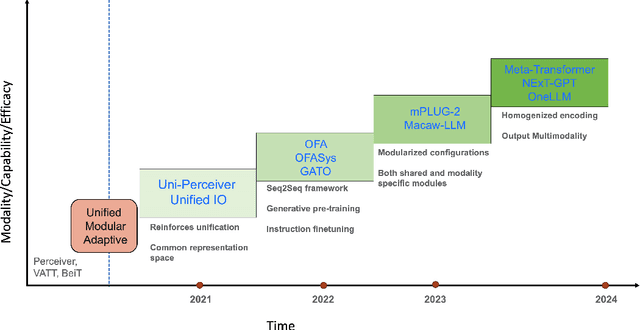
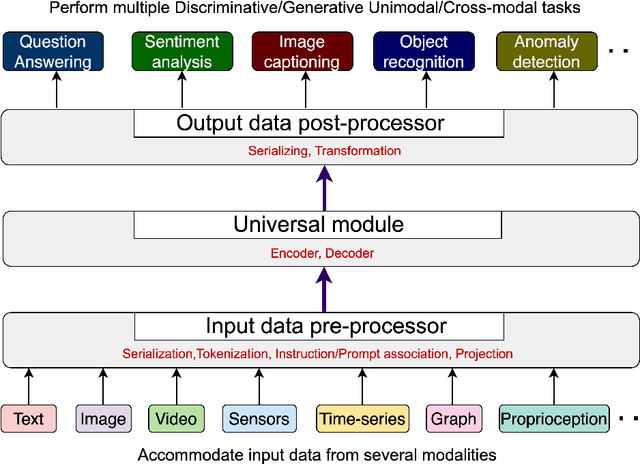

Multimodal models are expected to be a critical component to future advances in artificial intelligence. This field is starting to grow rapidly with a surge of new design elements motivated by the success of foundation models in natural language processing (NLP) and vision. It is widely hoped that further extending the foundation models to multiple modalities (e.g., text, image, video, sensor, time series, graph, etc.) will ultimately lead to generalist multimodal models, i.e. one model across different data modalities and tasks. However, there is little research that systematically analyzes recent multimodal models (particularly the ones that work beyond text and vision) with respect to the underling architecture proposed. Therefore, this work provides a fresh perspective on generalist multimodal models (GMMs) via a novel architecture and training configuration specific taxonomy. This includes factors such as Unifiability, Modularity, and Adaptability that are pertinent and essential to the wide adoption and application of GMMs. The review further highlights key challenges and prospects for the field and guide the researchers into the new advancements.
ATLANTIC: Structure-Aware Retrieval-Augmented Language Model for Interdisciplinary Science
Nov 21, 2023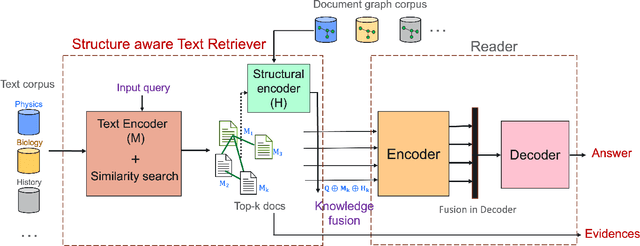
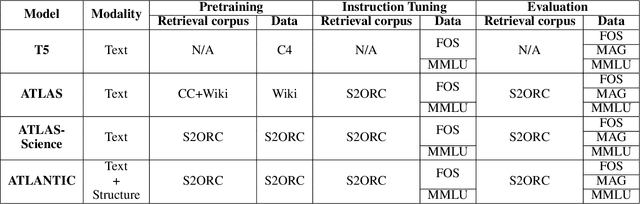
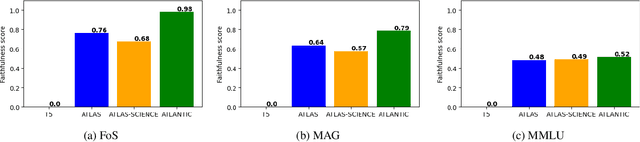
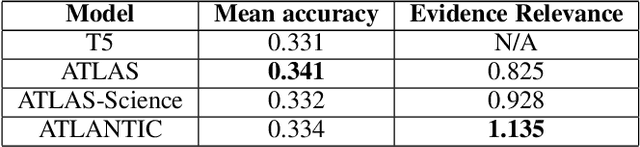
Large language models record impressive performance on many natural language processing tasks. However, their knowledge capacity is limited to the pretraining corpus. Retrieval augmentation offers an effective solution by retrieving context from external knowledge sources to complement the language model. However, existing retrieval augmentation techniques ignore the structural relationships between these documents. Furthermore, retrieval models are not explored much in scientific tasks, especially in regard to the faithfulness of retrieved documents. In this paper, we propose a novel structure-aware retrieval augmented language model that accommodates document structure during retrieval augmentation. We create a heterogeneous document graph capturing multiple types of relationships (e.g., citation, co-authorship, etc.) that connect documents from more than 15 scientific disciplines (e.g., Physics, Medicine, Chemistry, etc.). We train a graph neural network on the curated document graph to act as a structural encoder for the corresponding passages retrieved during the model pretraining. Particularly, along with text embeddings of the retrieved passages, we obtain structural embeddings of the documents (passages) and fuse them together before feeding them to the language model. We evaluate our model extensively on various scientific benchmarks that include science question-answering and scientific document classification tasks. Experimental results demonstrate that structure-aware retrieval improves retrieving more coherent, faithful and contextually relevant passages, while showing a comparable performance in the overall accuracy.
Empirical evaluation of Uncertainty Quantification in Retrieval-Augmented Language Models for Science
Nov 15, 2023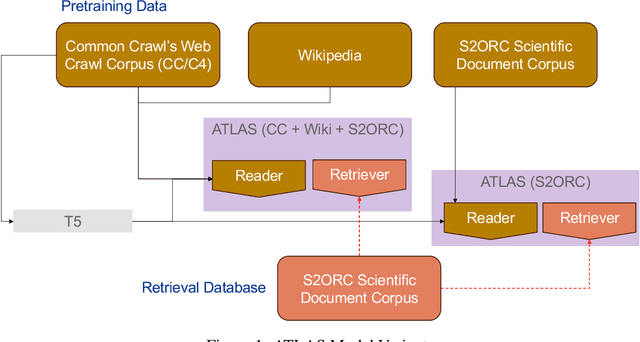
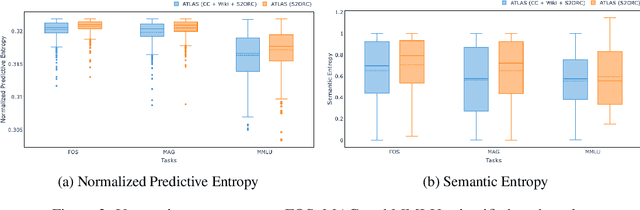
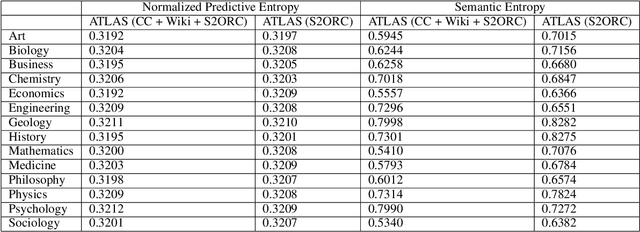
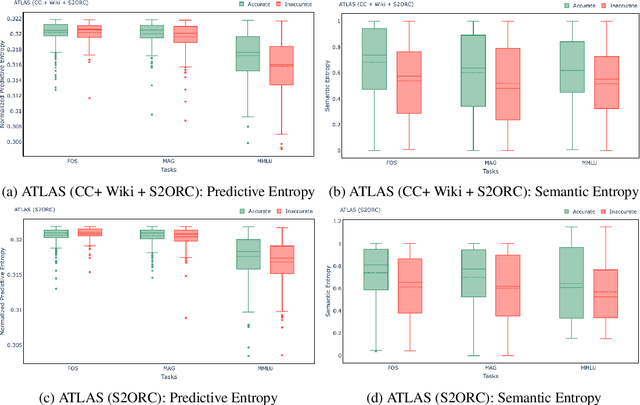
Large language models (LLMs) have shown remarkable achievements in natural language processing tasks, producing high-quality outputs. However, LLMs still exhibit limitations, including the generation of factually incorrect information. In safety-critical applications, it is important to assess the confidence of LLM-generated content to make informed decisions. Retrieval Augmented Language Models (RALMs) is relatively a new area of research in NLP. RALMs offer potential benefits for scientific NLP tasks, as retrieved documents, can serve as evidence to support model-generated content. This inclusion of evidence enhances trustworthiness, as users can verify and explore the retrieved documents to validate model outputs. Quantifying uncertainty in RALM generations further improves trustworthiness, with retrieved text and confidence scores contributing to a comprehensive and reliable model for scientific applications. However, there is limited to no research on UQ for RALMs, particularly in scientific contexts. This study aims to address this gap by conducting a comprehensive evaluation of UQ in RALMs, focusing on scientific tasks. This research investigates how uncertainty scores vary when scientific knowledge is incorporated as pretraining and retrieval data and explores the relationship between uncertainty scores and the accuracy of model-generated outputs. We observe that an existing RALM finetuned with scientific knowledge as the retrieval data tends to be more confident in generating predictions compared to the model pretrained only with scientific knowledge. We also found that RALMs are overconfident in their predictions, making inaccurate predictions more confidently than accurate ones. Scientific knowledge provided either as pretraining or retrieval corpus does not help alleviate this issue. We released our code, data and dashboards at https://github.com/pnnl/EXPERT2.