 Add to Chrome
 Add to Firefox
 Add to Edge
CHOP: Counterfactual Human Preference Labels Improve Obstacle Avoidance in Visuomotor Navigation Policies
Mar 02, 2026
Visuomotor navigation policies have shown strong perception-action coupling for embodied agents, yet they often struggle with safe navigation and dynamic obstacle avoidance in complex real-world environments. We introduce CHOP, a novel approach that leverages Counterfactual Human Preference Labels to align visuomotor navigation policies towards human intuition of safety and obstacle avoidance in navigation. In CHOP, for each visual observation, the robot's executed trajectory is included among a set of counterfactual navigation trajectories: alternative trajectories the robot could have followed under identical conditions. Human annotators provide pairwise preference labels over these trajectories based on anticipated outcomes such as collision risk and path efficiency. These aggregated preferences are then used to fine-tune visuomotor navigation policies, aligning their behavior with human preferences in navigation. Experiments on the SCAND dataset show that visuomotor navigation policies fine-tuned with CHOP reduce near-collision events by 49.7%, decrease deviation from human-preferred trajectories by 45.0%, and increase average obstacle clearance by 19.8% on average across multiple state-of-the-art models, compared to their pretrained baselines. These improvements transfer to real-world deployments on a Ghost Robotics Vision60 quadruped, where CHOP-aligned policies improve average goal success rates by 24.4%, increase minimum obstacle clearance by 6.8%, reduce collision and intervention events by 45.7%, and improve normalized path completion by 38.6% on average across navigation scenarios, compared to their pretrained baselines. Our results highlight the value of counterfactual preference supervision in bridging the gap between large-scale visuomotor policies and human-aligned, safety-aware embodied navigation.

EveryDayVLA: A Vision-Language-Action Model for Affordable Robotic Manipulation
Nov 07, 2025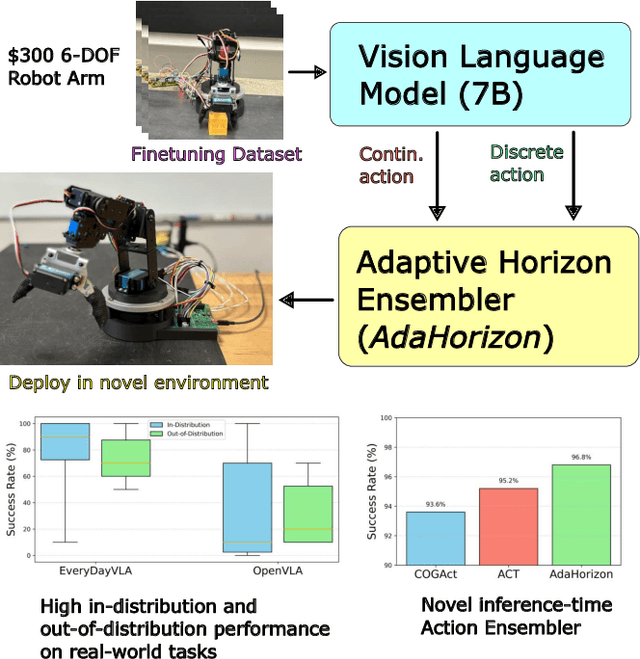
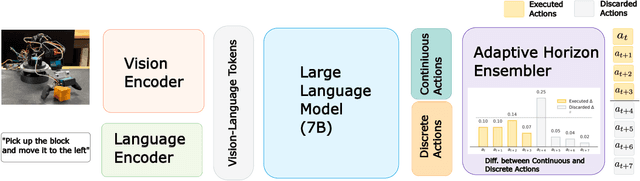
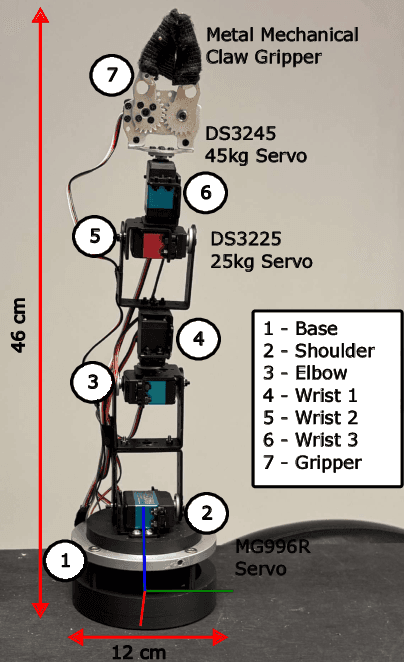
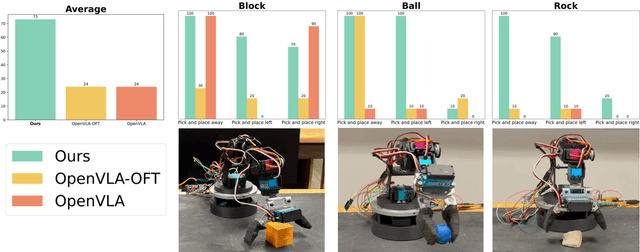
While Vision-Language-Action (VLA) models map visual inputs and language instructions directly to robot actions, they often rely on costly hardware and struggle in novel or cluttered scenes. We introduce EverydayVLA, a 6-DOF manipulator that can be assembled for under $300, capable of modest payloads and workspace. A single unified model jointly outputs discrete and continuous actions, and our adaptive-horizon ensemble monitors motion uncertainty to trigger on-the-fly re-planning for safe, reliable operation. On LIBERO, EverydayVLA matches state-of-the-art success rates, and in real-world tests it outperforms prior methods by 49% in-distribution and 34.9% out-of-distribution. By combining a state-of-the-art VLA with cost-effective hardware, EverydayVLA democratizes access to a robotic foundation model and paves the way for economical use in homes and research labs alike. Experiment videos and details: https://everydayvla.github.io/