 Add to Chrome
 Add to Firefox
 Add to Edge
Federated Learning over Blockchain-Enabled Cloud Infrastructure
Apr 21, 2026
The rise of IoT devices and the uptake of cloud computing have informed a new era of data-driven intelligence. Traditional centralized machine learning models that require a large volume of data to be stored in a single location have therefore become more susceptible to data breaches, privacy violations, and regulatory non-compliance. This report presents a thorough examination of the merging of Federated Learning (FL) and blockchain technology in a cloud-edge setting, demonstrating it as an effective solution to the stated concerns. We are proposing a detailed four-dimensional architectural categorization that meticulously assesses coordination frameworks, consensus algorithms, data storage practices, and trust models that are significant to these integrated systems. The manuscript presents a comprehensive comparative examination of two cutting-edge frameworks: the Multi-Objectives Reinforcement Federated Learning Blockchain (MORFLB), which is designed for intelligent transportation systems, and the Federated Blockchain-IoT Framework for Sustainable Healthcare Systems (FBCI-SHS), elucidating their distinctive contributions and inherent limitations. Lastly, we engage in a thorough evaluation of the literature that integrates a comparative perspective on current frameworks to discern the singular nature of this research within existing knowledge systems. The manuscript culminates in delineating the principal challenges and offering a strategic framework for prospective research trajectories, emphasizing the advancement of adaptive, resilient, and standardized BCFL systems across diverse application domains.
* 7 pages, 5 figures, 2 tables

Enhancing LLMs for Physics Problem-Solving using Reinforcement Learning with Human-AI Feedback
Dec 06, 2024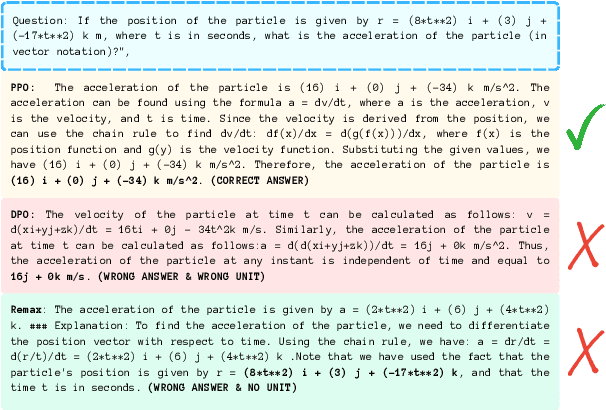
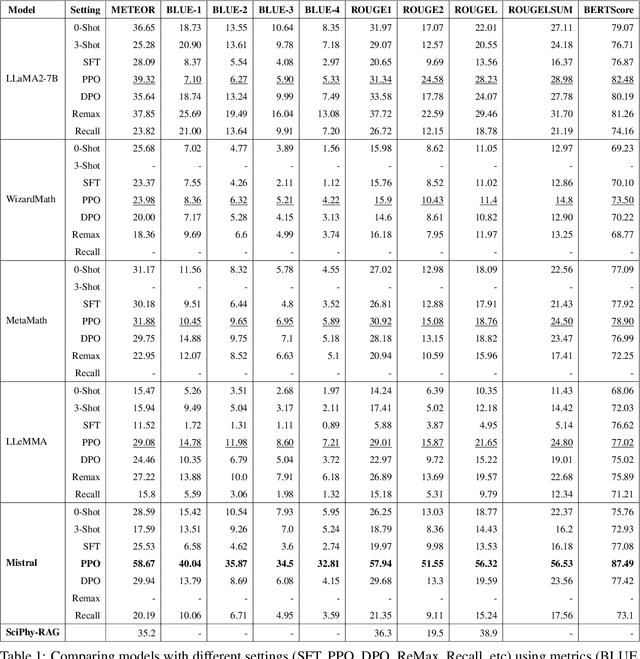
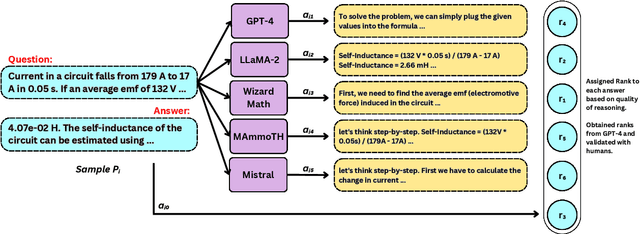
Large Language Models (LLMs) have demonstrated strong capabilities in text-based tasks but struggle with the complex reasoning required for physics problems, particularly in advanced arithmetic and conceptual understanding. While some research has explored ways to enhance LLMs in physics education using techniques such as prompt engineering and Retrieval Augmentation Generation (RAG), not enough effort has been made in addressing their limitations in physics reasoning. This paper presents a novel approach to improving LLM performance on physics questions using Reinforcement Learning with Human and Artificial Intelligence Feedback (RLHAIF). We evaluate several reinforcement learning methods, including Proximal Policy Optimization (PPO), Direct Preference Optimization (DPO), and Remax optimization. These methods are chosen to investigate RL policy performance with different settings on the PhyQA dataset, which includes challenging physics problems from high school textbooks. Our RLHAIF model, tested on leading LLMs like LLaMA2 and Mistral, achieved superior results, notably with the MISTRAL-PPO model, demonstrating marked improvements in reasoning and accuracy. It achieved high scores, with a 58.67 METEOR score and a 0.74 Reasoning score, making it a strong example for future physics reasoning research in this area.