 Add to Chrome
 Add to Firefox
 Add to Edge
"Many Are My Names": The Anatomy of the Assistant and Its Personas via Sparse Autoencoders
Aug 08, 2026
How a language model internally represents who is speaking, the Assistant, an assigned roleplay persona, or a narrated story character, remains underexplored. We study speaker representations using a dataset of user-expressed emotional text and corresponding model responses. We decompose three generation settings (Assistant, Roleplay, and Story) into sparse autoencoder features extracted at turn-boundary and pronoun-token positions and selected through a filtering pipeline for different depths. We characterize each surviving feature through its steering effects and activation distribution. Our main finding is that the Assistant and roleplay personas are not independent alternatives: personas retain the Assistant-associated feature core while progressively differentiating from it across layers, starting from operational machinery towards behavioral and stylistic features. Meanwhile, generated story characters lack the Assistant-associated core. Both Story and Roleplay can be distinguished from the Assistant with Immersive Simulation Mode. However, the Assistant can sometimes enter or slowly drift into it even in the default setting.

CSULoRA: Closest Safe Update Low-Rank Adaptation
May 28, 2026Low-rank adaptation has become a standard method for parameter-efficient fine-tuning of large language models, but even small amounts of unsafe or adversarial fine-tuning data can substantially weaken the safety behavior of aligned models. Existing safety-preserving LoRA methods often rely on hard interventions such as projection, pruning, thresholding, or additional training objectives. While these methods can suppress unsafe update directions, they may also remove task-relevant information or require extra tuning. We introduce CSULoRA, a post-hoc method for correcting trained LoRA adapters through closest safe update estimation. CSULoRA estimates a safety-aligned subspace from the weight displacement between a safety-aligned model and its corresponding base checkpoint. It then decomposes each LoRA update into fully aligned, partially aligned, and off-subspace components. Instead of discarding components outside the estimated safety subspace, CSULoRA solves a closed-form penalized minimum-change problem that preserves the fully aligned component while smoothly attenuating potentially unsafe directions according to their relative energy. In adversarial fine-tuning experiments, CSULoRA substantially reduces attack success rate while preserving most of the utility gains obtained from standard LoRA fine-tuning.
Evaluating Explainable AI Attribution Methods in Neural Machine Translation via Attention-Guided Knowledge Distillation
Mar 11, 2026The study of the attribution of input features to the output of neural network models is an active area of research. While numerous Explainable AI (XAI) techniques have been proposed to interpret these models, the systematic and automated evaluation of these methods in sequence-to-sequence (seq2seq) models is less explored. This paper introduces a new approach for evaluating explainability methods in transformer-based seq2seq models. We use teacher-derived attribution maps as a structured side signal to guide a student model, and quantify the utility of different attribution methods through the student's ability to simulate targets. Using the Inseq library, we extract attribution scores over source-target sequence pairs and inject these scores into the attention mechanism of a student transformer model under four composition operators (addition, multiplication, averaging, and replacement). Across three language pairs (de-en, fr-en, ar-en) and attributions from Marian-MT and mBART models, Attention, Value Zeroing, and Layer Gradient $\times$ Activation consistently yield the largest gains in BLEU (and corresponding improvements in chrF) relative to baselines. In contrast, other gradient-based methods (Saliency, Integrated Gradients, DeepLIFT, Input $\times$ Gradient, GradientShap) lead to smaller and less consistent improvements. These results suggest that different attribution methods capture distinct signals and that attention-derived attributions better capture alignment between source and target representations in seq2seq models. Finally, we introduce an Attributor transformer that, given a source-target pair, learns to reconstruct the teacher's attribution map. Our findings demonstrate that the more accurately the Attributor can reproduce attribution maps, the more useful an injection of those maps is for the downstream task. The source code can be found on GitHub.
Automating Historical Insight Extraction from Large-Scale Newspaper Archives via Neural Topic Modeling
Dec 12, 2025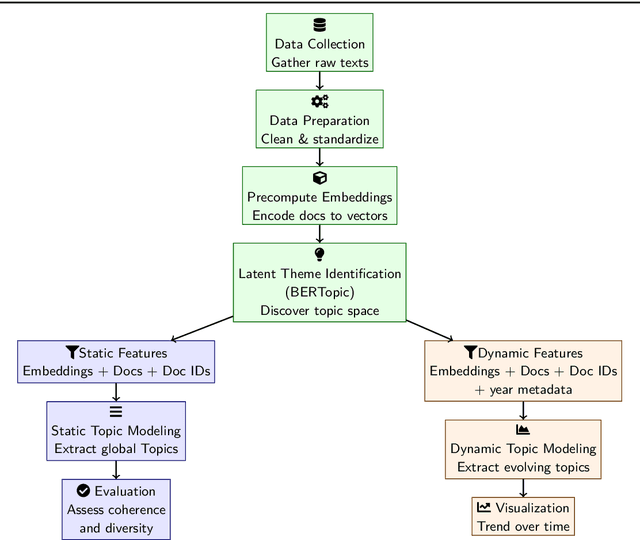
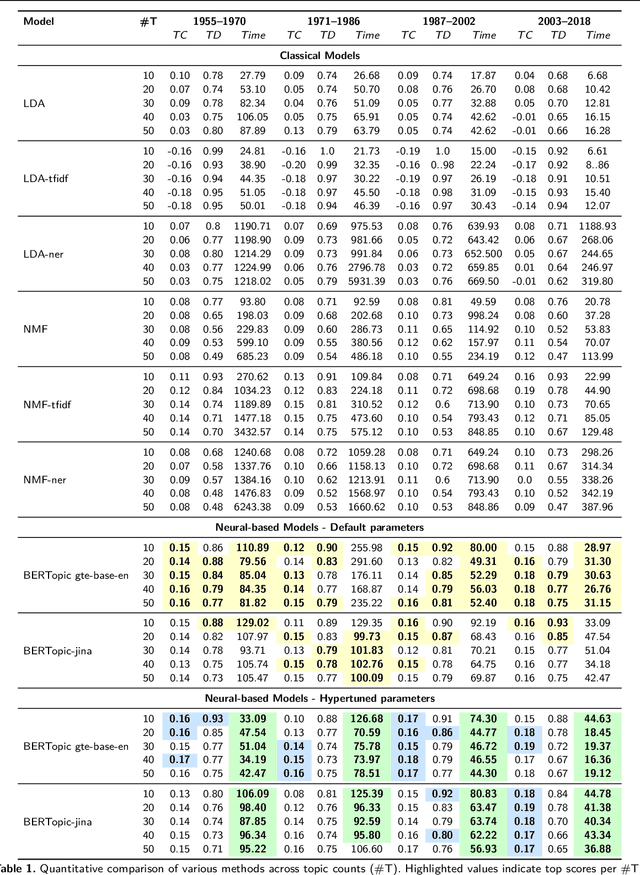
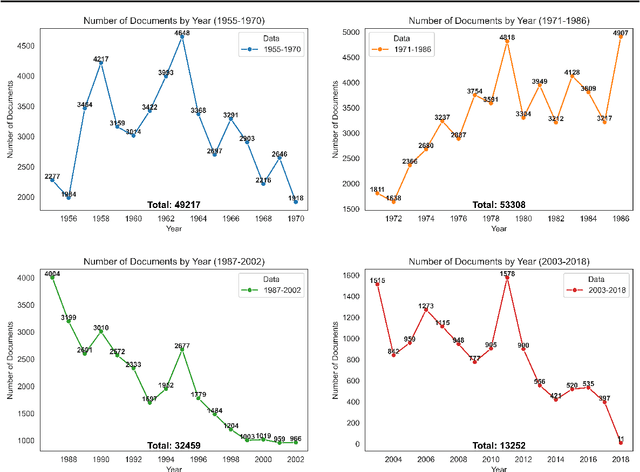
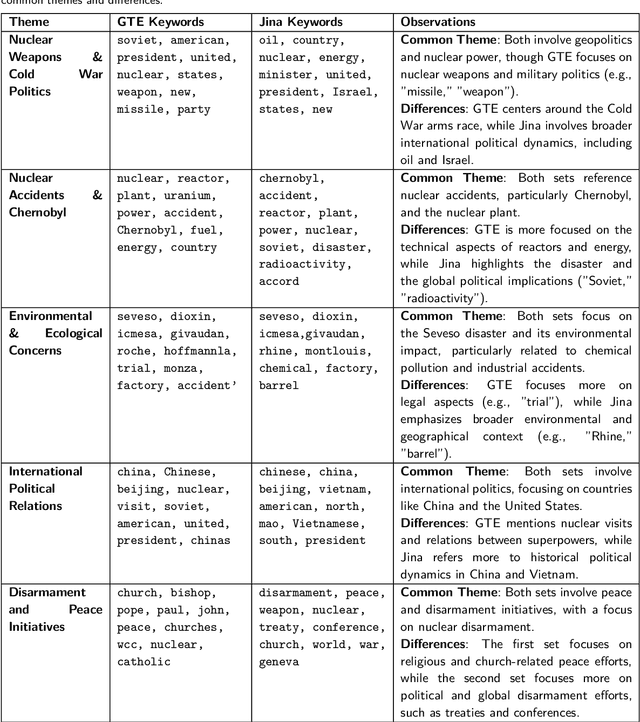
Extracting coherent and human-understandable themes from large collections of unstructured historical newspaper archives presents significant challenges due to topic evolution, Optical Character Recognition (OCR) noise, and the sheer volume of text. Traditional topic-modeling methods, such as Latent Dirichlet Allocation (LDA), often fall short in capturing the complexity and dynamic nature of discourse in historical texts. To address these limitations, we employ BERTopic. This neural topic-modeling approach leverages transformerbased embeddings to extract and classify topics, which, despite its growing popularity, still remains underused in historical research. Our study focuses on articles published between 1955 and 2018, specifically examining discourse on nuclear power and nuclear safety. We analyze various topic distributions across the corpus and trace their temporal evolution to uncover long-term trends and shifts in public discourse. This enables us to more accurately explore patterns in public discourse, including the co-occurrence of themes related to nuclear power and nuclear weapons and their shifts in topic importance over time. Our study demonstrates the scalability and contextual sensitivity of BERTopic as an alternative to traditional approaches, offering richer insights into historical discourses extracted from newspaper archives. These findings contribute to historical, nuclear, and social-science research while reflecting on current limitations and proposing potential directions for future work.
M-DAIGT: A Shared Task on Multi-Domain Detection of AI-Generated Text
Nov 14, 2025The generation of highly fluent text by Large Language Models (LLMs) poses a significant challenge to information integrity and academic research. In this paper, we introduce the Multi-Domain Detection of AI-Generated Text (M-DAIGT) shared task, which focuses on detecting AI-generated text across multiple domains, particularly in news articles and academic writing. M-DAIGT comprises two binary classification subtasks: News Article Detection (NAD) (Subtask 1) and Academic Writing Detection (AWD) (Subtask 2). To support this task, we developed and released a new large-scale benchmark dataset of 30,000 samples, balanced between human-written and AI-generated texts. The AI-generated content was produced using a variety of modern LLMs (e.g., GPT-4, Claude) and diverse prompting strategies. A total of 46 unique teams registered for the shared task, of which four teams submitted final results. All four teams participated in both Subtask 1 and Subtask 2. We describe the methods employed by these participating teams and briefly discuss future directions for M-DAIGT.
DomURLs_BERT: Pre-trained BERT-based Model for Malicious Domains and URLs Detection and Classification
Sep 13, 2024Detecting and classifying suspicious or malicious domain names and URLs is fundamental task in cybersecurity. To leverage such indicators of compromise, cybersecurity vendors and practitioners often maintain and update blacklists of known malicious domains and URLs. However, blacklists frequently fail to identify emerging and obfuscated threats. Over the past few decades, there has been significant interest in developing machine learning models that automatically detect malicious domains and URLs, addressing the limitations of blacklists maintenance and updates. In this paper, we introduce DomURLs_BERT, a pre-trained BERT-based encoder adapted for detecting and classifying suspicious/malicious domains and URLs. DomURLs_BERT is pre-trained using the Masked Language Modeling (MLM) objective on a large multilingual corpus of URLs, domain names, and Domain Generation Algorithms (DGA) dataset. In order to assess the performance of DomURLs_BERT, we have conducted experiments on several binary and multi-class classification tasks involving domain names and URLs, covering phishing, malware, DGA, and DNS tunneling. The evaluations results show that the proposed encoder outperforms state-of-the-art character-based deep learning models and cybersecurity-focused BERT models across multiple tasks and datasets. The pre-training dataset, the pre-trained DomURLs_BERT encoder, and the experiments source code are publicly available.