 Add to Chrome
 Add to Firefox
 Add to Edge
SAGE: Stochastic Prompt Optimization via Agent-Guided Exploration
Jun 17, 2026
Context engineering has emerged as a primary lever for improving AI systems without parameter updates. Recent work showing that textual gradients do not function as real gradients motivates treating automatic prompt optimization (APO) as black-box search. We introduce SPO (Stochastic Prompt Optimization), a framework for stochastic search over prompt space, and compare three strategies of increasing sophistication: error-informed random search, a genetic algorithm with evolutionary operators, and SAGE (SPO via Agent-Guided Exploration), a multi-agent pipeline with diagnostic code execution. Across three benchmarks, no single strategy dominates; effectiveness depends on the interaction of landscape structure with error type. We further deploy SAGE on a mental-health chatbot under a continuous optimization paradigm, where it compounds eight cycles of individually-noisy A/B tests into a statistically robust gain in next-day retention. We argue that coupling qualitative diagnosis with quantitative validation is what makes agentic optimization effective for open-ended task-oriented dialogue.

Virtual Adversarial Ladder Networks For Semi-supervised Learning
Dec 12, 2017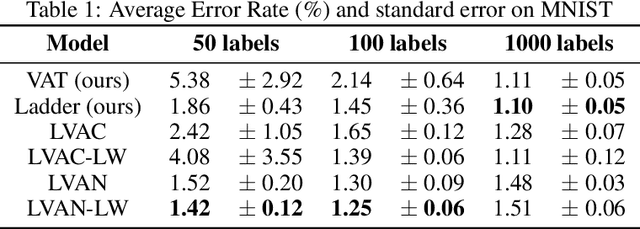
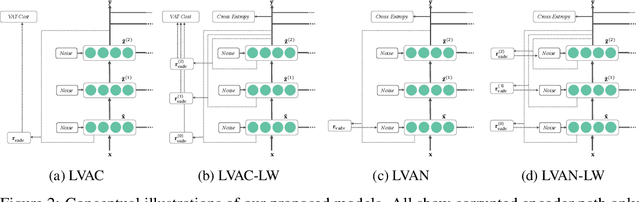
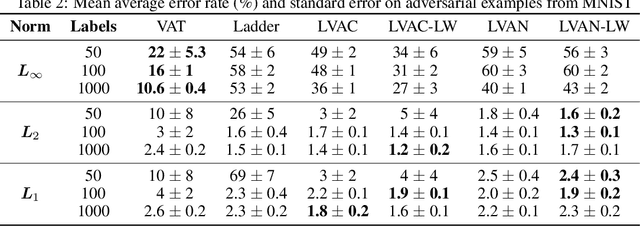
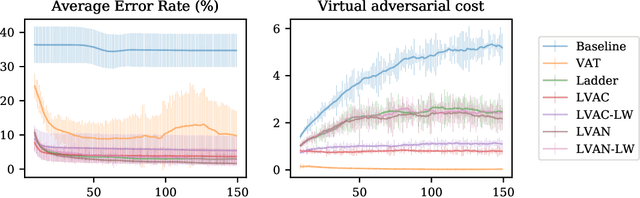
Semi-supervised learning (SSL) partially circumvents the high cost of labeling data by augmenting a small labeled dataset with a large and relatively cheap unlabeled dataset drawn from the same distribution. This paper offers a novel interpretation of two deep learning-based SSL approaches, ladder networks and virtual adversarial training (VAT), as applying distributional smoothing to their respective latent spaces. We propose a class of models that fuse these approaches. We achieve near-supervised accuracy with high consistency on the MNIST dataset using just 5 labels per class: our best model, ladder with layer-wise virtual adversarial noise (LVAN-LW), achieves 1.42% +/- 0.12 average error rate on the MNIST test set, in comparison with 1.62% +/- 0.65 reported for the ladder network. On adversarial examples generated with L2-normalized fast gradient method, LVAN-LW trained with 5 examples per class achieves average error rate 2.4% +/- 0.3 compared to 68.6% +/- 6.5 for the ladder network and 9.9% +/- 7.5 for VAT.