 Add to Chrome
 Add to Firefox
 Add to Edge
Temporal Dependencies in In-Context Learning: The Role of Induction Heads
Apr 01, 2026
Large language models (LLMs) exhibit strong in-context learning capabilities, but how they track and retrieve information from context remains underexplored. Drawing on the free recall paradigm in cognitive science (where participants recall list items in any order), we show that several open-source LLMs consistently display a serial-recall-like pattern, assigning peak probability to tokens that immediately follow a repeated token in the input sequence. Through systematic ablation experiments, we show that induction heads, specialized attention heads that attend to the token following a previous occurrence of the current token, play an important role in this phenomenon. Removing heads with a high induction score substantially reduces the +1 lag bias, whereas ablating random heads does not reproduce the same reduction. We also show that removing heads with high induction scores impairs the performance of models prompted to do serial recall using few-shot learning to a larger extent than removing random heads. Our findings highlight a mechanistically specific connection between induction heads and temporal context processing in transformers, suggesting that these heads are especially important for ordered retrieval and serial-recall-like behavior during in-context learning.

Temporal Information and Event Markup Language: TIE-ML Markup Process and Schema Version 1.0
Sep 28, 2021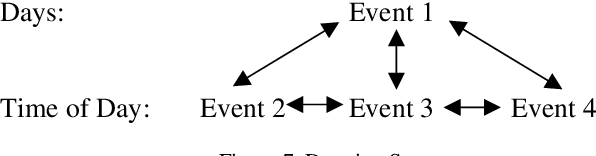
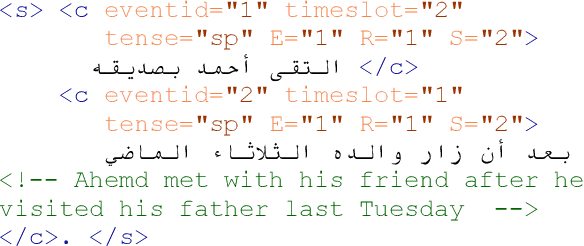
Temporal Information and Event Markup Language (TIE-ML) is a markup strategy and annotation schema to improve the productivity and accuracy of temporal and event related annotation of corpora to facilitate machine learning based model training. For the annotation of events, temporal sequencing, and durations, it is significantly simpler by providing an extremely reduced tag set for just temporal relations and event enumeration. In comparison to other standards, as for example the Time Markup Language (TimeML), it is much easier to use by dropping sophisticated formalisms, theoretical concepts, and annotation approaches. Annotations of corpora using TimeML can be mapped to TIE-ML with a loss, and TIE-ML annotations can be fully mapped to TimeML with certain under-specification.