 Add to Chrome
 Add to Firefox
 Add to Edge
RSMA Enabled Hierarchical UAV Networks with Non Linear Energy Harvesting: Outage Probability Analysis and UAV Placement Optimization
Jun 05, 2026
Uncrewed aerial vehicles (UAVs) are expected to enhance connectivity, extend network coverage, and support advanced communication services in sixth-generation (6G) cellular networks, particularly in public and civil applications. Although multi-UAV systems offer greater efficiency and cost-effectiveness than single-UAV deployments, their implementation still faces several fundamental challenges that limit their reliability, sustainability, and scalability. The limited onboard energy restricts mission duration and communication continuity. Therefore, wireless energy harvesting (EH) emerges as a promising solution to overcome this limitation. However, terrestrial energy sources experience path loss, making EH from surrounding UAVs more sustainable. Moreover, rate-splitting multiple access (RSMA) remains insufficiently explored in hierarchical UAV networks under hardware impairments (HWI) and imperfect channel state information (ICSI). This paper proposes a hierarchical ad hoc UAV network with non-linear EH and RSMA to enhance both energy and cost efficiency, where UAVs harvest energy from surrounding UAVs. For a practical scenario, we consider the effect of HWI and ICSI in our proposed system. To the best of the authors knowledge, this study is the first to investigate such a scenario in the literature. The outage probability expressions for ground Internet of things (IoT) devices, each CMU, and the overall outage probability of the proposed system are derived over Nakagami-$m$ fading channels while considering practical constraints such as HWI, ICSI, and non-linear EH. Additionally, approximate outage probability expressions are derived for high transmit power regimes. Subsequently, we formulate two optimization problems to enhance reliability and performance. Our findings indicate that the proposed system outperforms all benchmarks in terms of outage probability.

Outage Probability Analysis of NOMA Enabled Hierarchical UAV Networks with Non-Linear Energy Harvesting
Mar 19, 2026Uncrewed aerial vehicles (UAVs) are expected to enhance connectivity, extend network coverage, and support advanced communication services in sixth-generation (6G) cellular networks, particularly in public and civil domains. Although multi-UAV systems enhance connectivity for IoT networks more than single-UAV systems, energy-efficient communication systems and the integration of energy harvesting (EH) are crucial for their widespread adoption and effectiveness. In this regard, this paper proposes a hierarchical ad hoc UAV network with non-linear EH and non-orthogonal multiple access (NOMA) to enhance both energy and cost efficiency. The proposed system consists of two UAV layers: a cluster head UAV (CHU), which acts as the source, and cluster member UAVs (CMUs), which serve as relays and are capable of harvesting energy from a terrestrial power beacon. For the considered IoT network architecture, the outage probability expressions of ground Internet of things (IoT) devices, each CMU, and the overall outage probability of the proposed system are derived over Nakagami-m fading channels with practical constraints such as hardware impairments and non-linear EH. We compare the proposed system against a non EH system, and our findings indicate that the proposed system outperforms the benchmark in terms of outage probability.
* This paper is accepted for the IEEE ICC Workshops 2026
Resource-Efficient HAPS-RIS Enabled Beyond-Cell Communications
Jul 23, 2022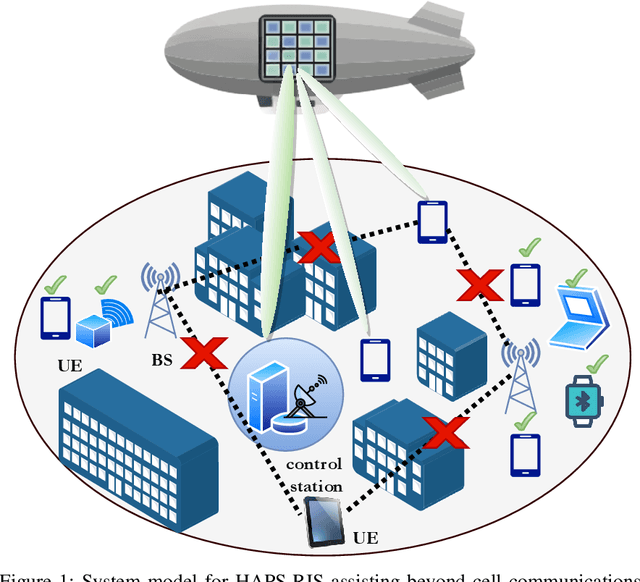
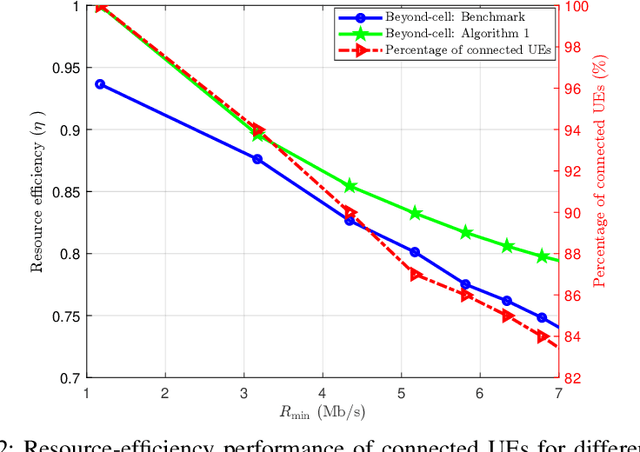
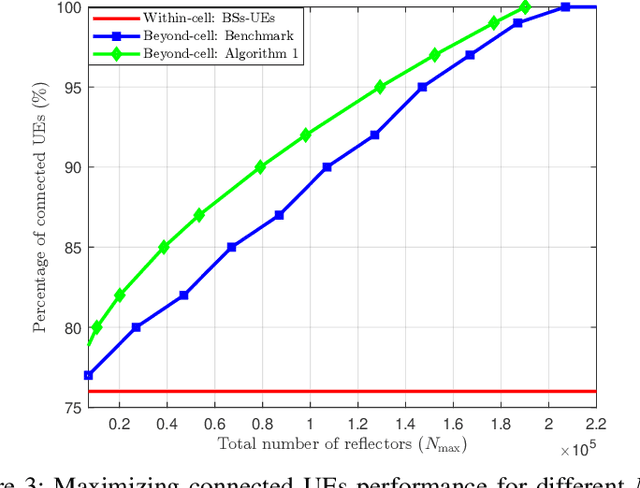
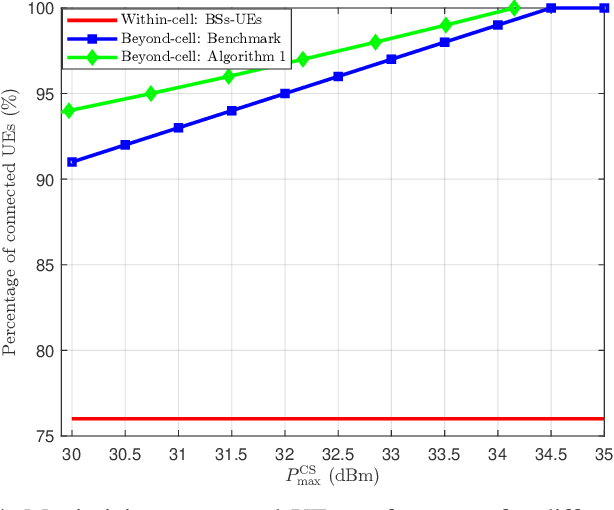
In the future, urban regions will encounter a massive number of capacity-hungry devices. Relying solely on terrestrial networks for serving all UEs will be a cost-ineffective approach. Consequently, with the anticipated supply and demand mismatch, several UEs will be unsupported. To offer service to the left-out UEs, we employ an energy-efficient and cost-effective beyond-cell communications approach, which uses reconfigurable intelligent surfaces (RIS) on a high-altitude platform station (HAPS). Particularly, unsupported UEs will be connected to a dedicated control station (CS) through RIS-mounted HAPS. A novel resource-efficient optimization problem is formulated that maximizes the number of connected UEs, while minimizing the total power consumed by the CS and RIS. Since the resulting problem is a mixed-integer nonlinear program (MINLP), a low-complexity two-stage algorithm is developed. Numerical results demonstrate that the proposed algorithm outperforms the benchmark approach in terms of the percentage of connected UEs and the resource-efficiency (RE). Also, the results show that the number of connected UEs is more sensitive to transmit power at the CS than the HAPS size.
Optimization of Quantized Phase Shifts for Reconfigurable Smart Surfaces Assisted Communications
Nov 22, 2021
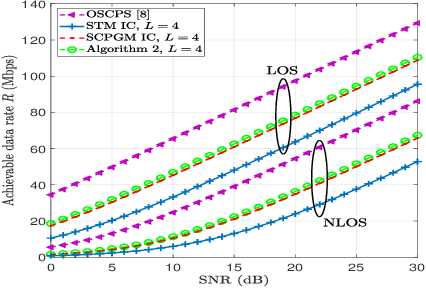


Reconfigurable Smart Surface (RSS) is assumed to be a key enabler for future wireless communication systems due to its ability to control the wireless propagation environment and, thus, enhance communications quality. Although optimal and continuous phase-shift configuration can be analytically obtained, practical RSS systems are prone to both channel estimation errors, discrete control, and curse of dimensionality. This leads to relaying on a finite number of phase-shift configurations that is expected to degrade the system's performances. In this paper, we tackle the problem of quantized RSS phase-shift configuration, aiming to maximize the data rate of an orthogonal frequency division multiplexing (OFDM) point-to-point RSS-assisted communication. Due to the complexity of optimally solving the formulated problem, we propose here a sub-optimal greedy algorithm to solve it. Simulation results illustrate the performance superiority of the proposed algorithm compared to baseline approaches. Finally, the impact of several parameters ,e.g., quantization resolution and RSS placement, is investigated.