 Add to Chrome
 Add to Firefox
 Add to Edge
Long Live the Librarian! A Persistent Search Sub-Agent for Energy-Efficient Multi-Agent Software Engineering Systems
May 27, 2026
Multi-agent systems (MAS) have substantially advanced autonomous software engineering (SWE), but their growing inference energy demands raise sustainability concerns. In this paper, we demonstrate that this cost is concentrated in an overlooked source: redundant output tokens generated across agents. Two empirical findings ground this claim. First, our per-token energy attribution for MAS reveals a sharp asymmetry: an output token consumes 30 to 1,000 times more energy than an input or cached token. Second, MAS inflate per-episode output because agents repeatedly re-explore overlapping repository regions. To address this inefficiency, we propose Librarian, a persistent search sub-agent that tracks repository-search history and suppresses redundant exploration actions across agents. By returning short references to file regions instead of full file excerpts, Librarian further reduces output-token volume. On SWE-Bench Verified, Librarian reduces per-episode GPU energy consumption of existing multi-agent SWE systems by up to 25% while preserving task performance.

Concept Unlearning via Cross-Attention Activation Projection for Diffusion Models
May 25, 2026Concept unlearning aims to erase a target concept from a pretrained text-to-image diffusion model without retraining. Closed-form methods are attractive in this setting because they apply a single deterministic edit to the cross-attention weights and add no inference-time cost. Existing closed-form methods, however, represent the target concept through the text encoder's response to a few short anchor prompts that name it, and paraphrased prompts that evoke the concept without naming it consistently bypass the edit. We argue that the target should instead be represented in the cross-attention activation space. Text embeddings describe the user's prompt, while cross-attention activations describe what the model is about to render, and the latter generalize to paraphrase the anchor templates do not cover. Building on this observation, we propose PURE (Projection in U-Net Rendering for Erasure), a closed-form method that builds the forget and retain bases from per-layer cross-attention activations captured along a short denoising trajectory and applies a single linear projector to the cross-attention key and value weights. On a recent holistic concept-unlearning benchmark covering ten concepts across artistic style, intellectual property, celebrity, and NSFW categories, PURE significantly reduces target leakage under paraphrased and adversarial prompts while preserving retain concepts close to the unedited model, yielding the best overall forget-retain trade-off among evaluated methods.
In-Place Feedback: A New Paradigm for Guiding LLMs in Multi-Turn Reasoning
Oct 01, 2025Large language models (LLMs) are increasingly studied in the context of multi-turn reasoning, where models iteratively refine their outputs based on user-provided feedback. Such settings are crucial for tasks that require complex reasoning, yet existing feedback paradigms often rely on issuing new messages. LLMs struggle to integrate these reliably, leading to inconsistent improvements. In this work, we introduce in-place feedback, a novel interaction paradigm in which users directly edit an LLM's previous response, and the model conditions on this modified response to generate its revision. Empirical evaluations on diverse reasoning-intensive benchmarks reveal that in-place feedback achieves better performance than conventional multi-turn feedback while using $79.1\%$ fewer tokens. Complementary analyses on controlled environments further demonstrate that in-place feedback resolves a core limitation of multi-turn feedback: models often fail to apply feedback precisely to erroneous parts of the response, leaving errors uncorrected and sometimes introducing new mistakes into previously correct content. These findings suggest that in-place feedback offers a more natural and effective mechanism for guiding LLMs in reasoning-intensive tasks.
Holistic Unlearning Benchmark: A Multi-Faceted Evaluation for Text-to-Image Diffusion Model Unlearning
Oct 08, 2024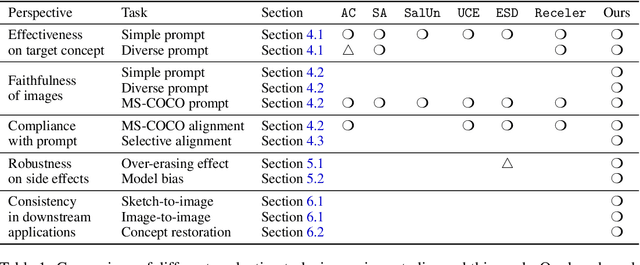
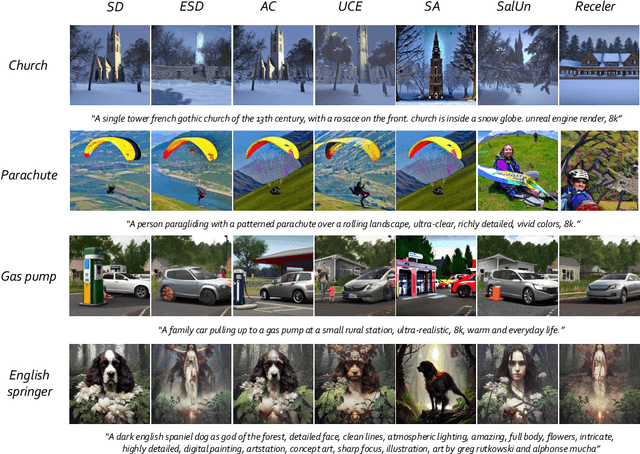
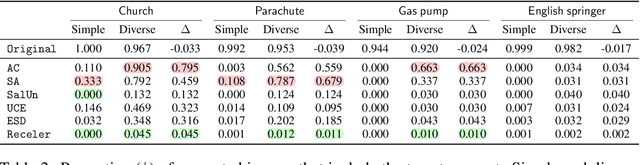
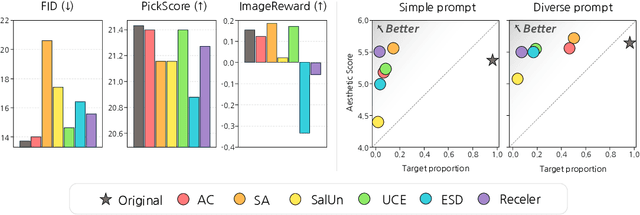
As text-to-image diffusion models become advanced enough for commercial applications, there is also increasing concern about their potential for malicious and harmful use. Model unlearning has been proposed to mitigate the concerns by removing undesired and potentially harmful information from the pre-trained model. So far, the success of unlearning is mainly measured by whether the unlearned model can generate a target concept while maintaining image quality. However, unlearning is typically tested under limited scenarios, and the side effects of unlearning have barely been studied in the current literature. In this work, we thoroughly analyze unlearning under various scenarios with five key aspects. Our investigation reveals that every method has side effects or limitations, especially in more complex and realistic situations. By releasing our comprehensive evaluation framework with the source codes and artifacts, we hope to inspire further research in this area, leading to more reliable and effective unlearning methods.
Feature Unlearning for Generative Models via Implicit Feedback
Mar 10, 2023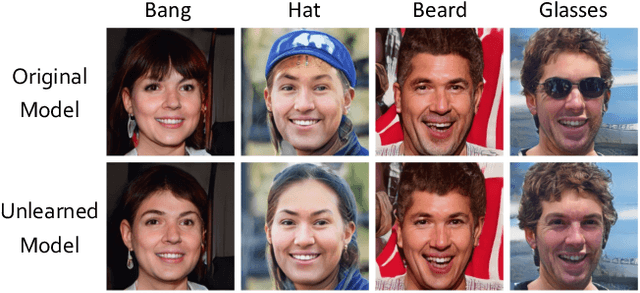
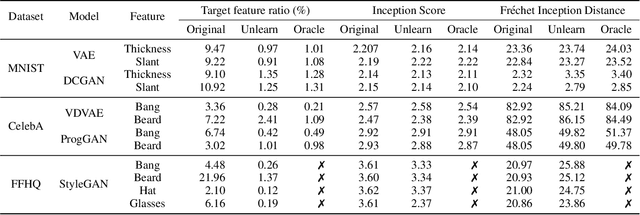
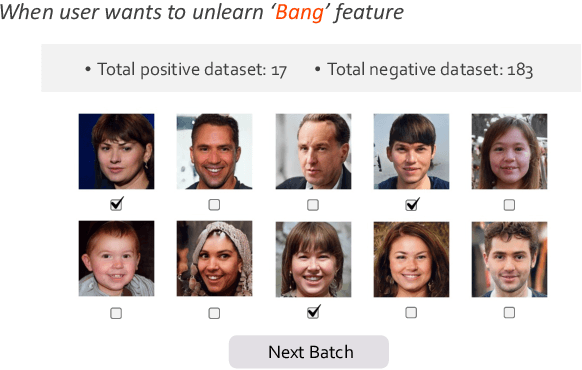
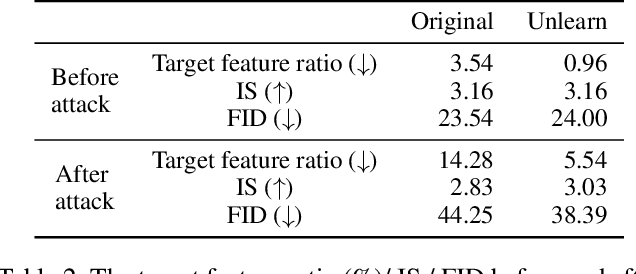
We tackle the problem of feature unlearning from a pretrained image generative model. Unlike a common unlearning task where an unlearning target is a subset of the training set, we aim to unlearn a specific feature, such as hairstyle from facial images, from the pretrained generative models. As the target feature is only presented in a local region of an image, unlearning the entire image from the pretrained model may result in losing other details in the remaining region of the image. To specify which features to unlearn, we develop an implicit feedback mechanism where a user can select images containing the target feature. From the implicit feedback, we identify a latent representation corresponding to the target feature and then use the representation to unlearn the generative model. Our framework is generalizable for the two well-known families of generative models: GANs and VAEs. Through experiments on MNIST and CelebA datasets, we show that target features are successfully removed while keeping the fidelity of the original models.